
Fortescue's Strategic Move into Renewable Mining Technologies: Assessing the Long-Term Value and Decarbonization Impact on Commodity and Mining Stocks
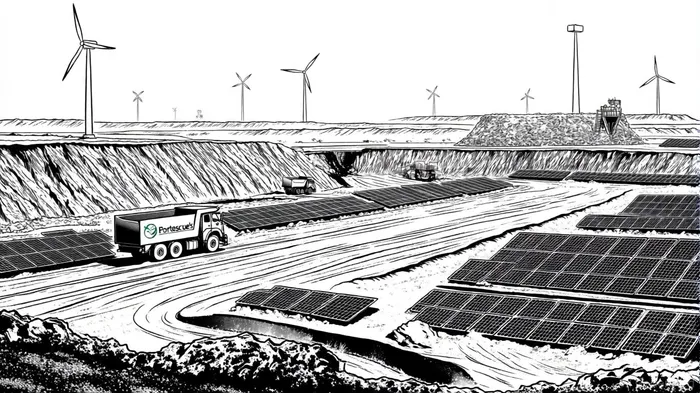
In the evolving landscape of global mining, Fortescue Metals Group (FMG) has emerged as a trailblazer in decarbonization, leveraging renewable technologies to redefine the economics of iron ore production. With a bold “Real Zero” target—eliminating Scope 1 and 2 emissions by 2030—Fortescue's strategic pivot toward electrification, green hydrogen, and renewable energy partnerships is not merely an environmental imperative but a calculated financial maneuver to secure long-term value in a carbon-constrained world.
Strategic Partnerships and Technological Investments
Fortescue's decarbonization blueprint hinges on partnerships with global green energy leaders. By 2028–2030, the company plans to deploy 300–400 zero-emissions 240-tonne haul trucks, with XCMG supplying half the fleet and Liebherr the remainder [1]. Complementing this, a $350 million deal with Epiroc for 50 autonomous electric drills will eliminate 35 million liters of diesel consumption annually and reduce 90,000 tonnes of CO₂ emissions [5]. These investments align with Fortescue's broader vision to replace fossil fuels with renewable energy, supported by a $1.98 billion syndicated loan facility secured in 2025 [3].
The company's collaboration with China Baowu Steel Group to develop green iron production using hydrogen and renewables further underscores its ambition to decarbonize the steel value chain [3]. Meanwhile, the acquisition of Spanish renewable firm Nabrawind and partnerships with Envision Energy and LONGi Solar are accelerating wind and solar deployment in the Pilbara region [1]. Collectively, these initiatives position Fortescue as a low-cost, low-emission producer, a critical differentiator in a sector where operational efficiency and ESG performance increasingly dictate market valuations.
Financial Performance and Market Dynamics
Despite a 41% decline in FY25 net profit after tax (NPAT) to $3.4 billion, driven by a 15% revenue drop and iron ore price volatility, Fortescue's operational resilience is evident. The company achieved a record 198.4 million tonnes of iron ore shipments in FY25, a 4% year-on-year increase, while maintaining Hematite C1 costs at $17.99 per wet metric tonne [1]. This cost discipline, coupled with a $1.10 per share fully franked dividend, demonstrates Fortescue's ability to balance decarbonization with shareholder returns.
However, the cancellation of high-profile green hydrogen projects—Arizona and PEM50—reflects the sector's financial and technical challenges. A $150 million pre-tax writedown was recorded, yet these adjustments signal a strategic realignment rather than a retreat from sustainability. By refocusing on core iron ore operations and green iron initiatives, Fortescue is prioritizing projects with clearer economic returns, such as its $6.2 billion capital plan to electrify its fleet and achieve Real Zero emissions [4].
Industry Trends and ESG-Driven Valuation Shifts
The mining sector is witnessing a paradigm shift as investors increasingly prioritize ESG metrics. A 2025 Accenture report reveals that 59% of institutional investors actively encourage miners to lead decarbonization efforts, while 63% would divest from laggards [1]. This trend is reshaping commodity valuations, with low-carbon materials commanding premiums. For instance, green steel in Europe is projected to see structural undersupply until 2030, driving price premiums as hydrogen-based direct reduced iron (DRI) plants come online [2].
Fortescue's strategic alignment with these trends is evident. By targeting high-grade iron ores suitable for low-carbon steelmaking and leveraging its renewable infrastructure, the company is positioning itself to capture green premiums. While specific low-carbon iron ore price premiums for 2023–2025 remain undefined, the broader market dynamics—such as the EU's Carbon Border Adjustment Mechanism (CBAM) and rising demand for direct reduction pellets—suggest Fortescue's decarbonization efforts could yield financial upside as the sector transitions [1].
Challenges and Strategic Resilience
Fortescue's path to Real Zero is not without hurdles. The cancellation of green hydrogen projects highlights the sector's volatility, with global demand for green hydrogen declining 15% year-on-year in 2025 [1]. Yet, the company's pivot to electrification and green iron demonstrates adaptability. Its $6.2 billion investment plan, which includes replacing 700 million liters of diesel and 15 million GJ of gas annually by 2030, is projected to yield $818 million in annual operating savings and $3 billion in cumulative savings by 2030 [2]. These figures underscore the long-term economic viability of decarbonization, even amid short-term setbacks.
Long-Term Value and Sector-Wide Implications
Fortescue's decarbonization strategy is poised to reshape both its financial performance and the mining sector's valuation landscape. By 2030, the company aims to achieve annual operating cost savings from eliminating diesel and carbon offsets, while its renewable infrastructure could generate new revenue streams via green hydrogen and clean energy exports [3]. Moreover, its alignment with global decarbonization goals—such as the EU's CBAM and Japan's hydrogen-based steelmaking initiatives—positions it to benefit from regulatory tailwinds and market premiums.
For investors, Fortescue's journey illustrates a critical insight: decarbonization is no longer a cost center but a value driver. As the mining sector grapples with Scope 3 emissions and supply chain transparency, companies like Fortescue that integrate renewable technologies and ESG principles into their core operations are likely to outperform peers. While the road to Real Zero is complex, Fortescue's strategic agility and financial discipline suggest it is well-positioned to lead the transition—and reap the rewards.







Comentarios
Aún no hay comentarios