
Foreign Automakers Thrive Amid Tariff Chaos: Strategic Entry Points for 2026 Growth
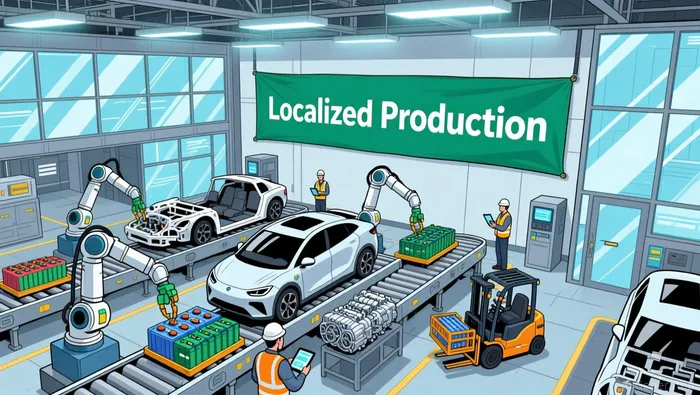
The U.S. automotive landscape in 2025 has been reshaped by a wave of tariffs and trade disruptions, creating both challenges and opportunities for foreign automakers. While the Trump administration's 35% tariffs on Canadian and 25% tariffs on Mexican vehicles, alongside 30% duties on Chinese imports, have raised costs and forced strategic recalibrations, automakers are leveraging these pressures to secure long-term growth. By pivoting to localized production, forming regional partnerships, and targeting untapped markets, foreign automakers are not only surviving but thriving in a volatile environment. For investors, the key lies in identifying the strategic entry points and technological innovations driving this transformation.
Navigating U.S. Tariff Pressures: Localization and Trade Deals
The U.S. tariff regime has forced foreign automakers to reevaluate their supply chains and production strategies. General MotorsGM--, for instance, reported a $1.1 billion decline in operating profit in Q2 2025 due to tariff exposure. However, companies like South Korea and Japan have turned these challenges into opportunities. South Korea's $350 billion investment in the U.S., including $200 billion for semiconductors and nuclear energy and $150 billion for shipbuilding, underscores a broader trend of localizing production to secure tariff exemptions. Similarly, Japanese automakers such as ToyotaTM-- and HondaHMC-- benefited from a U.S.-Japan trade deal that reduced tariffs on vehicle imports from 25% to 15%, contingent on $550 billion in U.S. investments.
These moves highlight a critical investment theme: regionalization. By shifting production closer to major markets, automakers reduce exposure to tariffs while aligning with U.S. trade policies. For example, Hyundai and Kia set consecutive U.S. sales records in 2025, demonstrating that strategic localization can offset short-term disruptions.
Global EV Strategy Shifts: Mexico and Europe as New Frontiers
While U.S. tariffs have stifled direct Chinese EV exports, Chinese automakers have found creative workarounds. Mexico has emerged as a critical gateway, with Chinese EV imports surging 2,300% year-over-year in November 2025. By producing in Mexico, companies like BYD and SAIC Motor can bypass U.S. tariffs and access North American markets through looser trade rules. This strategy is not limited to Mexico: Chinese automakers are also establishing local production in Europe. BYD, for instance, is shipping production equipment to a new plant in Hungary, with trial production expected in early 2026.
 Europe has also become a battleground for EV innovation. Faced with EU tariffs on battery-electric vehicles, Chinese automakers pivoted to plug-in hybrid electric vehicles (PHEVs), which are subject to only a 10% import duty. As a result, Chinese PHEV exports to Europe surged sixfold in 2025, capturing over 13% of the hybrid market. This adaptability underscores the importance of flexible product strategies for investors, as automakers navigate regulatory hurdles in key markets.
2026 Market Entry Strategies: Partnerships, Technology, and Emerging Markets
As the U.S. implements a 25% tariff on imported vehicles in 2026, foreign automakers are accelerating their shift to tariff-protected zones and forming strategic alliances. For example, BMW and other European automakers are urging the EU to finalize trade agreements with the U.S. to mitigate financial impacts. Meanwhile, Chinese automakers are expanding into Southeast Asia and Latin America, where regulatory environments are more favorable. BYD's 2025 record of 2.26 million EV deliveries-surpassing Tesla-demonstrates the potential of these emerging markets.
Technological innovation is another key driver. Chinese automakers, supported by state-backed R&D, have gained a competitive edge in battery technology and electric drivetrains. In response, U.S. automakers like GMGM-- and FordF-- are investing heavily in localized battery production and R&D partnerships to reduce reliance on foreign inputs. For investors, this signals a shift toward vertically integrated supply chains and regional R&D hubs, which are critical for long-term resilience.
The Road Ahead: Investment Opportunities in 2026
The automotive sector's transformation in 2026 presents several high-conviction investment themes:
1. Emerging Market Expansion: Automakers targeting Southeast Asia, Latin America, and Eastern Europe will benefit from less restrictive trade policies and growing middle-class demand.
2. Regional Partnerships: Companies forming alliances to localize production and share R&D costs-such as U.S.-China battery collaborations-will gain cost advantages.
3. Battery and EV Technology: Innovations in solid-state batteries and extended-range hybrids (e.g., Ford's pivot) will define the next phase of EV adoption according to market analysis.
While the U.S. market faces an "EV winter" due to waning tax credits and shifting consumer preferences as reported, global automakers are capitalizing on these disruptions. By prioritizing localization, technological agility, and strategic partnerships, they are positioning themselves for sustained growth. For investors, the key is to align with companies that can navigate regulatory complexity while scaling in high-potential markets.





Comentarios
Aún no hay comentarios