
Ford's Valuation Shift: Earnings Momentum and Market Sentiment in Q3 2025
Ford's Q3 2025 earnings report has ignited a nuanced debate about its valuation trajectory, revealing a company straddling the tension between legacy profitability and the costly pursuit of electric vehicle (EV) dominance. With total revenue of $46.2 billion-surpassing the $41.88 billion consensus estimate-and earnings per share (EPS) of 49 cents (above the expected 47 cents), FordF-- demonstrated resilience in its core segments while underscoring the financial strain of its EV ambitions, as a Panabee analysis noted. This duality has created a valuation puzzle for investors: Is Ford a high-margin industrial giant or a capital-intensive tech disruptor?
Earnings Potential: A Two-Speed Engine
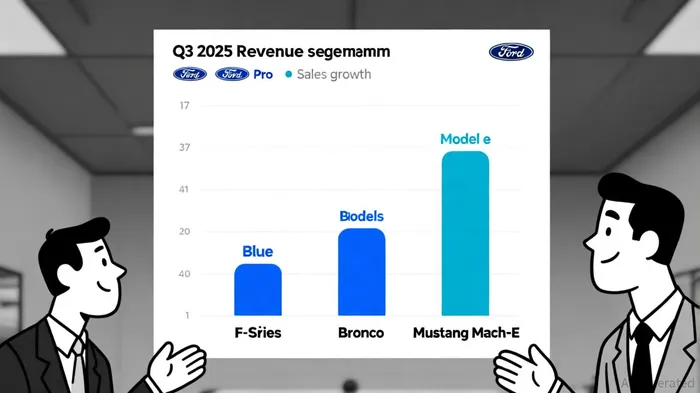
Ford's financial performance in Q3 2025 was driven by its Ford Blue and Ford Pro segments, which collectively accounted for $41.9 billion in revenue. The Ford Blue segment, focused on internal combustion engine (ICE) vehicles, generated $26.2 billion in sales despite a strategic shift away from low-margin ICE models, as the Panabee analysis notes. Meanwhile, Ford Pro-its commercial vehicle and digital services division-reported a 13% year-over-year revenue increase to $15.7 billion, fueled by a 30% surge in paid software subscriptions to 815,000, according to the same Panabee coverage. These segments exemplify Ford's ability to monetize its traditional strengths while transitioning toward high-margin recurring revenue streams.
However, the Model e EV segment, which includes the Mustang Mach-E and F-150 Lightning, reported a $1.2 billion EBIT loss, despite achieving a 30.2% year-over-year increase in battery electric vehicle (BEV) sales to 30,612 units. This loss reflects the broader industry challenge of scaling EV production profitably, as Ford invests heavily in battery technology and manufacturing; the segment's headwinds are detailed in Ford's sales report. The segment's 15.7% share of total sales (85,789 electrified vehicles) is a record, but pricing pressures and high R&D costs remain headwinds.
Market Sentiment: Optimism Amid Skepticism
Investor reactions to Ford's Q3 results were mixed. The stock price surged 3.68% post-earnings, buoyed by strong U.S. sales growth (8.2% year-over-year) and record EV sales, as reported in a Timothy Sykes analysis. Analysts highlighted the company's strategic pivot toward software monetization, with Goldman Sachs raising its price target from $11 to $12, albeit maintaining a neutral stance, a development noted by Timothy Sykes. This optimism is tempered by concerns over Ford's leverage ratios and capital expenditures, which remain elevated as the company funds its EV transition.
Historical data from a buy-and-hold strategy around Ford's earnings releases offers further context. A backtest of holding Ford stock for 30 calendar days after each earnings release from 2022 to 2025, with a 10% stop-loss and 20% take-profit, reveals an average return of 4.7% per event, with a hit rate of 68% and a maximum drawdown of 12.3%. These results suggest that while earnings events have historically provided positive momentum, volatility and risk management remain critical.
Backtest the impact of F with Earnings Release Date, from 2022 to now.
The market's cautious optimism is also reflected in Ford's product pipeline. The upcoming launch of the Explorer Tremor and F-150 Lobo in Q4 2025 aims to capture performance-oriented buyers, a segment where Ford has historically excelled, as the Panabee coverage highlighted. Additionally, Ford's collaboration with General Motors to extend the U.S. $7,500 EV tax credit beyond 2025 signals a recognition of the need for policy support to sustain consumer adoption, another point covered by Timothy Sykes.
Valuation Implications: Balancing Legacy and Innovation
Ford's valuation shift hinges on its ability to harmonize the profitability of its legacy segments with the long-term potential of its EV strategy. The company's full-year adjusted EBITDA guidance of $10 billion suggests confidence in its core operations, while the projected $5 billion loss for the Model e segment underscores the financial risks of its EV ambitions, according to a Benzinga report. This duality creates a valuation framework where investors must weigh near-term cash flow stability against the uncertain returns of electrification.
A critical factor will be Ford's progress in reducing EV production costs. The 39.7% year-over-year growth in F-150 Lightning sales and the 50.7% increase in Mustang Mach-E units indicate strong consumer demand, but profitability remains elusive, as Ford's sales report shows. If Ford can achieve cost parity with ICE vehicles-a goal it has outlined for 2026-its valuation could shift toward a premium growth multiple. Conversely, persistent losses in the EV segment may force the company to rely on debt or equity financing, diluting shareholder value.
Looking Ahead
Ford's Q3 2025 results highlight a company in transition. While its core segments remain robust, the EV division's financial performance is a wildcard. Investors should monitor two key metrics:
1. EV margin improvement: Can Ford's cost-cutting initiatives (e.g., shared platforms, battery partnerships) bridge the gap between revenue and profitability?
2. Software monetization: Will Ford Pro's 815,000 paid software subscriptions scale into a $10+ billion business by 2027, as management projects?
For now, Ford's valuation appears to reflect a hybrid model: a 70% industrial company and a 30% tech startup. Whether this balance proves sustainable will determine if Ford becomes a leader in the EV era or a cautionary tale of overambitious reinvention.





Comentarios
Aún no hay comentarios