
Ford's Turnaround Momentum and Strategic Tech Plays in 2026: A Long-Term Buy?
Ford Motor Company's recent strategic recalibrations and analyst upgrades have sparked renewed interest in its long-term investment potential. As the automotive industry grapples with shifting consumer demand and regulatory headwinds, Ford's pivot toward hybrids, extended-range electric vehicles (EREVs), and affordability-focused EVs-coupled with its advancements in autonomy and energy storage-raises critical questions about its ability to deliver sustainable value. This analysis evaluates whether Ford's 2026 roadmap and recent financial adjustments justify a long-term buy, drawing on its revised EV strategy, autonomy ambitions, and analyst sentiment.
1. Analyst Upgrade and Financial Revisions: A Cautious Optimism
Ford's decision to raise its 2025 adjusted EBIT guidance to $7 billion-up from $6–6.5 billion-reflects its ability to adapt to market realities while maintaining profitability. This upward revision, driven by cost improvements and a strategic refocus on higher-margin segments, has already translated into a 2% post-market stock price surge. However, the company's $19.5 billion write-down for EV-related restructuring in Q4 2025 underscores the scale of its challenges. Analysts like Piper Sandler and Goldman Sachs have upgraded Ford to "Overweight", citing its pivot toward ICE and hybrid vehicles as a "rational response to slowing EV demand." Yet, the magnitude of the write-down and the lengthy retooling of manufacturing plants remain red flags for capital efficiency.
2. EV Strategy: From All-Electric to Customer-Driven Flexibility
Ford's 2026 EV roadmap marks a stark departure from its earlier all-electric ambitions. The company is now prioritizing hybrids, EREVs, and affordable EVs, with plans to shift the F-150 Lightning to an EREV with an estimated 700+ mile range. By 2030, FordF-- projects that 50% of its global volume will consist of hybrids, EREVs, and EVs-up from 17% in 2025. This shift aligns with waning consumer interest in fully electric vehicles and regulatory changes, such as the expiration of the $7,500 federal EV tax credit.
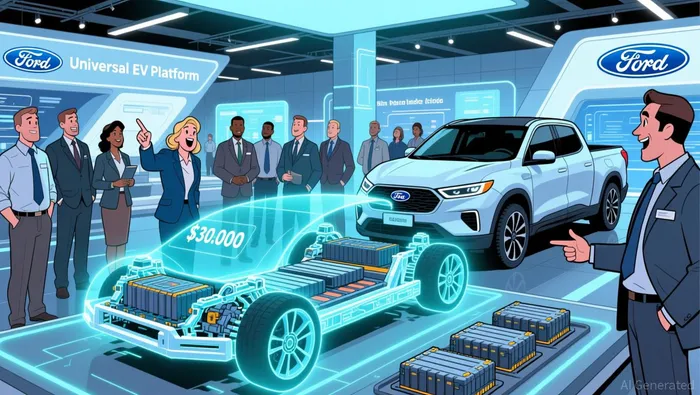
A key pillar of Ford's strategy is its Universal EV Platform, designed to support a midsize electric truck priced around $30,000. This platform aims to democratize EV access while reducing costs through in-house software and hardware development. Additionally, Ford's battery energy storage system (BESS) business, repurposing underutilized EV battery capacity, targets 20 GWh of annual deployment by late 2027. This pivot to energy infrastructure-serving data centers and grid support- positions Ford to capitalize on faster-growing markets.
3. Autonomy and AI: A Cost-Effective, In-House Approach
Ford's autonomy strategy emphasizes in-house development to reduce costs and accelerate integration. The company aims to achieve Level 3 "eyes-off" driving capabilities by 2028, with initial deployment on its Universal EV Platform. CEO Jim Farley has highlighted a 30% cost advantage from in-house development over outsourcing, a critical edge in a competitive landscape. Ford's centralized in-vehicle supercomputer, unifying infotainment, networking, and driver assistance, further streamlines operations.
Notably, Ford is also rolling out an AI-powered assistant via its mobile app by mid-2026, with in-vehicle integration planned for 2027. This personalized AI assistant, tailored to user preferences and vehicle specs, could enhance customer retention and differentiate Ford's offerings. While the company may explore licensing autonomy tech to accelerate its roadmap, its focus on affordability and accessibility remains central.
4. Analyst Sentiment and Risks: A Balancing Act
Despite Ford's strategic agility, risks persist. The $19.5 billion write-down-larger than General Motors'-and the retooling of plants toward ICE and hybrid production raise concerns about capital discipline. Analysts at Evercore ISI and Goldman Sachs acknowledge Ford's "customer-driven" approach but caution that profitability in the Model e segment won't materialize until 2029. Regulatory uncertainties, supply chain disruptions, and ongoing EV losses in Q3 2025 (nearly $4 billion) further cloud the outlook.
However, Ford's ability to raise EBIT guidance and its pivot to higher-return opportunities-such as BESS and affordable EVs- suggest a resilient business model. The company's partnerships, including licensing LFP battery technology from CATL, also demonstrate its capacity to leverage external expertise while maintaining control over core innovations.
5. Conclusion: A Long-Term Buy with Conditions
Ford's 2026 roadmap reflects a pragmatic response to market dynamics, with a clear focus on profitability, affordability, and technological differentiation. While the $19.5 billion write-down and regulatory headwinds pose near-term risks, the company's strategic shifts-toward EREVs, BESS, and in-house autonomy-position it to capitalize on evolving demand. Analyst upgrades and revised EBIT guidance signal cautious optimism, but investors must monitor Ford's ability to achieve profitability in the Model e segment by 2029 and navigate supply chain challenges. For long-term investors, Ford's customer-centric approach and technological agility justify a cautious "buy," contingent on its execution of the 2026 roadmap and capital efficiency.







Comentarios
Aún no hay comentarios