
Ford's Tariff Trials and Management Scrutiny: A Double Whammy for Investors
The automotive industry is no stranger to upheaval, but Ford Motor CompanyF-- (NYSE: F) now faces a perfect storm of trade-related financial pressures and management criticism that has investors questioning its ability to navigate these challenges. Analysts warn that the automaker’s tariff-driven financial strain, coupled with operational missteps and supply chain vulnerabilities, could prolong its struggles even as peers like General Motors (NYSE: GM) and Tesla (NASDAQ: TSLA) adjust to similar headwinds.
The Tariff Challenge
Ford’s 2025 financial outlook has been reshaped by U.S. trade policies, with tariffs imposing a $1.5 billion net adverse impact on adjusted EBIT this year. The automaker’s strategy to mitigate this—through bonded transportation for Mexico-to-Canada shipments, U.S. production scaling, and cost-cutting—has reduced the initial $2.5 billion tariff hit by $1 billion. Yet analysts remain skeptical.
The problem stems from the complexity of North America’s integrated supply chains. U.S. tariffs on imported vehicles and parts—25% for non-USMCA-compliant components—have forced Ford to rework logistics while facing retaliatory measures from trading partners. The company’s $50 billion investment in U.S. manufacturing since 2020 has insulated it somewhat, with 80% of U.S. sales now sourced domestically. But tariffs on imported parts like steel and aluminum—critical for vehicles like the F-150—still bite.
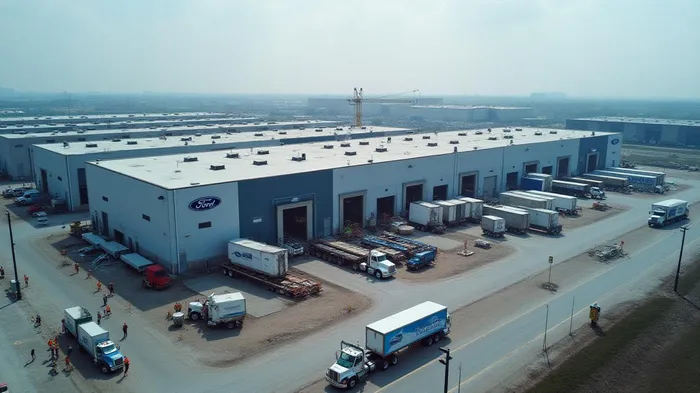
Supply Chain Vulnerabilities
Analysts highlight Ford’s reliance on global supply chains as a major weakness. For instance, tariffs on Canadian aluminum and Chinese-sourced rare earth materials—essential for EV batteries and electronics—threaten production timelines. Ford COO Kumar Galhotra admitted that even minor shortages could disrupt output, a risk underscored by Harley-Davidson’s $175 million tariff hit from Chinese parts.
The EV division, Model e, exemplifies these struggles. Despite narrowing losses to $849 million in Q1 from $1.3 billion in 2024, supply constraints and high production costs have limited sales growth. Analysts at Piper Sandler warn that Model e’s annual losses could hit $5 billion, with Q1 likely being its strongest quarter of the year. This contrasts with Ford Pro’s strong performance in commercial vehicles, which generated $15.2 billion in Q1 revenue, but analysts argue that this division’s success cannot offset broader challenges.
Financial Performance and Management Criticisms
Ford’s Q1 results offered a mixed picture. Revenue fell 5% to $40.7 billion due to planned plant shutdowns, but adjusted EPS of $0.14 beat estimates, driven by cost discipline in Ford Pro and software services. However, the suspension of full-year guidance—citing “substantial industry risks”—sparked investor skepticism.
Analysts are particularly critical of management’s handling of tariff-related costs. While CEO Jim Farley touts Ford’s “pole position” due to domestic manufacturing, critics note that tariffs on imported parts (half of the $2.5B gross impact) remain unresolved. The CFO’s admission that Ford’s adjusted EBIT could drop 32.6% year-over-year, per Zacks Investment Research, reinforces concerns about strategic missteps.
Analysts’ Downgrades and Market Sentiment
Wall Street has grown impatient. Piper Sandler cut its price target to $8.50 from $14, citing “ongoing uncertainty in tariff outcomes and supply chain risks.” The stock, once trading near $14, now hovers near a critical $10 support level—a 28% drop from its 2023 peak.
Comparisons to peers are stark. GM, despite facing a larger $4–$5 billion tariff hit, has retained guidance due to its global scale, while Tesla’s withdrawal of delivery targets highlights industrywide strain. Ford’s $1 billion cost-cutting plan (excluding tariffs) offers some hope, but its Q2 results will be pivotal in determining whether mitigation efforts are working.
Conclusion: A Pivotal Quarter Ahead
Ford’s 2025 outlook hinges on Q2’s ability to clarify tariff impacts and supply chain stability. While its U.S. manufacturing advantage and disciplined cost management have provided short-term resilience, lingering risks—retaliatory tariffs, geopolitical supply chain bottlenecks, and divisional underperformance—loom large.
The data is clear: Ford’s $1.5 billion EBIT hit and $5 billion annual EV loss warning underscore the scale of its challenges. If management fails to stabilize guidance by Q2, investor confidence could erode further, pushing the stock below its $10 support level. Conversely, a strong Q2 report could reposition Ford as a beneficiary of its domestic footprint, particularly in trucks and commercial vehicles.
For now, investors are left in limbo, weighing Ford’s operational strengths against its strategic vulnerabilities. The next quarter will test whether this automotive giant can turn the double whammy of tariffs and management scrutiny into a comeback—or a cautionary tale.
Data as of Q1 2025. Analysis based on publicly available financial reports and analyst commentary.





Comentarios
Aún no hay comentarios