
Ford's Strategic Shift: From Growth to Income-Driven Appeal
Ford Motor Company is undergoing a profound transformation, pivoting from a high-risk, high-reward growth strategy to a more conservative, income-focused approach. This shift, driven by evolving market dynamics and internal restructuring, has significant implications for investors. By prioritizing capital efficiency, shareholder returns, and operational discipline, FordF-- aims to stabilize its financial performance while navigating the challenges of its electric vehicle (EV) transition.
Strategic Shifts: Capital Efficiency and Electrification Focus
Ford's 2024-2025 strategic initiatives reflect a clear pivot toward income generation. The company has slashed debt, maintained robust liquidity ($28.5 billion in cash as of December 31, 2024), and repurchased shares to manage dilution [1]. Simultaneously, it is doubling down on high-margin segments like Ford Pro (commercial vehicles) and Ford Model e (electric vehicles), which are central to its electrification goals [2]. These segments are not just about innovation but about securing sustainable cash flows. For instance, Ford Pro generated $9.0 billion in EBIT in 2024 with a 13.5% margin, underscoring its potential as a recurring revenue engine [3].
However, the EV segment remains a financial drag. Ford projects losses of $5-$5.5 billion in its Model e division in 2025, a reality forcing the company to adopt a hybrid strategy. Leadership has acknowledged that hybrids are no longer a temporary fix but a long-term solution to balance profitability with electrification goals [4]. This pragmatic approach—delaying some all-electric vehicle launches to prioritize hybrids—highlights Ford's recalibration of risk.
Capital Allocation and Shareholder Yield: A New Priority
Ford's capital allocation strategy now emphasizes returning cash to shareholders. The company targets distributing 40-50% of free cash flow, offering a dividend yield exceeding 6%—well above the S&P 500 average [5]. In 2024, it returned $6.7 billion in adjusted free cash flow to shareholders and plans to maintain this pace in 2025 despite lower cash flow projections ($3.5-$4.5 billion) [6].
Cost-cutting measures are central to this strategy. Ford reduced stock bonuses for middle managers by $1 billion and identified an additional $1 billion in expense reductions for 2025 [7]. These moves, coupled with $1.5 billion in material cost savings achieved in 2024, underscore a relentless focus on margin preservation [8]. Analysts note that such discipline could offset near-term headwinds, including $3 billion in estimated 2025 tariff costs [9].
Leadership and Analyst Insights: Balancing Ambition and Pragmatism
Ford's leadership has faced scrutiny for missing growth targets. CEO Jim Farley's 2024 compensation dropped by 6.1% due to unmet quality and EV sales goals, signaling internal pressure to deliver results [10]. Yet, the company's broader restructuring has garnered cautious optimism. Goldman SachsGS-- and Bank of AmericaBAC-- analysts highlight that cost savings and operational improvements could drive a profit recovery in the second half of 2025 [11].
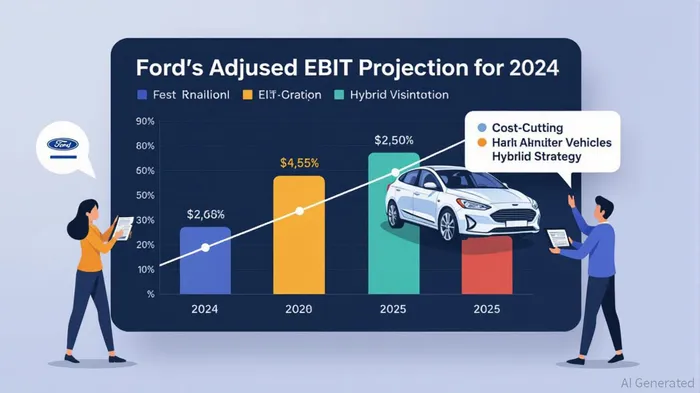
Ford's guidance for 2025—adjusted EBIT of $7.0-$8.5 billion—reflects a conservative but realistic outlook. While EBIT is projected to decline from 2024 levels, the focus on free cash flow and debt reduction suggests a shift toward long-term stability over short-term growth [12].
Conclusion: A Prudent Path Forward
Ford's transition from growth to income-driven appeal is neither abrupt nor without risks. The company's EV ambitions remain intact, but its financial strategy now prioritizes resilience. For investors, this means a stock that may lack the explosive upside of past decades but offers a compelling dividend yield, disciplined capital allocation, and a buffer against sector-wide volatility. As Ford navigates the complexities of electrification and global trade pressures, its ability to balance innovation with profitability will define its long-term value.





Comentarios
Aún no hay comentarios