
Ford's Strategic Rebirth: How Affordable EVs and In-House Autonomy Can Spark a New Bull Run
In the ever-evolving automotive landscape, Ford Motor CompanyF-- is undergoing a transformative strategic realignment that could redefine its competitive positioning. By pivoting toward affordable electric vehicles (EVs) and in-house autonomy development, FordF-- is addressing both market realities and technological opportunities. This shift, underpinned by cost-competitive innovation, positions the automaker to capitalize on emerging demand while mitigating risks from overextended investments.
Strategic Realignment in EVs: Balancing Affordability and Profitability
Ford's 2025 financial report reveals a recalibration of its EV strategy, marked by a $19.5 billion writedown due to the scaling back of large EV projects. This move reflects a pragmatic response to shifting consumer preferences and economic constraints. Rather than chasing high-cost, high-volume EVs, Ford is now prioritizing smaller, affordable models built on its Universal EV Platform. This platform, designed for cost efficiency, will underpin a mid-sized electric pickup truck priced around $30,000-a vehicle positioned to broaden EV accessibility.
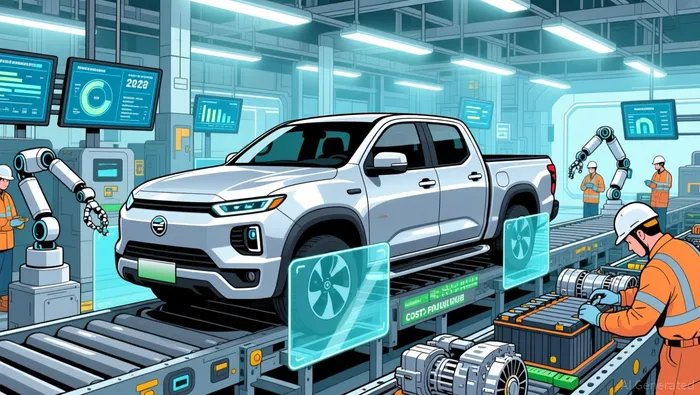 The company's focus on hybrids and extended-range EVs further underscores its commitment to balancing electrification with profitability. By 2030, Ford anticipates that 50% of its global sales will consist of hybrids, extended-range EVs, and fully electric vehicles, up from 17% in 2025. This gradual transition aligns with broader industry trends, where consumers remain hesitant to fully abandon internal combustion engines. Simultaneously, Ford is leveraging its EV-derived battery technology to enter the energy storage market, aiming to ship 20 GWh of battery systems annually by 2027. This diversification not only stabilizes revenue streams but also enhances the company's technological footprint.
Cost-Competitive Innovation in Autonomy: Building In-House for Scalability
Ford's autonomous vehicle (AV) strategy is equally noteworthy. The automaker plans to introduce eyes-off Level 3 autonomous driving by 2028, a capability that will debut on its low-cost Universal EV Platform. This next-generation BlueCruise system is projected to be 30% cheaper to build than its predecessor, while offering enhanced functionality. By developing autonomy in-house, Ford gains greater control over costs, feature integration, and deployment timelines- a critical advantage in a sector where partnerships often dilute margins.
Complementing this effort is Ford's integration of an AI assistant into its Ford app, with in-vehicle deployment slated for 2027. This AI will provide real-time vehicle diagnostics, route optimization, and personalized user experiences, enhancing customer retention and differentiating Ford's offerings in a crowded market. The in-house approach to autonomy and AI aligns with Ford's broader goal of reducing reliance on third-party technologies, thereby improving scalability and long-term profitability.
Synergy Between EVs and Autonomy: A Path to Sustainable Growth
The convergence of affordable EVs and cost-effective autonomy creates a flywheel effect for Ford. The Universal EV Platform not only reduces production costs but also serves as a foundation for integrating advanced AV features without inflating price tags. For instance, the mid-sized electric pickup truck, priced to compete with traditional gas models, will debut with Level 3 autonomy-a feature that could redefine value propositions in the EV segment.
Moreover, Ford's battery storage business, derived from EV technology, opens new revenue channels. By supplying energy storage systems to data centers and the electricity grid, Ford can monetize its expertise in battery chemistry and thermal management. This diversification reduces exposure to automotive market volatility and positions the company as a key player in the broader energy transition.
Conclusion: A Bull Run Built on Pragmatism and Innovation
Ford's strategic realignment is not a retreat from electrification but a recalibration to ensure long-term viability. By focusing on affordability, in-house innovation, and cross-sector opportunities, the automaker is addressing both immediate financial challenges and future growth. For investors, this approach signals a disciplined path to profitability-one that leverages Ford's legacy in manufacturing while embracing the disruptive potential of EVs and autonomy.
As the automotive industry navigates a period of uncertainty, Ford's ability to adapt without sacrificing technological ambition may well spark a new bull run. The coming years will test the resilience of its strategy, but the alignment of cost-competitive innovation with market demand suggests a compelling case for long-term value creation.





Comentarios
Aún no hay comentarios