
Ford's Strategic Positioning for AI-Driven Manufacturing and Autonomous Vehicles
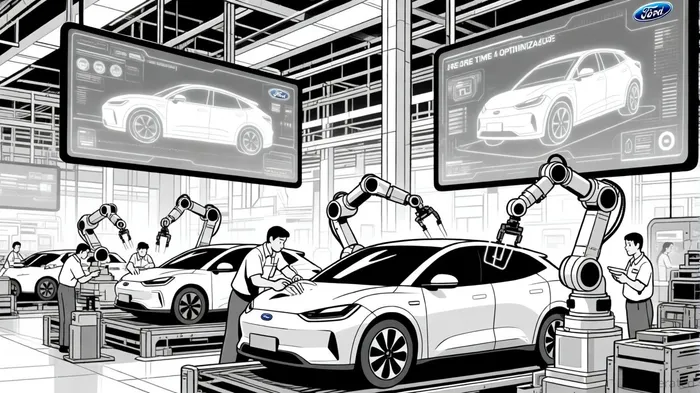
Ford Motor Company is navigating a pivotal inflection point in its transformation from a traditional automaker to a tech-driven mobility leader. As the automotive industry grapples with the dual challenges of electrification and artificial intelligence, Ford's strategic bets on AI-driven manufacturing and autonomous vehicle (AV) technologies are emerging as key catalysts for near-term earnings growth and market momentum. By pivoting from speculative long-term AV projects to practical, revenue-generating innovations, FordF-- is positioning itself to capitalize on both operational efficiencies and consumer demand for smarter, safer vehicles.
AI-Driven Manufacturing: A Foundation for Efficiency and Profitability
Ford's integration of AI into its manufacturing processes is already yielding measurable results. The company has partnered with NvidiaNVDA-- to leverage the latter's DGX H100 systems and Omniverse software, enabling the creation of virtual factories and digital twins, as detailed in a Ford–Nvidia partnership. These tools allow Ford to simulate production lines, identify bottlenecks, and optimize workflows before physical implementation. According to a report by DigitalDefynd, this approach has reduced defects, improved workplace safety, and cut costs by enabling real-time data analysis and adaptive learning in AI-powered robots.
The financial implications are significant. By automating repetitive tasks and minimizing human error, Ford is enhancing production efficiency at a time when margin pressures persist across the industry. For instance, the company's F-150 Lightning and Mustang Mach-E models, which rely on AI-driven assembly techniques, have seen reduced production delays compared to earlier EV projects. This operational discipline is critical for maintaining profitability as Ford scales its electric vehicle (EV) portfolio.
Autonomous Vehicles: From Ambition to Pragmatism
Ford's approach to autonomous vehicles has evolved dramatically in recent years. The company's decision to disband its Argo AI unit in late 2022-resulting in a $2.7 billion accounting charge, according to a Financial Express report-marked a strategic shift away from fully autonomous vehicles (Level 4/5) toward more commercially viable Level 2 and Level 3 driver-assistance systems. This pivot reflects a pragmatic recognition that widespread adoption of fully autonomous vehicles remains years, if not decades, away.
Instead, Ford is focusing on BlueCruise, its hands-free driving system now available in multiple models. As noted by Simply Wall St, BlueCruise's expansion to the Mustang Mach-E and F-150 Lightning represents a near-term revenue stream by enhancing driver safety and convenience. These systems also serve as a data-gathering tool, enabling Ford to refine its AI algorithms and improve over-the-air updates-a competitive advantage in the race for software-driven vehicle differentiation.
Financials and Analyst Projections: A Mixed but Cautiously Optimistic Outlook
Ford's second-quarter 2025 financial results underscored both the opportunities and challenges of its AI-driven strategy. While revenue exceeded expectations, earnings per share (EPS) fell short, partly due to ongoing R&D expenses and the Argo AI write-off. Analysts project a 23.4% annual earnings growth rate for 2025, with a 22.3% EPS growth rate, though these figures are tempered by downward revisions in recent months.
Historical context from recent earnings performance adds nuance to this outlook. A backtest of Ford's stock reactions to earnings misses from 2022 to 2025 reveals that the stock typically underperforms the S&P 500 by approximately -2% in the 30 days following a miss, compared to the benchmark's -1%. However, the hit rate for positive returns exceeds 50% only after Day 28, suggesting that while short-term sentiment is often negative, longer-term recovery is possible if fundamentals align with expectations. This pattern underscores the importance of monitoring Ford's ability to execute its strategic priorities-such as AI-driven cost reductions and BlueCruise adoption-to mitigate the drag from near-term earnings volatility.
The company's commitment to shareholder returns-evidenced by a $0.15 per share dividend-signals confidence in its long-term trajectory. However, the projected 0.9% annual revenue growth highlights the difficulty of scaling AI-driven initiatives in a mature market. Ford's recent investments in a new EV platform and affordable electric vehicle production could address this, but success hinges on execution.
Strategic Risks and Opportunities
Ford's AI and AV initiatives are not without risks. The automotive sector's transition to software-defined vehicles requires sustained R&D investment, and competitors like Tesla and GM are aggressively advancing their own AI capabilities. Additionally, the mixed financial results from Q2 2025 suggest that Ford's pivot to AI-driven manufacturing and AVs may take time to fully materialize in its bottom line.
Yet, the company's strategic clarity-focusing on near-term value over speculative bets-positions it to outperform peers still mired in costly AV development. By leveraging partnerships like its collaboration with Nvidia and prioritizing incremental innovations in driver-assistance systems, Ford is balancing innovation with profitability.
Conclusion
Ford's strategic repositioning in AI-driven manufacturing and autonomous vehicles reflects a calculated shift toward practical, revenue-generating technologies. While the road to profitability remains challenging, the company's focus on operational efficiency, software-driven differentiation, and shareholder returns creates a compelling case for near-term growth. Investors should monitor the rollout of BlueCruise, the impact of AI on production costs, and Ford's ability to execute its EV platform strategy-key catalysts that could drive both earnings and market momentum in the coming quarters.







Comentarios
Aún no hay comentarios