
Ford Motor Company: A Soft Buy Despite Tariffs Taking Their Pounds Of Flesh From Shareholders
The automotive industry is no stranger to turbulence, but Ford Motor CompanyF-- (F) faces a unique challenge in 2025: navigating the dual pressures of U.S. tariffs and the costly transition to electric vehicles (EVs). While tariffs have slashed projected profits and forced the suspension of financial guidance, Ford’s resilient commercial vehicle division, strategic cost-cutting, and strong U.S. manufacturing footprint position it as a soft buy for investors willing to endure near-term volatility.
The Tariff Toll: A $1.5B Drag on Earnings
The Trump administration’s 25% tariffs on imported vehicles and parts from Mexico and Canada have become Ford’s most immediate headwind. Analysts estimate these tariffs add $4,911 per vehicle to production costs, with steel and aluminum alone inflating the cost of an F-150 pickup by $400. The impact is stark: Ford now projects tariffs will cost the company $1.5 billion in adjusted EBIT for 2025, a figure that could rise if trade policies worsen.
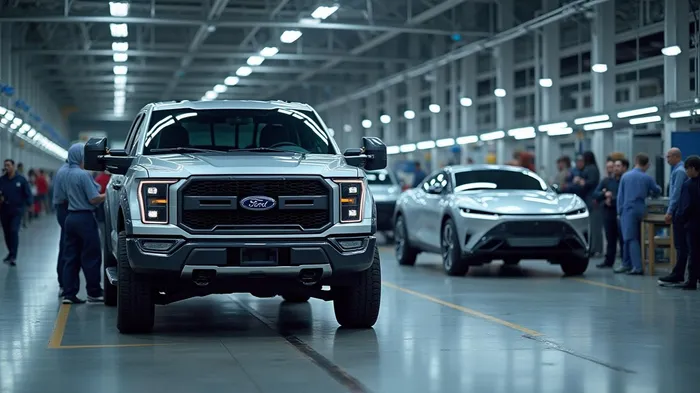
Despite this, Ford has implemented $1 billion in cost mitigations, including rerouting vehicles via bonded carriers to avoid tariffs and leveraging its 80% domestic production rate—the highest among U.S. automakers. Compare this to General Motors (GM), which relies on just 53% domestic production, leaving Ford better insulated against cross-border levies.
Divisional Performance: A Mixed Bag, but Signs of Hope
Ford’s three business segments paint a nuanced picture:
Ford Pro (Commercial Vehicles): The backbone of Ford’s resilience. Revenue hit $15.2 billion in Q1 2025, driven by strong demand for Super Duty trucks and software services. Gross margins surged 20% year-over-year, and the division’s EBIT of $1.31 billion—though down from prior records—reflects its dominance in commercial software (40% market share).
Ford Blue (Internal-Combustion Vehicles): Struggling but not sinking. EBIT plummeted 90% to $96 million due to plant shutdowns and pricing pressures, but Ford’s 18–23% price hikes on new models like the Lincoln Navigator and Expedition could stabilize margins.
Ford Model e (Electrified Vehicles): Losing money but gaining momentum. The division’s Q1 EBIT loss narrowed to $849 million (down from $1.3 billion in 2024), aided by a 15% rise in U.S. EV retail sales. Ford’s $5 billion annual EV loss target for 2025 remains daunting, but aggressive pricing and discounts—such as its “employee pricing” offer—could boost volume.
Financial Fortitude: Cash Reserves and Cost Discipline
Ford’s financial health provides a critical buffer. The company ended Q1 with $27 billion in cash and $45 billion in liquidity, enabling it to weather tariff storms and invest in U.S. plants (e.g., a $50 billion commitment since 2020). Meanwhile, quality improvements—20% lower warranty costs and the best performance in J.D. Power’s quality study—signal operational refinement.
Despite the tariff overhang, Ford’s stock has risen 6.4% year-to-date, outperforming the S&P 500’s 3.3% decline. However, volatility persists: shares dipped 2.4% after Q1 results due to guidance suspension.
Why a “Soft Buy”?
The “soft buy” recommendation hinges on three pillars:
1. Valuation: Ford’s price-to-book ratio of 0.8x reflects pessimism about its EV transition, but its commercial vehicle dominance and cost-cutting ($1 billion annual savings target) suggest undervaluation.
2. Tariff Mitigation: Ford’s $1 billion in cost savings and strategic use of bonded carriers limit the tariff impact to $1.5 billion, less than rivals like GM ($4–5 billion).
3. Long-Term Leverage: A U.S.-centric supply chain and planned EV investments (Blue Oval City by 2026) position Ford to capitalize on domestic demand as trade tensions ease.
Risks to Consider
- Tariff Uncertainty: Ford’s guidance suspension underscores risks from erratic trade policies.
- EV Losses: Model e’s $5 billion annual deficit could strain profits until 2027.
- Competitor Moves: GM’s shift of production to Indiana to avoid tariffs may erode Ford’s cost advantage.
Conclusion: A Patient Investor’s Play
Ford’s 2025 challenges are undeniable, but its $27 billion cash cushion, industry-leading U.S. production, and improving commercial vehicle margins make it a soft buy for investors with a 3–5 year horizon. While tariffs and EV losses will weigh on near-term results, Ford’s ability to mitigate costs and its dominance in trucks and software services suggest it can emerge stronger as trade policies stabilize.
Final Take:
- Buy for: Long-term growth in commercial vehicles and EVs, with a focus on U.S. manufacturing resilience.
- Avoid if: You prioritize short-term earnings stability or fear further tariff escalation.
Ford’s stock, currently trading at $10.03 (down from $13.28 in Q1 2024), offers a discount to its operational potential—if investors can stomach the tariff-driven turbulence ahead.





Comentarios
Aún no hay comentarios