
Ford's Engine Block Heater Recall: Assessing the Short-Term Impact on Stock Valuation and Investor Sentiment
Ford's June 2025 engine block heater recall, affecting over 47,000 vehicles across its 2023–2025 FordF-- Escape, Lincoln Nautilus, and other models, has intensified investor scrutiny of the automaker's quality control and financial resilience, according to a Ford Authority report. The defect, linked to overheating block heaters that could increase fire risk, underscores a broader pattern of recalls-88 in 2025 alone-positioning Ford as the most recall-prone automaker in the U.S. While the company reported no injuries or crashes tied to this specific issue, 120 warranty claims for coolant leaks and electrical connector damage highlight operational vulnerabilities, per a CarComplaints report.
Financial and Operational Implications
The recall adds to Ford's rising warranty costs, which surged 22% to $6 billion in 2024, driven by repeated safety campaigns, according to Forbes. Analysts estimate that the block heater recall, combined with other 2025 issues like rearview camera failures and brake defects, could strain the company's profitability. Ford's cash reserves of $26.99 billion provide some buffer, but recurring recalls risk eroding margins and investor confidence, as noted in an Investing.com analysis.
Investor Sentiment and Stock Performance
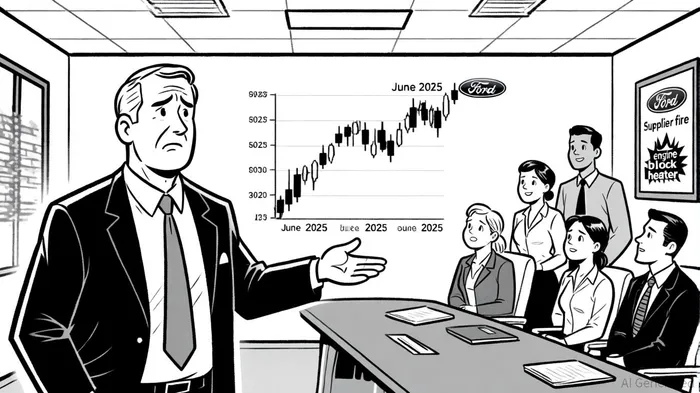
Ford's stock has underperformed the S&P 500 by 25 percentage points over the past 12 months, closing at $12.10 as of July 2025-a 15% decline from its 2024 peak, per a MarketBeat forecast. While the June 4 recall announcement did not trigger an immediate sharp drop in share price, it exacerbated existing concerns. A Forbes report notes that Ford's stock has been pressured by a "record number of recalls," with analysts issuing a consensus "Reduce" rating and a 12-month price target of $10.57, implying a 12.63% downside.
The lack of granular stock data for the June 4–13 period complicates isolating the recall's direct impact. However, broader trends suggest that the block heater recall contributed to a negative sentiment environment. For instance, Ford's stock fell 7% in September 2025 following a supplier fire and additional recalls, illustrating how quality issues compound investor fears, according to a TS2 report.
Strategic Challenges and Outlook
Ford CEO Jim Farley has acknowledged the need for stricter quality controls, but analysts caution that improvements may take 18 months to materialize, a point raised in the earlier Forbes coverage. Meanwhile, the company's electric vehicle (EV) segment faces a projected $5 billion loss in 2025, compounding pressure on its traditional internal combustion engine (ICE) business, per a Monexa analysis. The block heater recall, while relatively small in scale compared to the 1.9 million-vehicle rear camera recall in May 2025, reinforces perceptions of systemic operational inefficiencies, as reported in Barron's.
Conclusion
Ford's June 2025 engine block heater recall is a microcosm of the automaker's broader struggles with quality and reliability. While the immediate stock price reaction to the recall was muted, the cumulative effect of 88 recalls in 2025 has eroded investor confidence. With warranty costs rising and EV losses mounting, Ford's ability to regain market trust will depend on swift execution of its quality initiatives and transparency in addressing systemic issues. For now, the stock remains a high-risk proposition, with analysts projecting continued underperformance relative to the S&P 500.





Comentarios
Aún no hay comentarios