
Folks Finance: A High-Growth DeFi Hub Driving Cross-Chain Interoperability and Liquidity Aggregation
The Rise of Cross-Chain DeFi: A Necessity, NotNOT-- a Trend
The fragmentation of blockchain networks has long hindered DeFi's mass adoption. However, 2025 has seen a surge in cross-chain solutions, driven by demand for seamless asset mobility and liquidity efficiency. According to a Validation Cloud report, the institutional DeFi market-powered by cross-chain interoperability-is projected to surpass $100 trillion in on-chain value by 2030. This growth is underpinned by innovations like Chainlink's Cross-Chain Interoperability Protocol (CCIP), which enables secure, real-time asset transfers across ecosystems. While Folks Finance has not yet announced proprietary cross-chain tools, its recent Binance listing signals growing institutional confidence in its role as a hub for multi-chain activity.
Strategic Partnerships: Bridging Traditional and Decentralized Finance
Folks Finance's value proposition is amplified by its alignment with industry-wide efforts to merge traditional finance (TradFi) and DeFi. For instance, ChainlinkLINK-- and Validation Cloud's collaboration-which integrates CCIP with AI-driven analytics-highlights the demand for interoperability tools that Folks Finance could leverage to enhance its platform. Similarly, the Bitget–Fasanara partnership to tokenize liquidity underscores the sector's shift toward hybrid financial models. While Folks Finance has not disclosed direct ties to these initiatives, its token ($FOLKS) listing on Binance positions it to benefit from the same institutional-grade infrastructure being developed by market leaders.
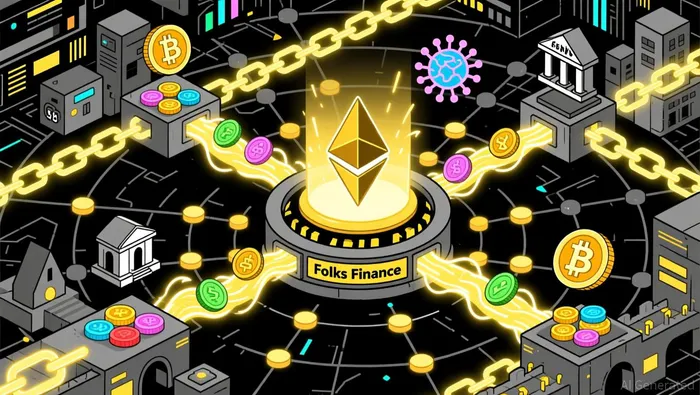
Liquidity Aggregation: The Next Frontier
Liquidity remains a thorny challenge for DeFi protocols, but 2025 has seen breakthroughs in aggregating fragmented pools. Validation Cloud's Mavrik platform, for example, uses AI to optimize liquidity distribution across chains, a capability described in the Validation Cloud report that could complement Folks Finance's user base. While the protocol has not yet announced its own liquidity aggregation strategies, its growing visibility-such as the Binance listing-suggests it is attracting capital that could fund such innovations. Investors should monitor whether Folks Finance adopts similar AI-driven tools to enhance yield generation and reduce slippage for users.
Risk Considerations and Valuation Realities
Despite its promising trajectory, Folks Finance faces headwinds. The DeFi sector remains volatile, with protocols like ZEUS Chain (unrelated to Folks Finance) grappling with valuation concerns and governance disputes. However, Folks Finance's focus on interoperability-rather than speculative tokenomics-positions it as a more sustainable play. Its recent Binance listing also provides a liquidity boost, reducing the risk of illiquid token markets.
The Investment Case: Positioning for the Omni-Chain Future
Folks Finance's strategic alignment with cross-chain infrastructure and institutional DeFi trends makes it a compelling long-term investment. Key catalysts include:
1. Partnership Expansion: Collaborations with Binance and AI-driven analytics firms could unlock new use cases.
2. TVL Growth: As cross-chain TVL surges, Folks Finance's platform may attract a larger share of liquidity.
3. TradFi Integration: Its positioning at the intersection of DeFi and tokenized finance could drive adoption among institutional players.
While direct data on Folks Finance's TVL or user growth is currently limited, the broader industry's trajectory-as projected in the Validation Cloud report-suggests that early movers in cross-chain interoperability will outperform.
Conclusion
Folks Finance represents a high-conviction bet on the omni-chain future. By leveraging industry-wide advancements in interoperability and liquidity aggregation, it is well-positioned to capture value as DeFi matures. Investors seeking exposure to this narrative should closely monitor its strategic partnerships and token utility developments, while hedging against sector-wide volatility.






Comentarios
Aún no hay comentarios