
FOLD's Bitcoin Rewards Visa Card and Its Impact on Financial Innovation
The launch of Fold's Bitcoin Rewards Visa Credit Card marks a seismic shift in the fintech landscape, blending the worlds of traditional finance and decentralized digital assets. By partnering with VisaV-- and Stripe, Fold has created a product that rewards users with BitcoinBTC-- on everyday purchases, offering up to 3.5% returns—far exceeding conventional cashback rates. This innovation not only challenges legacy banking models but also accelerates Bitcoin's integration into mainstream financial systems.
Disruptive Fintech: Simplifying Bitcoin for the Masses
Fold's card eliminates the friction that has long hindered crypto adoption. Unlike traditional rewards programs, which require users to navigate complex redemption tiers or exchange accounts, Fold's offering rewards Bitcoin directly, with no staking requirements or token lock-ins[1]. Users earn 2% immediately on all purchases, with an additional 1.5% for repaying balances via Fold's checking account[2]. At top retailers like Amazon and Starbucks, rewards surge to 10%, creating a compelling incentive for everyday spending[3].
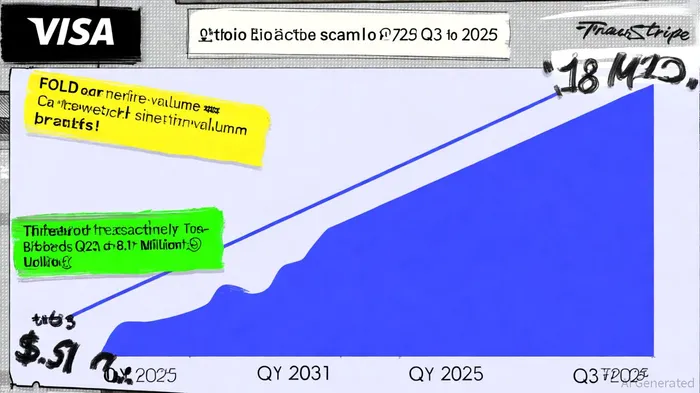
This “earn first, learn later” approach democratizes Bitcoin access. As of Q3 2025, Fold has processed $3.1 billion in transactions and distributed $83 million in Bitcoin rewards[4], demonstrating robust adoption. The card's success is underpinned by Stripe's issuing infrastructure and Visa's global network, which ensure scalability and security while reducing operational complexity for Fold[5].
Traditional Banking's Response: Embracing or Resisting?
Traditional banks initially viewed Bitcoin as a threat to their centralized systems. However, the rise of crypto-native financial tools has forced a strategic pivot. Institutions are now exploring Bitcoin custody, crypto-collateralized loans, and stablecoin-based rewards[6]. For example, Mastercard's partnership with Bakkt to enable crypto rewards signals a broader industry shift[7]. Yet, Fold's card stands apart by offering Bitcoin-only rewards without intermediaries like stablecoins, which remain under regulatory scrutiny[8].
The volatility of Fold's stock—spiking 20% pre-market before plunging 15% post-announcement—reflects investor uncertainty[9]. While some banks are cautiously integrating crypto, others remain wary of Bitcoin's price swings and the erosion of their control over financial systems. Fold's $250 million equity purchase facility to expand its Bitcoin treasury, however, underscores institutional confidence in Bitcoin's long-term value[10].
Regulatory Implications: A Double-Edged Sword
U.S. regulators have taken a nuanced approach, easing restrictions on crypto engagement while tightening oversight of stablecoins. The GENIUS Act, which prohibits stablecoin interest payments but allows crypto exchanges to offer rewards, has created a legal framework for products like Fold's card[11]. This regulatory flexibility enables innovation while addressing risks like money laundering and consumer protection.
However, challenges persist. Unlike FDIC-insured bank accounts, Bitcoin rewards are not protected against theft or loss, raising concerns about consumer safety[12]. Additionally, the lack of a centralized authority to stabilize Bitcoin's value means rewards could lose purchasing power rapidly—a risk Fold mitigates by emphasizing its insured custody services[13].
The Road Ahead: Bitcoin as a Financial Utility
Fold's card is more than a rewards program; it's a gateway to Bitcoin's utility. By embedding crypto into daily transactions, Fold is redefining how consumers interact with digital assets. The company's ecosystem—encompassing debit cards, exchanges, and gift cards—creates a seamless on-ramp for both novices and experienced users[14].
For traditional banks, the lesson is clear: adapt or risk obsolescence. While some institutions may replicate Fold's model, the company's first-mover advantage and partnerships with Stripe and Visa position it as a leader in the Bitcoin fintech space[15]. As regulatory clarity improves and adoption accelerates, Fold's card could become a blueprint for the next generation of financial tools.
Conclusion: A New Era of Financial Innovation
Fold's Bitcoin Rewards Visa Card exemplifies the disruptive potential of fintech. By simplifying access to Bitcoin and leveraging the infrastructure of Visa and Stripe, Fold has bridged the gap between traditional finance and crypto. While regulatory and market risks remain, the product's success highlights a growing demand for decentralized financial solutions. For investors, this represents a pivotal moment: the convergence of crypto and mainstream finance is no longer speculative—it's here, and it's reshaping the industry.





Comentarios
Aún no hay comentarios