
Is Fluor's 2025 Stock Decline a Buying Opportunity for 2026?
The stock market's cyclical nature often creates dislocations between short-term performance and long-term fundamentals. Fluor CorporationFLR-- (FLR) has experienced a 19% decline in 2025, underperforming broader indices. For investors, the critical question is whether this correction reflects a mispricing of value or a signal of deeper structural challenges. A closer examination of institutional conviction, sector-specific catalysts, and strategic positioning reveals a nuanced picture.
Institutional Conviction: DME Capital's 44.3% Stake Increase
Institutional investors often act as barometers of market sentiment. DME Capital's decision to increase its stake in FluorFLR-- by 44.3% in Q3 2025-bringing its total holding to 5.51 million shares-is a significant vote of confidence. This move elevated Fluor to the second-largest holding in DME's portfolio, representing 9.13% of its assets under management. Such a concentrated bet suggests that DME sees undervalued potential in Fluor's business model, particularly in its energy and infrastructure segments.
This institutional conviction is further reinforced by Fluor's ongoing capital return initiatives. The company spent $70 million repurchasing shares in Q3 2025, with a $800 million buyback target by early 2026. These actions signal management's belief in the stock's intrinsic value, even as broader market conditions weigh on its price.
Sector-Specific Catalysts: NuScale Monetization and Backlog Stability
Fluor's strategic alignment with long-term industry trends is another compelling factor. The company's structured monetization of its remaining stake in NuScale Power-a nuclear energy startup-provides a clear near-term catalyst. By Q3 2025, Fluor had already secured $605 million in net proceeds from selling 15 million NuScale shares. The remaining 111 million shares are expected to be liquidated by Q2 2026 under a volume-restricted process designed to preserve NuScale's equity value according to the agreement. This monetization not only strengthens Fluor's balance sheet but also aligns with its capital allocation strategy, which prioritizes shareholder returns.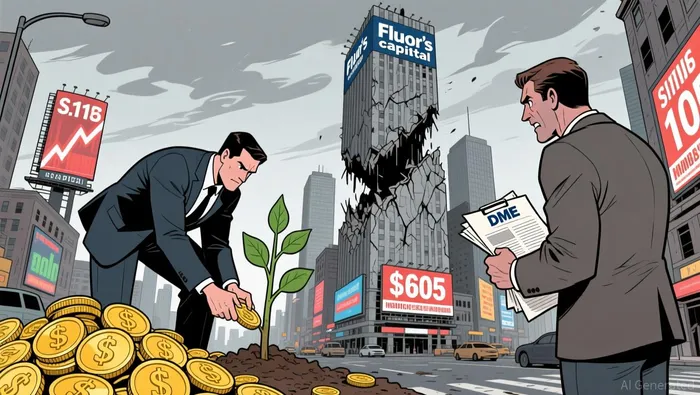
Equally important is Fluor's backlog stability. As of Q3 2025, the company reported a $28.2 billion backlog, with 82% of the value tied to reimbursable contracts. This resilience is critical in a sector prone to cost overruns and project delays. The $3.3 billion in new project awards during the quarter, 99% of which were reimbursable, further underscores Fluor's ability to secure high-margin, low-risk work. While the Energy Solutions segment faced a $533 million loss in Q3 due to the Santos project ruling, the overall backlog suggests the company is well-positioned to absorb such short-term setbacks.
Energy Transition Positioning: A Long-Term Growth Engine
Fluor's strategic pivot toward energy transition projects adds another layer of appeal. The company is actively expanding into hydrogen production, carbon capture and storage (CCS), and renewable fuels, positioning itself at the forefront of decarbonization efforts. For instance, Fluor's expertise in CCS is being leveraged in projects influenced by U.S. tax incentives like the 45Q credit according to industry analysis. Additionally, its work on converting refineries into renewable fuels facilities aligns with global net-zero targets.
While Fluor's 2025 filings do not explicitly detail energy transition initiatives, its 2024-2028 growth strategy emphasizes "advanced technologies" and "sustainable industrial solutions." This forward-looking approach, combined with its track record in large-scale engineering projects, positions Fluor to benefit from the accelerating shift toward clean energy.
Weighing the Risks Against the Rewards
Critics may argue that Fluor's stock decline reflects legitimate concerns about sector headwinds, such as inflationary pressures and geopolitical uncertainties. However, the interplay of institutional conviction, near-term monetization proceeds, and long-term energy transition trends suggests that the market may be underestimating the company's resilience. DME Capital's stake increase, in particular, highlights the appeal of Fluor's disciplined project delivery model and its ability to generate cash flow in a volatile environment.
For investors with a 2026 horizon, the key question is whether Fluor's current valuation adequately discounts these catalysts. Given the company's $28.2 billion backlog, its $800 million buyback target, and the impending NuScale monetization, the answer appears to lean toward "no." While cyclical risks remain, the alignment of institutional confidence and sector-specific tailwinds creates a compelling case for a strategic entry point.







Comentarios
Aún no hay comentarios