
Flexqube's Breakthrough in U.S. Robotics Adoption: Strategic Implications of Pilot Orders for Scalable AI-Driven Automation Solutions
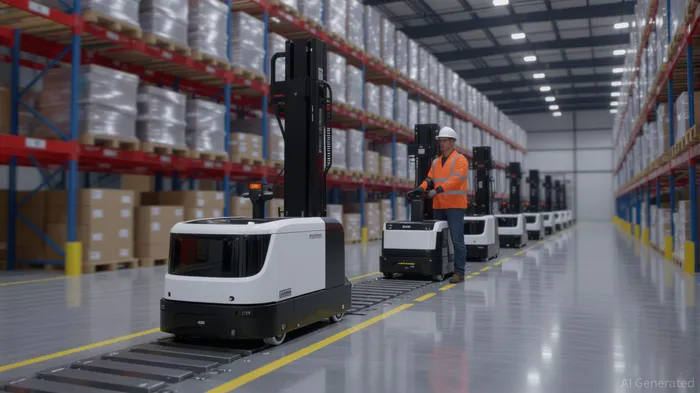
In 2025, Flexqube has emerged as a pivotal player in the U.S. robotics market, securing pilot orders that underscore its strategic positioning in AI-driven automation. The company's recent $270,000 pilot order for its Navigator AMR solution with an existing U.S. customer highlights its ability to tailor scalable automation to operational needs[1]. This project, involving a customized load carrier for the customer's cart fleet, builds on a prior collaboration in August 2025[4], signaling growing trust in Flexqube's modular approach. Simultaneously, a $3.5 million SEK (approximately $370,000) pilot for a material handling solution has the potential to expand into a $6 million+ project by early 2026[5], reflecting Flexqube's capacity to scale from pilot to enterprise-level deployment.
The U.S. robotics market is accelerating, driven by AI integration and automation demand. According to the Association for Advancing Automation (A3), North American robot orders in H1 2025 hit $1.094 billion, a 7.5% revenue increase year-over-year[1]. Cobots accounted for 25% of Q2 2025 robot sales, while the automotive sector led growth with a 34% year-over-year surge in orders[1]. Statista Market Insights projects the U.S. AI robotics market to reach $9.49 billion in 2025, expanding at a 27.42% CAGR to $40.60 billion by 2031[2]. Flexqube's pilot orders align with these trends, positioning the company to capitalize on a market forecasted to grow 19.6% annually through 2035[6].
Flexqube's competitive advantages lie in its modular AMR system, which features a standardized coupling interface enabling seamless integration with existing infrastructure[1]. This design allows businesses to adopt automation incrementally, reducing upfront costs and complexity. For instance, the company's recent pilot with a U.S. customer involves a scalable configuration of modular carts and tugger trains, with potential expansion to AMRs[2]. Such flexibility is critical in industries like automotive and logistics, where operational needs evolve rapidly.
Strategic partnerships further bolster Flexqube's U.S. ambitions. A collaboration with distributor Lean Factory America enhances the availability of its solutions across diverse sectors[5], while its ProMat 2025 showcase in Chicago highlights its technical capabilities to a broader audience[2]. The CEO, Anders Fogelberg, has emphasized modularity and customer experience as core differentiators[4], a stance validated by a potential $12 million project with an existing U.S. client by 2027[3]. This trajectory suggests Flexqube is not merely securing pilots but laying the groundwork for long-term industry leadership.
For investors, Flexqube's U.S. expansion represents a compelling case study in scalable automation. The company's ability to convert pilot projects into large-scale deployments—such as the 8.5 MSEK tugger train order in North America[4]—demonstrates its value proposition in a market prioritizing adaptability. As AI-driven robotics become table stakes for competitiveness, Flexqube's modular, customer-centric approach positions it to outpace rivals reliant on rigid, one-size-fits-all solutions.







Comentarios
Aún no hay comentarios