
Flex shares fall 3.03% to $61.75 as bearish engulfing pattern and death cross signal prolonged selling pressure amid key support at $61.35 and $56.55.
Flex (FLEX) closed the most recent session at $61.75, down 3.03%, reflecting a bearish reversal from recent highs. Candlestick Theory reveals a bearish engulfing pattern at the $63.68 level, where a large red candle consumed a smaller green candle, suggesting short-term bearish momentum. Key support levels are identified at $61.35 (immediate) and $56.55 (prior swing low), while resistance lies at $63.68 (failed high) and $67.81 (December peak). A bullish harami at $62.41 and a potential bullish reversal at $56.55 indicate possible short-term bounces, but bearish continuation patterns like the evening star near $68.80 underscore prolonged selling pressure.
Moving Average Theory shows the 50-day MA at $60.20 crossing below the 200-day MA at $55.90, signaling a bearish "death cross." The 100-day MA at $59.80 reinforces the downtrend. Price is currently below all three MAs, confirming bearish bias. Short-term traders may note the 50-day MA as a dynamic support level, but a break below $56.55 could trigger a retest of the 200-day MA.
MACD & KDJ Indicators indicate oversold conditions, with the MACD line (-1.20) below the signal line (-0.85) and a bearish crossover in early January. The KDJ stochastic oscillator (K: 25, D: 30) suggests a potential near-term bounce, though bearish divergence persists in the RSI and price action. A failure to break above $63.68 may trigger a deeper pullback. 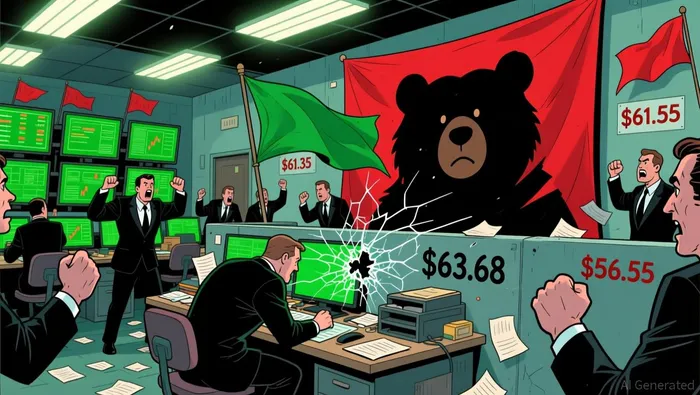 Bollinger Bands show a recent contraction around $62.41, signaling low volatility and a potential breakout. Price is currently near the lower band at $61.35, suggesting oversold conditions, but the 20-day volatility remains elevated, indicating a possible continuation of the downtrend.
The Volume-Price Relationship highlights a surge in volume during the January 2nd rally to $63.68, validating the failed breakout. However, declining volume during the subsequent pullback to $61.75 suggests weakening bearish momentum. A surge in volume on a potential rebound above $62.41 could confirm a short-term reversal, while low volume would indicate a false signal.
RSI at 28 (oversold) aligns with Bollinger Bands and KDJ in suggesting a potential bounce, but caution is warranted due to the RSI's 14-day divergence (price lower lows, RSI higher lows). A sustained close above $63.68 may push RSI above 40, reducing oversold conditions.
Fibonacci Retracement levels from the $34.34 (March low) to $72.08 (December high) show critical support at $53.68 (61.8% retracement) and resistance at $64.65 (38.2% retracement). The current price near $61.75 aligns with the 50% retracement level, acting as a potential pivot point. A break below $53.68 could accelerate the downtrend toward $44.45 (38.2% retracement from the recent rally).
Confluence points between RSI, Bollinger Bands, and Fibonacci levels suggest a high probability of a short-term rebound from $61.35 to $62.41. However, divergences in MACD and KDJ, along with bearish moving average crossovers, indicate a stronger likelihood of continuation below $56.55. Traders should monitor volume and price action at key Fibonacci and moving average levels to confirm trend validity.





Comentarios
Aún no hay comentarios