
Flex LNG's $15M Share Buyback: A Strategic Move to Unlock Shareholder Value in a Volatile LNG Market
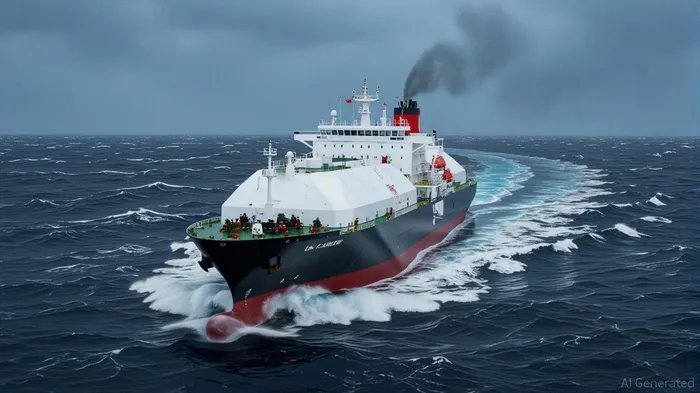
In the high-margin, long-term contracted world of liquefied natural gas (LNG) shipping, capital allocation discipline is the cornerstone of sustainable value creation. Flex LNG's recent $15 million share buyback program, announced in August 2025, is a masterclass in this principle. By repurchasing up to 900,000 shares at $25 apiece—representing a 3.6% reduction in shares outstanding—the company is signaling confidence in its intrinsic value while leveraging its fortress balance sheet to reward shareholders. This move, paired with a 12% trailing dividend yield and a 59-year minimum firm charterCHTR-- backlog, underscores Flex LNG's strategic approach to capital returns in a sector where volatility is the norm.
Capital Allocation Discipline: Balancing Buybacks and Liquidity
Flex LNG's buyback program is not a knee-jerk reaction to short-term market noise but a calculated step rooted in its broader Balance Sheet Optimization Program 3.0. The company's $412.7 million in cash and equivalents, coupled with no debt maturities until 2028, provides ample flexibility to execute buybacks without compromising operational or financial stability. This is critical in an industry where liquidity constraints can force suboptimal decisions.
The buyback's independence from dividend policy further highlights Flex LNG's disciplined approach. While the company maintains a consistent $0.75 per share quarterly dividend (a 12% yield at $25), the buyback allows it to capitalize on undervalued shares without diluting its ability to reward shareholders through dividends. This dual-pronged strategy—returning cash via both dividends and buybacks—ensures that Flex LNGFLNG-- can adapt to shifting market conditions while prioritizing long-term value.
Moreover, the buyback's timing is telling. With Flex LNG trading at a 10x P/E ratio based on Q2 2025 adjusted EBITDA of $62.6 million, the stock appears significantly undervalued relative to its peers and its own historical metrics. Management's decision to repurchase shares at this level suggests a belief that the market is underappreciating the company's long-term contracted backlog and high-margin fleet.
Undervaluation Signals: A High-Margin, Contract-Driven Play
Flex LNG's 56–85-year firm charter backlog is a critical differentiator in a sector prone to cyclical swings. Nearly all of its 13 LNG carriers—averaging just 5.5 years in age—are under long-term contracts, with only two vessels exposed to the spot market. This structural insulation from short-term volatility ensures stable cash flows, which are further amplified by the company's 78.5% gross profit margin.
The buyback, therefore, is not just a capital return tactic but a re-rating catalyst. By reducing shares outstanding, Flex LNG can boost earnings per share (EPS) and potentially justify a higher valuation multiple. At a 10x P/E, the company's $1.35 billion market cap implies a valuation that fails to account for its 59-year backlog or its $132 million in recent refinancing proceeds. For investors, this creates a compelling asymmetry: the downside is capped by the company's liquidity and contract coverage, while the upside lies in a potential re-rating as the market recognizes Flex LNG's fundamentals.
Strategic Positioning in a Volatile Sector
The LNG market remains fragmented, with spot rates fluctuating due to geopolitical tensions and shifting energy demand. Yet Flex LNG's proactive refinancing—extending debt maturities to 2035 and securing SOFR-based terms—has fortified its balance sheet. This financial flexibility allows the company to focus on shareholder returns rather than deleveraging pressures, a rare advantage in capital-intensive industries.
The delisting from the Oslo Stock Exchange in September 2025 further streamlines operations, reducing administrative costs and improving liquidity for U.S. investors. This move, combined with the buyback, signals a clear intent to simplify capital structure and enhance transparency—a critical factor in attracting institutional investors.
Investment Implications
For investors seeking exposure to a high-margin, contract-driven sector, Flex LNG's $15 million buyback represents a strategic inflection pointIPCX--. The company's disciplined capital allocation—returning $690 million to shareholders over the past four years—demonstrates a management team focused on long-term value. With a 12% yield, a 3.6% potential EPS boost from buybacks, and a fortress balance sheet, Flex LNG offers a rare combination of income and growth in a volatile market.
However, risks remain. The LNG sector is sensitive to macroeconomic shifts, and while Flex LNG's long-term contracts mitigate this, investors should monitor global energy demand trends. That said, the company's proactive approach to capital returns and its structural advantages—modern fleet, extended debt maturities, and a 59-year backlog—position it as a compelling play for those willing to bet on undervalued, cash-generative assets.
In conclusion, Flex LNG's share buyback is more than a tactical move—it's a strategic lever to unlock shareholder value in a sector where patience and discipline are rewarded. For investors with a medium-term horizon, this is a compelling opportunity to capitalize on a company that's not just surviving the volatility but thriving within it.





Comentarios
Aún no hay comentarios