
Flash Crashes in Crypto: Understanding Causes and Identifying Opportunities
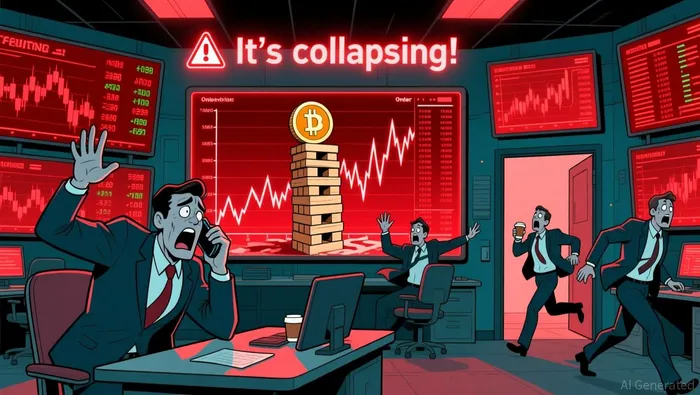
The October 2025 flash crash stands as a defining moment in cryptocurrency history, exposing systemic vulnerabilities in market structure and liquidity dynamics. Over $450 billion in market capitalization vanished in a single day, driven by a cascade of leveraged liquidations, stablecoin depegging, and a collapse in order book depth. This event, triggered by external macroeconomic shocks like Trump's 100% tariff threat on Chinese imports, underscores the fragility of crypto markets and the urgent need for structural reforms. Yet, amid the chaos, new opportunities are emerging-from institutional-grade infrastructure to machine learning-driven trading strategies.
Market Structure Vulnerabilities: Leverage, Margin Systems, and Stablecoin Risks
The October 2025 crash was not a random event but a predictable outcome of crypto's unique market structure. Unlike traditional financial systems, which employ circuit breakers and conservative margin models, crypto exchanges often combine order matching, custody, and price determination, creating a single point of failure during stress. Unified margin systems, where cross-asset collateral is used to cover leveraged positions, amplified the crisis. As prices plummeted, margin calls triggered automatic liquidations, which in turn deepened the sell-off- a negative feedback loop that wiped out $19 billion in leveraged positions within hours.
Stablecoin depegging further exacerbated the crisis. On platforms like Binance and Bybit, stablecoins such as USDeUSDe-- traded at discounts of 5-10%, exposing internal oracles to local price distortions. This disconnect between on-chain and off-chain valuations triggered margin calls even when broader markets had not yet adjusted, accelerating the collapse. Academic research corroborates these dynamics, noting that pro-cyclical liquidity-where order books swell during bullish phases but evaporate during downturns-leaves crypto markets uniquely exposed to sudden deleveraging.
Liquidity Dynamics: The Illusion of Depth and the Role of Derivatives
Liquidity in crypto markets is often an illusion. During the October 2025 crash, bid-ask spreads widened to over 10%, and order book depth collapsed by 90% on major exchanges. This starkly contrasts with traditional markets, where liquidity is maintained through mechanisms like market makers and central limit order books. The reliance on derivatives-particularly perpetual futures with 100x leverage-compounded the problem. As open interest exceeded $70 billion, liquidations became self-fulfilling, with each forced sale further depressing prices.
Academic studies highlight the systemic risks of this structure. A 2025 TVP-VAR model analysis revealed that BitcoinBTC-- and EthereumETH-- had become net transmitters of volatility post-FTX, with DeFi tokens experiencing asymmetric spillovers. Meanwhile, the Crypto Volatility Index (CVI) demonstrated non-linear correlations with traditional volatility benchmarks like the VIX, suggesting crypto's integration into global financial systems is both deeper and more fragile than previously understood.
Opportunities in a Post-Crash Landscape
Despite these vulnerabilities, the October 2025 crash has catalyzed innovation. Institutional-grade infrastructure is emerging to address liquidity fragmentation. Platforms like Kraken Prime and Ripple's Hidden Road acquisition are bridging the gap between centralized and decentralized exchanges, offering smart order routing and cross-venue margining. These solutions aim to reduce slippage and improve capital efficiency, addressing a key pain point for institutional investors.
Stablecoins, meanwhile, are reshaping global finance. With a market size exceeding $215 billion in early 2025, they are facilitating cross-border transactions, payroll systems, and remittances at scale. Their adoption in emerging markets-where transaction costs are traditionally high-has been particularly transformative, enabling millions to access low-cost financial services.
Machine learning is also unlocking new opportunities. Advanced models, including LSTM networks and ensemble methods, are improving predictive accuracy in volatile crypto markets. These tools not only enhance trading strategies but also enable better risk assessment, helping investors navigate the inherent instability of the sector.
Conclusion: A Path Forward
The October 2025 flash crash was a wake-up call for crypto markets. It exposed the dangers of excessive leverage, unified margin systems, and fragile liquidity, while also highlighting the need for structural reforms. Yet, the crisis also revealed pathways to resilience: tighter leverage caps, multi-venue oracles, and institutional infrastructure. For investors, the key lies in balancing risk with innovation-leveraging tools like machine learning and stablecoins while advocating for regulatory frameworks that prioritize transparency and stability.
As the crypto ecosystem evolves, understanding these dynamics will be critical. The next bull market will not be defined by speculative euphoria but by the ability to withstand-and adapt to-systemic shocks.






Comentarios
Aún no hay comentarios