
The Fiscal Crossroads: Why U.S. Credit Downgrade Demands a Defensive Shift in Portfolios
The downgrade of U.S. sovereign credit by Moody’s to Aa1—a first since the rating agency’s inception—marks a seismic shift in the calculus of fiscal risk. With political gridlock entrenching unsustainable debt dynamics, investors face a stark choice: reduce exposure to vulnerable assets or risk erosion of capital as market discipline intensifies. The stakes are high, with long-dated Treasuries and equity sectors reliant on federal spending now bearing the weight of systemic fiscal instability.
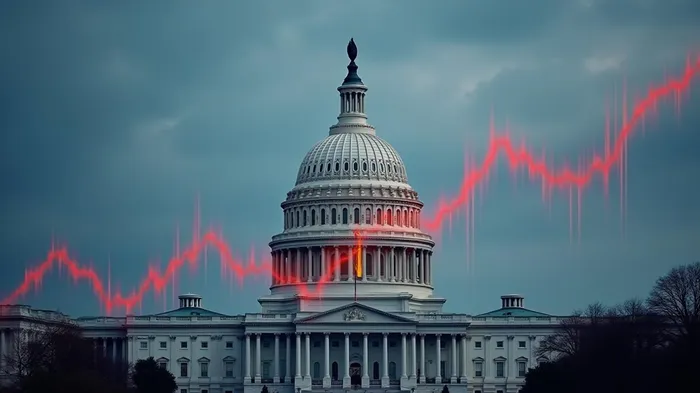
The Anatomy of a Downgrade
Moody’s decision hinges on three pillars: escalating deficits, entitlement-driven debt, and partisan paralysis. The agency forecasts deficits to hit 9% of GDP by 2035, fueled by soaring Social Security and Medicare costs, interest payments on the $40 trillion debt, and the potential extension of the 2017 Trump tax cuts. The latter alone could add $4 trillion to deficits over a decade—a fiscal time bomb Democrats refuse to fund via spending cuts to programs like Medicaid or clean energy.
The GOP’s infighting over spending exacerbates this impasse. Recent House negotiations collapsed after hardliners demanded cuts to Medicaid and climate initiatives, which Democrats rejected. Moody’s explicitly linked this dysfunction to the downgrade, warning that legislative stalemates erode confidence in Washington’s ability to stabilize debt.
Sector-Specific Vulnerabilities: Healthcare and Energy at Risk
Healthcare equities tied to Medicaid subsidies and energy stocks reliant on green energy tax credits now face existential risks. If budget negotiations force cuts to Medicaid—a program covering 88 million Americans—managed-care companies like UnitedHealth (UNH) and Centene (CNC) could see enrollment declines and margin pressure. Similarly, renewable energy firms such as NextEra Energy (NEE) and Tesla (TSLA), which depend on federal subsidies, may face funding gaps if tax incentives are delayed or diluted.
The Case Against Long-Dated Treasuries
The downgrade’s immediate impact will be felt in fixed income. As lenders demand higher yields to compensate for elevated sovereign risk, long-dated Treasuries (e.g., 30-year bonds) will suffer. The yield on 10-year Treasuries has already risen by 40 basis points year-to-date, but this is just the beginning.
Investors holding long-dated Treasuries risk double whammy losses: rising yields mean falling prices, while inflation could further erode real returns. The solution? Shorten duration or shift to inflation-linked bonds.
Defensive Allocations: Inflation-Linked Bonds and Resilient Sectors
Inflation-Protected Securities (TIPS):
Treasury Inflation-Protected Securities (e.g., TIP) offer principal adjustments tied to CPI, shielding investors from rising prices. Their yields, though modest, now appear attractive compared to nominal bonds.Technology and Consumer Staples:
Sectors insulated from fiscal volatility—such as Microsoft (MSFT), Amazon (AMZN), or Coca-Cola (KO)—boast pricing power, global reach, and cash flows unshackled from Washington’s dysfunction.Global Diversification:
Allocate to sovereign bonds of Aaa-rated nations like Germany (Bund) or Canada (Canada 10Y), which offer superior creditworthiness and diversification benefits.
The Bottom Line: Act Now, Act Decisively
The Moody’s downgrade is not a distant warning—it’s a call to arms. Investors must rebalance portfolios to reflect the new fiscal reality:
- Reduce exposure to long-dated Treasuries and equity sectors dependent on federal largesse.
- Increase allocations to inflation-linked bonds and secular growth stocks with self-funding business models.
- Diversify globally to hedge against U.S. fiscal instability.
History shows markets punish procrastination. In 2011, S&P’s first U.S. downgrade triggered a 17% market correction. Today’s risks are even greater. The path to preservation—and opportunity—lies in decisive, defensive action.
The fiscal crossroads is here. Choose wisely.





Comentarios
Aún no hay comentarios