
Firefly Aerospace's Stock Plunge: A Volatile Path to Long-Term Space Sector Dominance?
Firefly Aerospace (NASDAQ: FLY) has experienced a tumultuous September 2025, with its stock plummeting 20% following a catastrophic rocket explosion during a ground test of its Alpha Flight 7 booster. This setback compounded an earlier 10% drop in early September after the company reported wider-than-expected second-quarter losses and a 36% year-over-year Q2 revenue decline. While the immediate volatility has rattled investors, the broader narrative of Firefly's technological ambition, strategic positioning in the small satellite launch market, and long-term financial runway suggests that this turbulence may present a unique entry point for patient capital.
Technological Resilience Amid Setbacks
Firefly's recent explosion, though alarming, must be contextualized within its history of innovation. The company achieved a historic milestone in March 2025 with the successful Blue Ghost lunar landing-the first private mission to touch down on the Moon without toppling. This feat, coupled with a 24-hour U.S. Space Force mission in 2023, underscores Firefly's rapid-response capabilities and technical agility. The Alpha rocket, despite its mixed performance (six orbital launches with only two full successes), remains a critical asset for payloads exceeding 1,000 kg to low Earth orbit (LEO), a niche where competitors like Rocket Lab's Electron (300 kg capacity) lack reach, as FireflyFLY-- detailed in its second-quarter results.
However, Firefly's technical challenges are real. The Alpha Flight 7 explosion during a first-stage test-a stage where safety protocols were followed and no personnel were harmed-has delayed its launch timeline and raised questions about reliability. Rocket Lab, by contrast, has maintained a higher launch cadence (21 successful missions as of 2021) and is developing the Neutron rocket, a reusable vehicle with 13-ton capacity that could outpace Firefly's offerings in the future, as noted in a MarketBeat's note. Yet Firefly's focus on defense and lunar contracts-such as its $176.7 million NASA Blue Ghost Mission 4 and $50 million Northrop Grumman partnership for the Eclipse rocket-positions it to capitalize on sectors where Rocket Lab has limited exposure.
Market Dynamics and Competitive Edge
The small satellite launch market is projected to grow at a 16.4% CAGR from 2025 to 2034, reaching $30.6 billion by 2034. Firefly's Alpha rocket is uniquely positioned to serve this demand, particularly for heavier payloads or rapid-deployment scenarios. For instance, the U.S. National Reconnaissance Office (NRO) and NASA have opted for Firefly's services for missions requiring larger satellites or expedited timelines, as shown in a demand comparison. Rocket Lab's Electron, while cheaper ($7 million per launch vs. Firefly's $15 million), remains better suited for smaller, frequent launches. Firefly's pricing premium is justified by its ability to handle complex, high-value contracts, such as the 25 missions secured with Lockheed Martin and 23 with L3Harris.
The defense sector further amplifies Firefly's potential. With the U.S. Department of Defense and international partners like the United Arab Emirates now part of its customer base, Firefly is tapping into a market where reliability and national security considerations outweigh cost sensitivity. Analysts note that the company's Elytra orbital tug and rapid-response capabilities could secure a dominant role in Pentagon contracts, a segment Rocket Lab has yet to penetrate.
Financial Health and Analyst Outlook
Firefly's financials reveal a company in transition. Its Q2 2025 revenue of $15.5 million, while down from $55.9 million in Q1 due to milestone timing, reflects the cyclical nature of aerospace contracts. The company's $1.3 billion backlog-bolstered by the Blue Ghost Mission 4 and supplemental NASA data contracts-provides a clear revenue pipeline. However, Firefly's cash burn remains a concern: it used $84.6 million in net cash from operating activities in the first half of 2025, despite an $868 million IPO in August 2025. This burn rate, while manageable for now, will need to align with revenue growth to avoid future liquidity crises.
Analysts remain cautiously optimistic. A "Moderate Buy" consensus rating from six Wall Street firms is supported by an average 12-month price target of $55.17 (a 21.89% upside from current levels). Cantor Fitzgerald and JPMorgan have upgraded the stock to "Overweight," citing Firefly's strategic positioning in the defense and lunar markets. Forward-looking metrics are equally compelling: revenue is projected to grow at 44.2% annually, while earnings are expected to rise 73% per year. These figures suggest that Firefly's long-term value could outpace its short-term volatility.
Conclusion: Volatility as a Filter
Firefly Aerospace's stock decline in September 2025 is a stark reminder of the risks inherent in the commercial space sector. Technical setbacks and financial burn rates are legitimate concerns. Yet, the company's technological milestones, strategic partnerships, and alignment with high-growth markets (defense, lunar exploration) suggest that this volatility may be a temporary correction rather than a terminal event. For investors with a multi-year horizon, Firefly's current valuation-discounted by recent headlines-could represent an opportunity to participate in a company poised to benefit from the $30.6 billion small satellite market and the broader democratization of space.
As Firefly prepares for its Alpha Flight 7 relaunch and the 2026 debut of the Eclipse rocket, the coming months will test its resilience. But history shows that the most transformative companies in aerospace-SpaceX, Blue Origin, even Rocket Lab-have all weathered similar storms. For Firefly, the question is not whether the road will be bumpy, but whether the destination justifies the ride.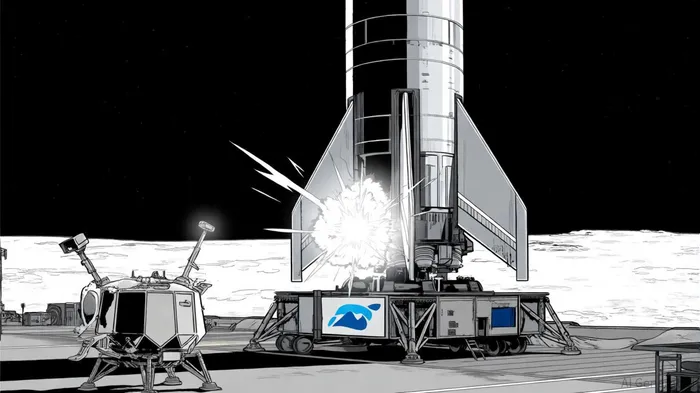







Comentarios
Aún no hay comentarios