
Firefly Aerospace's Lunar Ambition: High-Growth Potential Amid Debt and Cash Burn Risks
The space economy is undergoing a quiet renaissance, fueled by geopolitical competition, private-sector innovation, and investor hunger for the next big disruptor. FireflyAIFF-- Aerospace, a Texas-based rocketRCKT-- manufacturer and lunar logistics pioneer, is at the center of this revival. Its pending Nasdaq IPO—filed under the ticker “FLY”—offers investors a chance to bet on a company that has achieved the rare feat of landing on the moon while building a $1.1 billion order backlog. Yet, Firefly's path is fraught with financial hurdles, including a $173.6 million debt burden and a net loss of $231 million in 2024. This article explores whether the company's strategic partnerships, lunar leadership, and ambitious backlog can justify its high-growth narrative—and whether the risks are worth the reward.
The Lunar Achievement and Strategic Momentum
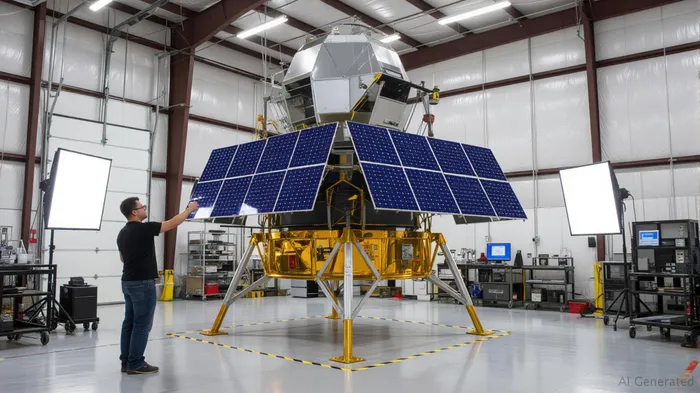
Firefly's most compelling asset is its Blue Ghost lunar lander, which made history in March 2025 by executing the first entirely commercial moon landing. This milestone is no small achievement: it positions Firefly as a critical partner in NASA's Artemis program, which aims to establish a sustained human presence on the moon by the late 2020s. The Blue Ghost's success has already secured a $18 million contract for lunar orbit calibration services on its next mission, and its scalability could open doors to future government and commercial contracts.
Beyond the moon, Firefly's partnerships are equally pivotal. Its collaboration with Northrop GrummanNOC-- to develop the reusable Eclipse launch vehicle—a key component of the U.S. military's space logistics strategy—adds credibility. A 25-launch agreement with Lockheed MartinLMT--, coupled with its upcoming Elytra spacecraft for in-space transportation, further diversifies its revenue streams. These alliances are not just about prestige; they're about liquidity. As of March 2025, Firefly's order backlog had doubled year-over-year to $1.1 billion, driven by multi-launch deals for its Alpha rocket and lunar delivery contracts.
Financial Challenges and the IPO's Role
Firefly's financials paint a mixed picture. While its revenue surged from $8.3 million in 2024 to $55.8 million through March 2025, the bulk of this growth—$50 million—comes from spacecraft solutions (i.e., lunar lander services). Gross profit remains razor-thin at $2.2 million, with operational costs nearly matching revenue ($53 million). The company's net loss of $60.1 million in Q1 2025 underscores its cash burn problem: it needs $176.9 million in cash to survive 12 months, but its $173.6 million debt—much of it a high-interest term loan at 13.87%—threatens to drain liquidity further.
The IPO aims to address this by raising funds to repay the term loan and stabilize its balance sheet. However, the company's controlled company status post-IPO—ensuring private equity firm AE Industrial Partners retains influence—may deter some investors wary of limited governance transparency.
Valuation Upside in a Recovering Space Tech Market
Firefly's IPO arrives amid a nascent recovery in space tech valuations. The sector's 2025 IPO pipeline includes over 90 aerospace and defense firms, with proceeds surging as geopolitical tensions boost defense budgets. Companies like Voyager Space (up 139% on its first day) and Karman Holdings (valued at $6.17 billion) have demonstrated investor enthusiasm for firms with NASA ties and scalable contracts. Firefly's lunar success and backlog align closely with these trends, suggesting it could command a valuation 15–20x revenue—far above its current $176.9 million cash position but reflective of its growth potential.
The company's alignment with AI-driven advancements, such as predictive maintenance for its launch vehicles, also positions it to benefit from the $7.8 billion invested in space tech startups in Q2 2025. While Firefly isn't explicitly an AI firm, its integration of smart systems into spacecraft operations could help it compete in a sector increasingly dominated by tech-driven innovation.
Risks and Considerations
Investors must weigh Firefly's potential against significant risks:
1. Technical Execution: A recent Alpha rocket stage separation issue highlights the risks of rapid scaling.
2. Profitability: Sustained losses could pressure valuations if revenue growth stalls.
3. Market Volatility: The space sector remains sensitive to macroeconomic headwinds, including inflation and trade disputes.
Investment Conclusion: A High-Risk, High-Reward Bet on the Moon Economy
Firefly Aerospace's IPO is a speculative play on the space economy's long-term growth. Its lunar leadership, strategic partnerships, and robust backlog justify optimism, but its debt and cash burn demand caution. Investors with a high-risk tolerance and a 5–10-year horizon may find value in Firefly's potential to capture a share of NASA's Artemis program and commercial lunar logistics. For others, the risks—technical, financial, and regulatory—may outweigh the rewards.
The company's success hinges on three variables:
- Debt Repayment: Will IPO proceeds sufficiently reduce its financial burden?
- Execution Speed: Can it deliver on its Eclipse and Elytra programs without costly delays?
- Market Sentiment: Will the space tech sector's recovery continue, or will it falter amid macroeconomic headwinds?
For now, Firefly's IPO is a signal of confidence in the space economy's future. But as with all moonshots, the path to profitability remains uncertain—and the risks are as vast as the cosmos itself.







Comentarios
Aún no hay comentarios