
Fintech Valuation Pressures: Decoding Mizuho's Price Target Cuts
The fintech sector, once a darling of high-growth speculation, is now under renewed scrutiny as macroeconomic headwinds and sector-specific risks reshape investor sentiment. Mizuho's recent price target cuts for fintech stocks, including a notable reduction for StrategyMSTR-- Inc. (NASDAQ:MSTR), reflect a broader recalibration of expectations driven by interest rates, inflation, and evolving market dynamics. This analysis unpacks the interplay between macro-driven caution and overvaluation risks, using Mizuho's research as a lens to assess the sector's trajectory.
Macro-Driven Caution: Interest Rates and Inflation as Valuation Anchors
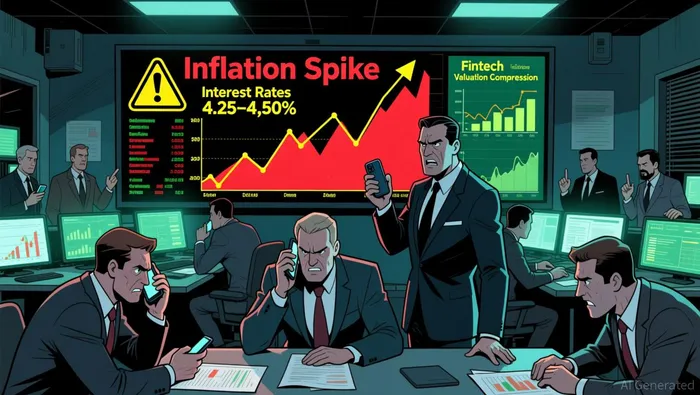
Mizuho's adjustments to fintech valuations are deeply tied to macroeconomic realities. The Federal Reserve's 4.25–4.50% interest rate range in 2025 has shifted investor priorities from growth-at-all-costs to profitability, tightening capital flows and compressing valuation multiples. For capital-intensive sub-sectors like BNPL (Buy Now, Pay Later) and lending, this has been particularly disruptive, as higher borrowing costs erode margins and force fintechs to optimize unit economics.
The ripple effects of inflation further complicate the landscape. Consumer spending habits have shifted toward essential goods, reducing discretionary spending that underpins cross-border and transaction-based fintech services. Platforms like RobinhoodHOOD-- and CoinbaseCOIN--, which rely on speculative trading activity, have seen revenue declines as inflation dampens retail investor appetite. Mizuho's caution is thus not unfounded: the firm's 2025 sector outlook highlights how inflation-driven behavioral shifts could persist into 2026, further constraining growth forecasts for fintechs.
Sector-Specific Overvaluation Risks: P/E Ratios and Revenue Projections
While macroeconomic factors set the stage, fintech's valuation pressures are also rooted in sector-specific imbalances. As of November 2025, the fintech sector's average P/E ratio stands at 14.1, significantly below the peer average of 19.6 and the fair valuation benchmark of 16.2. Mizuho Financial Group (MFG), a key player in the space, trades at a trailing P/E of 14.79 and a forward P/E of 16.89, suggesting a mixed outlook. While these metrics hint at undervaluation relative to historical averages, they also underscore the sector's vulnerability to earnings volatility.
Mizuho's price target cut for MSTR-from $586 to $484-exemplifies this tension. Despite the firm's "Outperform" rating and Q3 2025 results showing an EPS of $8.42 and a 26% year-to-date BitcoinBTC-- yield, the adjustment reflects concerns about leverage and exposure to Bitcoin's price swings. This duality-strong earnings versus structural risks-highlights the sector's fragility. Similar caution is evident in Mizuho's 2026 projections, where revenue growth estimates for Shift4Payments and price targets for PayPal and Fiserv were revised downward, citing inflationary pressures and reduced consumer spending.
Strategic Implications: M&A and Innovation as Countercyclical Levers
Amid these pressures, Mizuho's research identifies two potential countercyclical forces: M&A activity and AI-driven innovation. The blurring lines between traditional banks, neobanks, and fintechs are fueling dealmaking, as firms seek to consolidate capabilities and reduce costs. Lower interest rates in late 2024 and early 2025 have already created a more favorable environment for such transactions. Additionally, strategic partnerships with established banks and the adoption of AI-driven tools are becoming critical for fintechs to differentiate themselves in a crowded market.
However, these opportunities come with caveats. Geopolitical tensions and trade policies could disrupt cross-border fintech operations, while regulatory shifts-particularly in crypto-remain a wildcard. For instance, Mizuho's bullish stance on MSTR hinges on the assumption of a stable regulatory environment for Bitcoin, a factor that could quickly sour if volatility resurfaces.
Conclusion: Navigating the New Normal
Mizuho's price target cuts are not a dismissal of fintech's long-term potential but a recalibration in response to macroeconomic realities. The sector's valuation pressures are a function of both external forces-rising rates, inflation, and geopolitical risks-and internal challenges, such as overreliance on speculative assets like Bitcoin. For investors, the key lies in distinguishing between fintechs with sustainable unit economics and those clinging to outdated growth models.
As the sector navigates this inflection point, the interplay between macro-driven caution and innovation will define its next chapter. Those who can adapt to the new normal-prioritizing profitability, leveraging M&A, and embracing AI-may yet thrive, even as the broader market remains wary.





Comentarios
Aún no hay comentarios