
FingerMotion's Turnaround Gambit: Navigating Profitability and Scalability in a High-Stakes Market
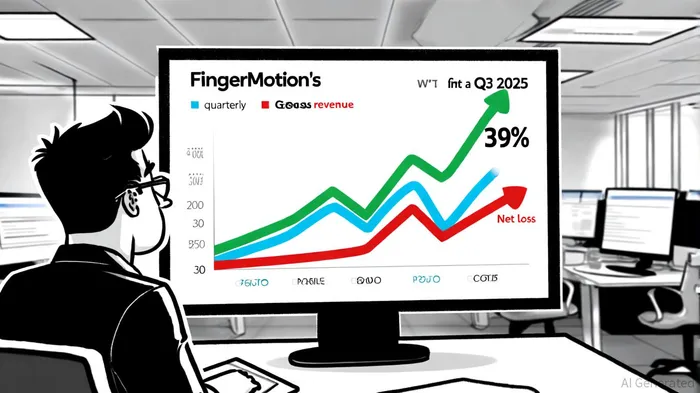
FingerMotion Inc. (NASDAQ: FNGR) has painted a mixed picture of resilience and fragility in its recent financial performance, offering investors a complex puzzle to solve. While the company reported a 39% year-over-year revenue surge to $8.53 million in Q3 2025, driven by its Telecommunications Products & Services segment according to FingerMotion's Q3 2025 report, profitability remains a critical concern. Gross profit plummeted by 30% to $0.44 million, reflecting a 47% spike in cost of revenue, per the company's Q3 2025 earnings. This margin compression-exacerbated by a 243% surge in marketing expenses-was also flagged in the SEC 10‑Q filing.
The company's liquidity position further underscores its precariousness. As of November 30, 2024, FingerMotionFNGR-- held just $164,600 in cash, with total liabilities of $22.36 million against shareholders' equity of $9.58 million, according to the Q2 2025 report. This leveraged balance sheet, coupled with a 79% revenue concentration from a single customer and 78% procurement reliance on one supplier per a StockTitan article, exposes FingerMotion to operational and pricing risks that could derail its scalability ambitions.
Yet, there are glimmers of hope. Q2 2026 results, released in October 2025, revealed a 23% reduction in operating expenses and a 9% narrowing of the net loss to $1.52 million, according to the Q2 2026 press release. The DaGe Platform and Command and Communication segments, though still under 1% of total revenue, showed early traction in the company's SEC 10‑Q. CEO Martin Shen emphasized progress in mobile payment solutions and 5G infrastructure, framing these as "cornerstones for long-term monetization" in the company's Q3 2025 earnings.
Operational scalability, however, remains elusive. The Big Data segment, a strategic focus area, generated zero revenue in Q3 2025 per the Q2 2025 report, while the SMS & MMS business-once a revenue pillar-collapsed from $0.87 million in Q3 2023 to $0.01 million in Q3 2024 according to the Q3 2024 report. This volatility highlights the company's struggle to diversify beyond its core telecommunications offerings.
FingerMotion's pivot to higher-margin segments like mobile payments and 5G infrastructure is theoretically sound, but execution risks loom large. The company's gross margin improved to 5.20% in Q3 2025, a 47.35% quarter-on-quarter gain as shown in the company's Q3 2025 earnings, yet this remains far below industry benchmarks. For context, telecom peers typically maintain gross margins between 40–60%. Without significant margin expansion, FingerMotion's path to profitability will remain constrained.
Investors must also weigh the company's strategic optimism against its operational realities. While management aims for 15% annual revenue growth in Q4 2025, according to the Q3 2025 guidance, the reliance on external financing to scale new ventures-coupled with a working capital surplus of just $9.43 million reported in the Q2 2025 report-suggests a fragile foundation for sustainable scalability.
In conclusion, FingerMotion's near-term turnaround hinges on three critical factors:
1. Margin Expansion: Sustaining the Q3 2025 gross margin improvement while curbing cost of revenue growth.
2. Diversification: Proving the DaGe Platform and Big Data segments can scale beyond niche contributions.
3. Liquidity Management: Securing additional capital to fund operations without diluting shareholder value.
For now, the company's strategic bets on 5G and mobile payments offer a compelling narrative, but investors should remain cautious. The road to profitability is paved with both potential and peril.





Comentarios
Aún no hay comentarios