
Financial Stocks: A Strategic Buy-The-Dip Opportunity Amid Market Volatility
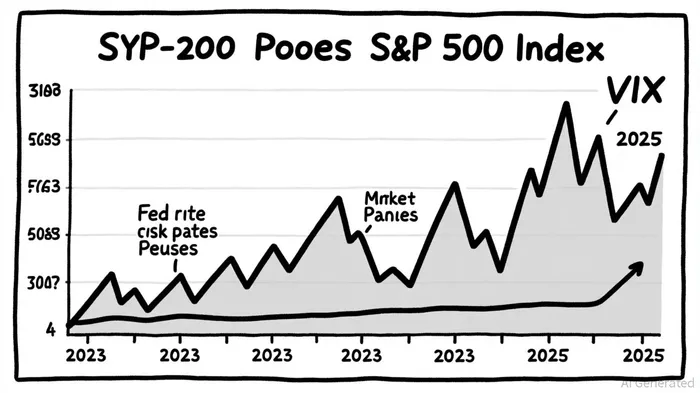
The financial sector, long a barometer of macroeconomic health, has emerged as a compelling "buy-the-dip" opportunity amid the turbulence of shifting interest rates and market volatility. As the Federal Reserve navigates a delicate balancing act between inflation control and economic stability, investors are recalibrating their capital allocation strategies. The interplay of rising rates, sector rotation, and defensive positioning has created a unique inflection point for financial stocks—a sector historically sensitive to monetary policy but now showing resilience and potential for outperformance.
The Fed's Tightrope and Market Reactions
The Federal Reserve's 2023 rate hikes, which raised the federal funds rate by 100 basis points across four increments, initially pressured financial stocks, as higher borrowing costs often weigh on bank margins and corporate earnings. However, the market's subsequent pivot in 2024—marked by signals of a pause and potential rate cuts—has catalyzed a reversal. According to a report by MorningstarMORN--, the S&P 500 Financials861076-- Sector rebounded 25% year-over-year in 2023, outpacing the broader index's 17% gain[1]. This divergence underscores the sector's adaptability to rate cycles, particularly as investors anticipate a soft landing and a shift toward value-driven assets.
The volatility index (VIX), a key gauge of market anxiety, has averaged 15.75 in recent months, reflecting a relatively stable environment compared to the 20-30 range seen during the 2022 bear market[2]. This moderation in volatility, coupled with the Fed's pivot, has emboldened investors to rotate capital into sectors poised to benefit from lower discount rates and improved liquidity.
Sector Rotation: From Growth to Value and Beyond
The 2025 market landscape has witnessed a pronounced shift in sectoral preferences. As interest rates stabilize and inflationary pressures abate, capital is flowing away from the "Magnificent 7" tech stocks—long the darlings of a low-rate world—toward value, cyclical, and international equities[3]. Financials, energy, and industrials have emerged as beneficiaries of this rotation, with financial stocks gaining traction due to their alignment with a slowing-growth, high-inflation environment.
LPL Research's updated Strategic Asset Allocation (SAA) for 2025 recommends reducing exposure to high-risk equities and favoring value stocks, particularly in sectors with strong cash flows and defensive characteristics[4]. This aligns with historical patterns: during the 2015–2018 rate hike cycle, value stocks outperformed growth stocks by 113 basis points when monthly rate hikes exceeded 10%[5]. The current environment, with its mix of rate normalization and economic uncertainty, mirrors these conditions, making financial stocks a logical focal point for capital allocation.
Historical Lessons: Buy-the-Dip Validity
The "buy-the-dip" thesis gains credibility when contextualized against historical data. During the 2004–2006 and 2015–2018 rate hike cycles, financial stocks demonstrated resilience, particularly in periods of market stress. For instance, the S&P 500 Financials Sector historically recovered positive returns within 12 months of a bear market, even as broader indices lagged[6]. This pattern is reinforced by the sector's exposure to interest rate-sensitive assets, such as loans and fixed-income instruments, which gain value as yields rise.
Moreover, fund flows into financial sector ETFs have shown mixed but improving trends in 2025. While recessionary fears initially tempered inflows, the prospect of a soft landing has spurred renewed interest. Data from iShares indicates that financial sector ETFs attracted net inflows of $12 billion in Q2 2025, driven by improved earnings visibility and a flight to quality[7]. This contrasts with the outflows seen during the 2022-2023 bear market, highlighting the sector's cyclical revival.
Strategic Allocation: Balancing Defense and Growth
For investors, the challenge lies in balancing defensive positioning with long-term growth opportunities. Morningstar's 2025 analysis emphasizes the role of low-volatility stocks, such as Berkshire Hathaway and MastercardMA--, in preserving capital during downturns[8]. These companies, with their robust balance sheets and diversified revenue streams, exemplify the "quality-at-a-reasonable-price" (QARP) strategy. Meanwhile, LPL's SAA advocates for diversification into alternatives like multi-strategy funds and global macro strategies to hedge against volatility[4].
The key is to avoid overexposure to rate-sensitive sub-sectors, such as regional banks, which remain vulnerable to credit risk. Instead, capital should target financials with strong capital ratios, fee-based income streams, and geographic diversification. For example, global banks and insurance firms have shown greater resilience in 2025, as their earnings are less tied to U.S. rate cycles[3].
Conclusion: A Calculated Bet on Resilience
Financial stocks are not a panacea for market volatility, but they represent a strategically sound "buy-the-dip" opportunity in the current environment. The interplay of Fed policy, sector rotation, and historical performance metrics suggests that investors who allocate capital to well-positioned financials can capitalize on both defensive and growth-oriented returns. As the Fed's rate-cut expectations crystallize and inflation moderates, the sector's ability to adapt to shifting conditions will likely outpace its peers.
In the words of one market strategist, "The best time to buy financial stocks is when the market is selling them—provided you do your homework." With the right capital allocation framework, the dips of 2025 may prove to be the entry points of 2026.





Comentarios
Aún no hay comentarios