
The Financial Implications of Extended Mortgages in a High-Interest Rate Era
The Affordability Mirage: Lower Payments, Higher Costs
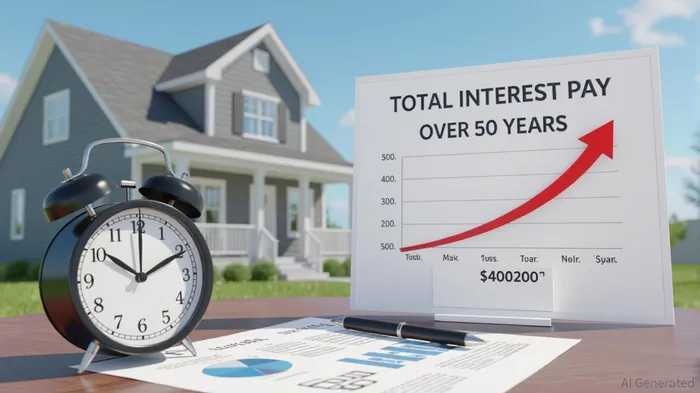
President Trump's 50-year mortgage proposal hinges on the premise that extending amortization periods will make homeownership more accessible. For a $400,000 home with a 6.575% interest rate and 20% down payment, monthly payments would drop from $2,788 (30-year term) to $2,572 (50-year term) Yahoo Finance report. However, this comes at a steep cost: total interest paid over the life of the loan would nearly double, reaching $749,000 compared to $402,000 for a 30-year mortgage, according to a Fortune analysis.
Richard Green, a professor at the University of Southern California, highlights that while monthly payments decrease, equity accumulation slows dramatically. Borrowers would take 30 years to build $100,000 in equity under a 50-year plan, compared to 12–13 years for a 30-year mortgage, per the Fortune analysis. This delayed equity buildup raises concerns about default risk, particularly as loans stretch into retirement years when income stability may decline.
Investor Risks: Duration, Volatility, and MBS Vulnerability
The 50-year mortgage proposal introduces significant risks for investors in mortgage-backed securities. MBS are inherently sensitive to interest rate fluctuations, with longer-duration instruments experiencing greater price volatility. For example, the JPMorgan Mortgage-Backed Securities ETF (JMTG), which targets a duration of two to ten years, has shown pronounced sensitivity to rate changes in 2025, according to a JPMorgan ETF article. A 50-year mortgage would extend this duration exponentially, amplifying price swings in high-interest environments.
Data from 2020–2025 underscores this risk. The BlackRock Income Trust (BKT), heavily exposed to long-term MBS, saw its share price decline by 6.8% over the past year as rates rose, with its net asset value (NAV) falling steadily since 2020, according to a Seeking Alpha analysis. The fund's reliance on leverage further magnifies losses, as rising rates erode the value of its long-duration holdings. A 50-year mortgage would likely exacerbate such vulnerabilities, as investors face prolonged exposure to refinancing risk and default uncertainty.
The Housing Market Paradox: Artificial Demand vs. Supply Constraints
Critics argue that the 50-year mortgage plan fails to address the root causes of housing unaffordability. Logan Mohtashami, a housing analyst, notes that supply and demand imbalances-driven by stagnant construction and regulatory barriers-remain the primary drivers of high prices, according to a San Diego Union-Tribune report. By extending mortgage terms, the policy could artificially inflate demand without increasing supply, pushing prices even higher.
For instance, in Florida, where the average 30-year mortgage rate hit 6.38% in Q2 2025, a 50-year option might lure buyers into the market despite elevated rates, as noted in a Palm Beach Post article. However, this could backfire if home prices continue to outpace wage growth, leaving borrowers with underwater mortgages and lenders facing higher default rates.
Policy and Market Implications: A High-Stakes Gamble
The Federal Reserve's recent balance sheet adjustments add another layer of complexity. As the Fed considers reinvesting MBS paydowns into Treasurys, 10-year yields-and by extension, mortgage rates-could fall, according to a HousingWire article. While this might temporarily boost refinancing activity, it would also increase reinvestment risk for MBS holders of long-duration assets like 50-year mortgages.
Moreover, the Qualified Mortgage (QM) rule under Dodd-Frank currently prohibits 50-year mortgages, creating a legal hurdle for implementation, as noted in a HousingWire article. Even if the rule is revised, the proposal's success hinges on lenders' willingness to absorb higher interest rate risk-a challenge in an era of tightening credit standards.
Conclusion: A Risky Proposition for Homeowners and Investors
The 50-year mortgage plan represents a double-edged sword. While it offers short-term relief for monthly payments, it locks homeowners into decades of debt with minimal equity gains. For investors, the policy could transform MBS into high-risk, long-duration assets, amplifying volatility in a high-interest rate environment.
As the housing market grapples with affordability crises, policymakers must weigh the allure of extended mortgages against their systemic risks. Without addressing supply-side constraints and construction costs, such policies risk deepening financial instability rather than alleviating it.







Comentarios
Aún no hay comentarios