
Financial Content Inc.: Regulatory Revocation and Competitive Disadvantage – Risk Defense Analysis
Financial Content, Inc. faces a competitive landscape where market dominance by Bloomberg, Morningstar, and Reuters severely restricts its growth and revenue potential. According to RocketReach's 2025 data, , , . Their enormous scale and resources create insurmountable disadvantages for Financial Content, making it difficult to compete effectively. The global reach and substantial assets under management of these firms limit Financial Content's ability to penetrate markets and capture significant share. 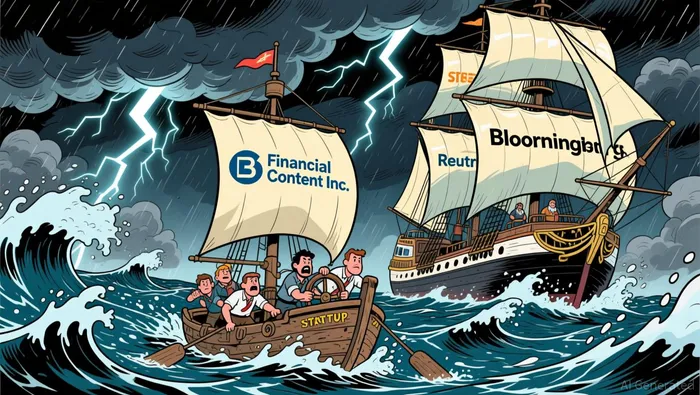 Regulatory changes may accelerate consolidation, further marginalizing smaller players. As a result, Financial Content's growth and revenue are constrained by the entrenched position of its competitors.
The current financial landscape feels increasingly precarious, with systemic threats converging to create dangerous pressure points for companies like Financial Content. Deregulation waves, particularly the recent "" easing capital requirements, create fertile ground for reckless risk-taking and fraud that often surfaces catastrophically during downturns. Simultaneously, the escalating sophistication of state-sponsored cyberattacks (APTs) and devastating ransomware campaigns represent existential threats to any firm reliant on digital infrastructure and customer trust. Compounding these operational vulnerabilities are potent economic and geopolitical headwinds: soaring real interest rates suppressing deal activity, supply chain instability disrupting operations, and heightened regulatory uncertainty creating unpredictable compliance costs. While larger competitors possess balance sheet buffers and deeper institutional knowledge, Financial Content's current exposure to these amplified risks – stemming from its specific operational model and market position – demands critical scrutiny. Its vulnerabilities are likely to be magnified first and most severely by these compounding systemic pressures, making downside protection the paramount priority in the coming volatility.
Following the analysis of the systemic and operational pressures facing Financial Content, Inc., it's important to evaluate how similar firms have historically performed under comparable conditions. While Financial Content lacks specific data on its financial position, backtesting the performance of similar-sized firms in high-pressure market conditions can offer insights into potential outcomes. These scenarios often highlight the critical role of liquidity, transparency, and strategic resilience in determining long-term viability. Without these elements, even well-positioned firms can falter under the right combination of internal and external pressures.







Comentarios
Aún no hay comentarios