
Filecoin's Regulatory Crossroads: Assessing Long-Term Investment Viability Amid Market Volatility
The SEC's Shifting Stance and Legal Uncertainty
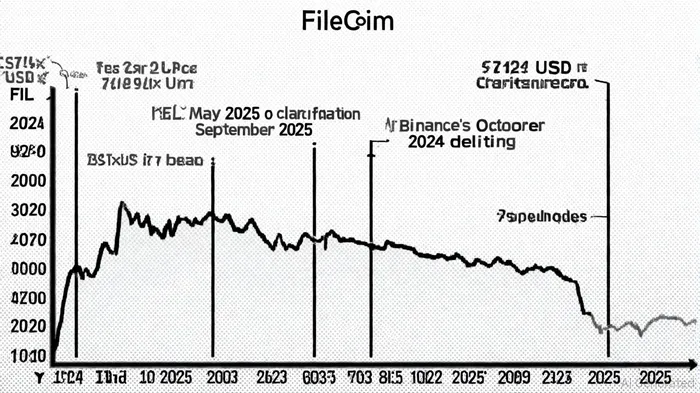
The U.S. Securities and Exchange Commission (SEC) has long grappled with how to classify Filecoin's native token, FILFIL--. In 2025, the agency reaffirmed its position that FIL qualifies as an investment contract under the Howey test, rejecting Grayscale's application for a FilecoinFIL-- Trust product[1]. This classification hinges on the argument that FIL's value is tied to speculative returns rather than its utility in decentralized storage[2]. However, the SEC's May 2025 statement on protocol staking activities—declaring self-staking and custodial staking non-securities—introduced a nuanced shift[3]. By emphasizing that FIL's primary function is to enable data storage and retrieval, the SEC's own analysis created a regulatory gray area, with Commissioner Caroline Crenshaw criticizing the inconsistency[3].
This legal ambiguity has real-world consequences. For instance, the SEC's August 2025 renewed focus on crypto storage tokens triggered a 4% price drop for FIL, underscoring how regulatory rhetoric can destabilize markets[4]. Yet the agency's broader enforcement strategy appears to be recalibrating. The dismissal of cases against Kraken, CoinbaseCOIN--, and Binance suggests a pivot toward clearer guidance rather than aggressive litigation[1]. For Filecoin, this could mean opportunities to reframe its business model, though companies must remain cautious about future enforcement priorities[1].
Exchange Delistings and Liquidity Risks
Operational risks on crypto exchanges further complicate FIL's market dynamics. Binance's October 2024 delisting of FIL/BNB pairs—citing insufficient liquidity and stability—resulted in a 6.66% price dip within 24 hours[5]. While trading volume surged by 34.74% to $192 million post-delisting, the event exposed FIL's reliance on major exchanges for liquidity[5]. OKX's similar delisting actions in 2025 highlight a broader trend of exchanges tightening compliance standards amid regulatory uncertainty[5].
These delistings are not merely technical adjustments but signals of deeper market risks. Exchanges face mounting pressure to comply with evolving securities laws, particularly if FIL remains classified as a security. This could force platforms to delist FIL entirely or implement stricter KYC/AML protocols, further fragmenting liquidity and deterring retail investors[6].
Balancing Innovation and Compliance
Despite these challenges, Filecoin's technological advancements offer a counterweight to regulatory headwinds. The implementation of FIP-81 (increased collateral requirements) and FIP-100 (protocol revenue burns) has bolstered network security and token scarcity[7]. Meanwhile, enterprise adoption of Filecoin's Proof of Data Possession (PoDP) and cross-chain bridges has expanded its utility beyond speculative trading[7]. These innovations, coupled with the development of a FIL-backed stablecoin and Layer 2 solutions, suggest a maturing ecosystem less reliant on short-term market sentiment[7].
However, long-term viability depends on resolving the regulatory question. The Digital Chamber's white paper, co-authored with Willkie Farr & Gallagher LLP, argues persuasively that FIL's functional role as a storage utility token disqualifies it as an investment contract[2]. If the SEC adopts a more coherent framework—perhaps aligning with the agency's May 2025 staking guidance—Filecoin could avoid the compliance burdens that stifle innovation[3].
Conclusion: A Calculated Bet on Resilience
Investing in Filecoin remains a high-risk, high-reward proposition. Regulatory uncertainty and exchange volatility pose significant threats, yet the project's technological progress and growing enterprise adoption provide a foundation for long-term resilience. For investors, the key is to monitor two variables: (1) the SEC's enforcement trajectory and (2) FIL's ability to demonstrate its utility beyond speculative investment. While the road ahead is fraught with legal and market challenges, Filecoin's unique position in the decentralized storage sector could yet justify its place in a diversified crypto portfolio.






Comentarios
Aún no hay comentarios