
Figma vs. UiPath: Assessing the Growth Trajectory and Market Capture Potential
The investment case for both FigmaFIG-- and UiPathPATH-- rests on a simple, powerful equation: a vast total addressable market (TAM) combined with a significant gap between current penetration and ultimate potential. For Figma, that gap is enormous; for UiPath, it is narrowing as the company pivots to capture a faster-growing segment of the automation market.
Figma's TAM is estimated between $26 billion and $33 billion, a figure that represents the total addressable market for product design and development. The company currently captures only about 4% of that potential, according to Morgan Stanley. This leaves a massive runway for growth. The company's aggressive product expansion is the engine for closing that gap. Its recent launches, including Figma Make, Sites, Buzz, and Draw, are explicitly designed to move beyond its core design user base. The strategy is working: approximately two-thirds of its monthly active users in Q4 2024 identified beyond traditional design roles, with around 30% self-identifying as developers. This shift is turning Figma from a design tool into a design-to-product platform, directly targeting the broader market of product managers, marketers, and engineers involved in digital creation.
UiPath operates in a different but equally expansive market. The global RPA market is projected to grow from USD 35.27 billion in 2026 to nearly USD 247.34 billion by 2035, expanding at a strong compound annual growth rate of 24.2%. UiPath, with a commanding 35.8% market share, is a leader in this space. However, the company is not content to simply ride this wave. It is executing a strategic pivot to agentic automation, a segment expected to expand at a 48.6% CAGR. This move targets the most complex, decision-driven workflows where traditional RPA has plateaued. To address the fragmentation of enterprise automation, UiPath is upgrading its platform with agentic capabilities like Maestro orchestration and Agent Builder. This evolution aims to provide a unified, governed system for AI agents to collaborate end-to-end, positioning UiPath to capture a larger share of the enterprise AI spend as the market consolidates.
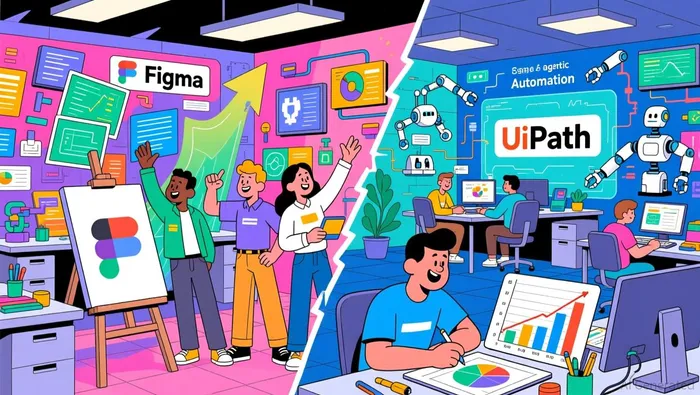
The bottom line is a contrast in market dynamics. Figma has a huge, untapped TAM and is aggressively expanding its product suite to capture it. UiPath is a market leader in a growing field but is proactively evolving its platform to address the next wave of automation demand. Both companies are leveraging AI not just to improve existing products, but to redefine their markets and capture a larger slice of the future.
Financial Performance and Scalability: Growth Rates vs. Profitability
The financial profiles of Figma and UiPath reveal two distinct paths to scalability. Figma is scaling a high-margin, asset-light model at a rapid but decelerating pace, while UiPath is transitioning to a more efficient, profitable operation after a period of slower growth.
Figma's model is built on extreme scalability. The company's gross margin of ~85% indicates a classic software business where incremental revenue comes with minimal additional cost. This efficiency powered a 48% revenue growth in 2024 to $749 million. However, this growth is being funded by massive investment, widening its net loss to $732 million last year. The company is spending heavily on cloud infrastructure, sales, and marketing to drive adoption of new AI tools and expand its user base. This strategy is reflected in analyst forecasts, which project a 27% CAGR to $1.53 billion by 2027, with the net loss narrowing but still significant. The scalability is there, but the path to profitability requires sustained, high-velocity growth to offset these upfront costs.
UiPath's journey is one of stabilization and efficiency. After a period of deceleration, the company has achieved a critical inflection point. For its third quarter of fiscal 2026, UiPath reported its first GAAP operating income of $13 million, marking its first profitable quarter as a public company. This shift signals a move from pure growth investment to operational discipline. The company's gross margin of ~83-85% is comparable to Figma's, showing a similar asset-light model. Its revenue growth has slowed to a 9% increase in its last fiscal year, but analysts expect a steady 10% CAGR to $1.88 billion by 2028. The focus is now on converting this growth into consistent profits, with the company actively cutting costs and streamlining operations.
The bottom line is a maturity trade-off. Figma's scalability is evident in its margins and growth, but its financial model remains unprofitable, making its sustainability dependent on maintaining a high growth rate. UiPath's scalability is now being proven by its profitability, but its growth rate is lower, suggesting it is capturing a larger share of a more mature market. For investors, the choice is between a high-risk, high-reward growth story or a lower-risk, steady-profit business.
Competitive Landscape and Execution Risks
The competitive threats facing Figma and UiPath are not abstract; they are immediate and come from the giants that dominate the enterprise software ecosystem. For Figma, the most potent threat is from Adobe, its former acquirer, and Microsoft's Copilot. Adobe, which nearly bought Figma for $20 billion in 2022, has a deep understanding of design workflows and a massive installed base. More critically, Microsoft is embedding similar AI-powered design and prototyping tools directly into its Copilot suite. This integration creates a formidable cost and convenience advantage for enterprises already paying for Microsoft 365, potentially eroding Figma's collaborative moat.
UiPath faces an even more direct competitive squeeze from Microsoft's Power Automate. Power Automate Desktop is included with Windows, and its cloud flows are bundled with Microsoft 365 licenses. This bundling gives it a significant cost and integration advantage for simpler workflows, making the question "Why pay a separate vendor?" increasingly common in boardrooms. As one analysis notes, Microsoft's pitch is irresistible: "You already own Power Automate... Integration with Outlook, Excel, SharePoint, Teams, Dynamics? Native." This forces UiPath into a defensive position, where it must justify its cost for more complex automations while competing on a price and integration front it cannot match.
Beyond these external threats, each company grapples with internal execution risks. For Figma, the risk is self-inflicted: its aggressive expansion into new product areas like Figma Draw and its AI tools could cannibalize its core subscription revenue. The company is already introducing consumption-based fees to attract cost-conscious customers, a move that may dilute its brand focus and further pressure margins as it ramps up cloud infrastructure and sales spend. Its growth deceleration, from 48% in 2024 to a projected 27% CAGR through 2027, suggests this expansion is not yet yielding the expected returns.
UiPath's execution challenge is more about paradigm shift than cannibalization. The company is transitioning from traditional RPA to agentic automation, a more complex and intelligent model. This requires convincing enterprises to adopt a new way of thinking about automation and manage a more sophisticated platform. While UiPath's platform offers superior orchestration and governance for complex workflows, the transition to this new paradigm carries adoption risk. Enterprises may be slow to move from the simpler, cheaper Power Automate for basic tasks to a more complex, higher-value solution for advanced automation, especially if they are already under cost pressure.
The bottom line is a battle on two fronts. Figma must defend its collaborative fortress against integrated giants, while navigating the risks of its own expansion. UiPath must leverage its strengths in complexity and governance to win the high-value automation wars, all while managing the adoption hurdles of a new technological paradigm. Their paths forward are defined by how they execute against these intense competitive and internal pressures.
Catalysts, Valuation, and Investment Implications
The investment case for Figma and UiPath now hinges on whether their near-term catalysts can justify their current valuations, which reflect starkly different growth and risk profiles. For Figma, the catalyst is the market reception of its new AI products and its ability to convert its massive user base into paying customers. For UiPath, it is the successful adoption of its agentic automation platform, which could re-accelerate growth.
Figma's primary catalyst is the commercial traction of its AI suite, particularly Figma Make and Figma Weave. The company announced these tools at its Config 2025 conference, aiming to turn Figma into a design-to-product platform. The early signs are promising, with approximately 30% of its largest customers creating on Figma Make weekly in Q3. The vision is to monetize this AI-native workflow, moving value up the software stack. The company's massive monthly active user base-where two-thirds identify beyond traditional design roles-provides a vast pool for conversion. However, the risk is that this expansion into AI and new product categories could cannibalize core subscriptions or dilute focus, especially as growth decelerates.
UiPath's catalyst is the adoption of its agentic automation platform, centered on its UiPath Platform™ for Agentic Automation & Orchestration. The company is upgrading its software robots with AI tools to analyze data and is positioned to lead in a market where 90% of RPA vendors will offer generative-AI-assisted automation by 2025. Its recent collaborations with Microsoft, OpenAI, and NVIDIA are designed to integrate its platform into enterprise AI workflows, providing governance and orchestration. The success of its Agent Builder and ScreenPlay tools will determine if it can move beyond core RPA into higher-value, complex automation, potentially re-accelerating its growth from the 11% ARR increase seen in Q3.
Valuations reflect these divergent paths. Figma trades at a premium, with analysts citing a significant premium to its Fair Value and a price target implying a multiple around 13x sales. This reflects high growth expectations and its position as the industry standard. UiPath, by contrast, trades at a discount, with its stock price well below its 2021 IPO level. This discount is a direct reflection of its growth deceleration to single digits in fiscal 2025 and the market's focus on its recent, hard-won profitability. While it has achieved GAAP profitability, the valuation does not yet reward future growth acceleration.
The investment implications are clear. Figma is a high-risk, high-reward bet on platform dominance and market expansion. Its success depends on the AI features gaining broad adoption and converting its user base, all while navigating a structural slowdown in growth. UiPath is a lower-risk bet on a profitable niche leader navigating a technological transition. Its investment case is built on defending its 35.8% RPA market share while successfully pivoting to agentic automation, a transition that could unlock new enterprise budgets. For investors, the choice is between betting on a decelerating growth story with a massive TAM expansion thesis or a profitable company with a clear, albeit challenging, path to re-acceleration.







Comentarios
Aún no hay comentarios