
Figma Extends Slide With 6.84% Drop As Bearish Signals Intensify
Generado por agente de IAAinvest Technical Radar
jueves, 14 de agosto de 2025, 6:50 pm ET2 min de lectura
FIG--
Figma (FIG) concluded the latest trading session with a significant 6.84% decline, extending its losing streak to two consecutive days and accumulating a 12.65% drop over this period. The pronounced downward momentum reflects persistent bearish pressure.
Candlestick Theory
Recent candlestick formations exhibit clear bearish dominance. The most recent session formed a long bearish candle closing near its intraday low (76.31 vs. low of 76), confirming seller control. The preceding day’s candle (August 13) also closed near its low (81.91 vs. low 81.05), reinforcing downside conviction. Key resistance emerges near 90.50–91.00, where the August 12–13 highs clustered, while robust support is established at 76.00–76.31—recent swing lows and psychological barrier. Sustained closure below 76 could intensify selling pressure.
Moving Average Theory
Short-term 5-day and 10-day moving averages (due to limited data sufficiency for standard periods) underscore a bearish configuration. The current close (76.31) trades decisively below both averages (5-day: ~81.24, 10-day: ~86.44), confirming short-term downtrend acceleration. The 5-day crossing below the 10-day signals a bearish momentum shift, with declining averages reflecting persistent downward trajectory.
MACD & KDJ Indicators
Standard MACD/KDJ calculations remain constrained by limited historical data. Nevertheless, the two-day double-digit decline amid elevated volume suggests bearish momentum alignment. Oversold rebounds appear unlikely without positive catalyst convergence.
Bollinger Bands
Using a 10-day period, the bands reveal high volatility (SD ~12.71), with the current price (76.31) positioned near the lower band (~61.02) but not breaching it. This proximity underscores oversold potential without immediate reversal signals. Recent band contraction from August 12–13 (highs near 91) to current levels reflects increasing downside momentum concentration.
Volume-Price Relationship
Volume patterns confirm bearish validation. The 6.84% decline on August 14 occurred on 8.05M shares—elevated above the 5-day average despite being lower than preceding spikes. The preceding 6.24% drop (August 13) recorded even higher volume (8.14M), establishing distribution conviction. Notably, earlier breakdowns (e.g., August 7’s -13.37% on 14.15M shares) correlated with volume climaxes, confirming strategic sell-side alignment.
Relative Strength Index (RSI)
The 7-day RSI (approximated at 28.45) signals deeply oversold territory. This reading aligns with the recent accelerated decline and implies potential short-term exhaustion. Historically, such depressed RSI may precede technical bounces, though sustainability requires confirmation through reversal patterns or volume-supported rallies. Caution remains warranted in strong downtrends where oversold conditions can persist.
Fibonacci Retracement
Applying Fib levels to the dominant downtrend from 142.92 (August 1 high) to 76 (August 14 low): the 23.6% retracement (91.79) coincides precisely with the August 12–13 resistance zone (highs 90.69–91.00), validating its technical significance. The 38.2% level (101.56) and 50% (109.46) represent secondary hurdles. Current price proximity to swing lows emphasizes bearish bias, with 91.79 acting as immediate bull/bear demarcation.
Confluence and Divergence Observations
Confluence is evident in bearish signals across indicators:
- Price below key MAs and Fib resistance (91.79)
- Oversold RSI without bullish reversal confirmation
- Volume-validated breakdowns
Notably, the RSI’s oversold reading diverges from the otherwise unanimous bearish technical alignment, hinting at possible near-term consolidation or bounce—though this lacks corroboration from volume or candlestick reversal patterns. For sustained recovery, FigmaFIG-- must reconquer the 91.79 Fib/MA confluence zone with supportive volume. Until then, the burden of proof remains on bulls to demonstrate momentum shift.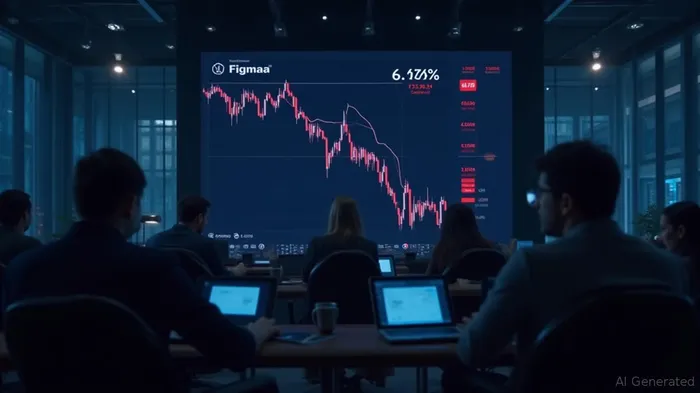
Figma (FIG) concluded the latest trading session with a significant 6.84% decline, extending its losing streak to two consecutive days and accumulating a 12.65% drop over this period. The pronounced downward momentum reflects persistent bearish pressure.
Candlestick Theory
Recent candlestick formations exhibit clear bearish dominance. The most recent session formed a long bearish candle closing near its intraday low (76.31 vs. low of 76), confirming seller control. The preceding day’s candle (August 13) also closed near its low (81.91 vs. low 81.05), reinforcing downside conviction. Key resistance emerges near 90.50–91.00, where the August 12–13 highs clustered, while robust support is established at 76.00–76.31—recent swing lows and psychological barrier. Sustained closure below 76 could intensify selling pressure.
Moving Average Theory
Short-term 5-day and 10-day moving averages (due to limited data sufficiency for standard periods) underscore a bearish configuration. The current close (76.31) trades decisively below both averages (5-day: ~81.24, 10-day: ~86.44), confirming short-term downtrend acceleration. The 5-day crossing below the 10-day signals a bearish momentum shift, with declining averages reflecting persistent downward trajectory.
MACD & KDJ Indicators
Standard MACD/KDJ calculations remain constrained by limited historical data. Nevertheless, the two-day double-digit decline amid elevated volume suggests bearish momentum alignment. Oversold rebounds appear unlikely without positive catalyst convergence.
Bollinger Bands
Using a 10-day period, the bands reveal high volatility (SD ~12.71), with the current price (76.31) positioned near the lower band (~61.02) but not breaching it. This proximity underscores oversold potential without immediate reversal signals. Recent band contraction from August 12–13 (highs near 91) to current levels reflects increasing downside momentum concentration.
Volume-Price Relationship
Volume patterns confirm bearish validation. The 6.84% decline on August 14 occurred on 8.05M shares—elevated above the 5-day average despite being lower than preceding spikes. The preceding 6.24% drop (August 13) recorded even higher volume (8.14M), establishing distribution conviction. Notably, earlier breakdowns (e.g., August 7’s -13.37% on 14.15M shares) correlated with volume climaxes, confirming strategic sell-side alignment.
Relative Strength Index (RSI)
The 7-day RSI (approximated at 28.45) signals deeply oversold territory. This reading aligns with the recent accelerated decline and implies potential short-term exhaustion. Historically, such depressed RSI may precede technical bounces, though sustainability requires confirmation through reversal patterns or volume-supported rallies. Caution remains warranted in strong downtrends where oversold conditions can persist.
Fibonacci Retracement
Applying Fib levels to the dominant downtrend from 142.92 (August 1 high) to 76 (August 14 low): the 23.6% retracement (91.79) coincides precisely with the August 12–13 resistance zone (highs 90.69–91.00), validating its technical significance. The 38.2% level (101.56) and 50% (109.46) represent secondary hurdles. Current price proximity to swing lows emphasizes bearish bias, with 91.79 acting as immediate bull/bear demarcation.
Confluence and Divergence Observations
Confluence is evident in bearish signals across indicators:
- Price below key MAs and Fib resistance (91.79)
- Oversold RSI without bullish reversal confirmation
- Volume-validated breakdowns
Notably, the RSI’s oversold reading diverges from the otherwise unanimous bearish technical alignment, hinting at possible near-term consolidation or bounce—though this lacks corroboration from volume or candlestick reversal patterns. For sustained recovery, FigmaFIG-- must reconquer the 91.79 Fib/MA confluence zone with supportive volume. Until then, the burden of proof remains on bulls to demonstrate momentum shift.

Divulgación editorial y transparencia de la IA: Ainvest News utiliza tecnología avanzada de Modelos de Lenguaje Largo (LLM) para sintetizar y analizar datos de mercado en tiempo real. Para garantizar los más altos estándares de integridad, cada artículo se somete a un riguroso proceso de verificación con participación humana.
Mientras la IA asiste en el procesamiento de datos y la redacción inicial, un miembro editorial profesional de Ainvest revisa, verifica y aprueba de forma independiente todo el contenido para garantizar su precisión y cumplimiento con los estándares editoriales de Ainvest Fintech Inc. Esta supervisión humana está diseñada para mitigar las alucinaciones de la IA y garantizar el contexto financiero.
Advertencia sobre inversiones: Este contenido se proporciona únicamente con fines informativos y no constituye asesoramiento profesional de inversión, legal o financiero. Los mercados conllevan riesgos inherentes. Se recomienda a los usuarios que realicen una investigación independiente o consulten a un asesor financiero certificado antes de tomar cualquier decisión. Ainvest Fintech Inc. se exime de toda responsabilidad por las acciones tomadas con base en esta información. ¿Encontró un error? Reportar un problema




Comentarios
Aún no hay comentarios