
Fidelity High Dividend ETF (FDVV): A Balanced Approach to Income Generation for Retirees and Income-Focused Investors
For retirees and investors prioritizing steady cash flow, the Fidelity High Dividend ETF (FDVV) has emerged as a compelling option in 2025. Unlike many high-dividend ETFs that prioritize yield at the expense of quality, FDVV's unique methodology combines income generation with rigorous financial screening, creating a portfolio that balances risk and reward. This article explores how FDVV's strategy positions it as a long-term solution for income-focused investors.
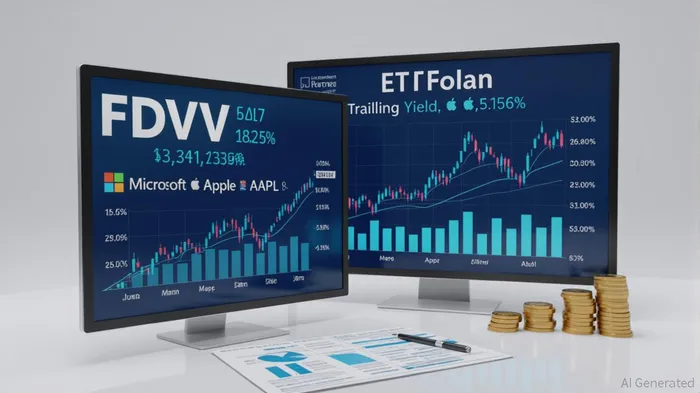
The FDVV Advantage: Yield Meets Quality
FDVV tracks the Fidelity Core Dividend Index, which selects large- and mid-cap U.S. companies with a track record of consistent and growing dividends. The fund's screening process goes beyond yield, evaluating key metrics such as payout ratios, year-over-year dividend growth, and sector-relative performance. This approach filters out "value traps"—companies that offer high yields but lack the financial strength to sustain them. For example, FDVV avoids firms with payout ratios exceeding 80%, ensuring that dividends are backed by sustainable earnings.
The hybrid weighting system further enhances FDVV's appeal. While the fund initially weights stocks by market capitalization, it applies an equal-weighting adjustment to boost smaller, high-quality dividend payers. This reduces overconcentration in a few large names (e.g., MicrosoftMSFT-- or Apple) while maintaining exposure to companies with resilient business models. The result is a diversified portfolio of 123 holdings, with the top 10 accounting for just 32.9% of assets.
Performance and Risk Management
FDVV's strategy has delivered strong results in 2025. Over the past year, the ETF returned 14.9%, outperforming the Large Value category average of 10.02%. Its trailing dividend yield of 3.16% is 50% higher than the category average, reflecting its focus on income generation. Notably, FDVV's volatility remains moderate, with a beta of 0.90 and a 20-day volatility of 7.04%. This combination of yield and stability is rare in the high-dividend space, where many funds prioritize aggressive yield-seeking at the cost of increased risk.
Why Retirees and Income Investors Should Care
- Consistent Cash Flow: FDVV's emphasis on companies with a history of dividend growth ensures a reliable income stream. For retirees, this consistency is critical, as it reduces the risk of sudden cuts or eliminations.
- Downside Protection: The fund's exclusion of weak fundamentals and its hybrid weighting system help mitigate losses during market downturns. For example, FDVV outperformed many peers during the 2020 market selloff, preserving capital while maintaining dividend payouts.
- Cost Efficiency: With an expense ratio of 0.16%, FDVV is among the most affordable high-dividend ETFs. This low cost is particularly valuable for long-term investors, as it amplifies net returns over time.
- Diversification: While FDVV is U.S.-centric (94.9% domestic exposure), it includes up to 10% international stocks, broadening its income sources and reducing geographic risk.
Comparative Edge in a Competitive Landscape
FDVV stands out against alternatives like the SPDR Portfolio S&P 500 High Dividend ETF (SPYD) and the iShares Core Dividend Growth ETF (DGRO). While these funds also target high yields, FDVV's sector-relative screening and hybrid weighting create a more balanced risk profile. For instance, FDVV's exposure to technology (25% of assets) and consumer defensive stocks (18%) provides growth and stability, whereas SPYD is heavily tilted toward utilities and real estate.
Investment Advice for 2025
For retirees and income-focused investors, FDVV offers a compelling long-term strategy. Here's how to incorporate it into a portfolio:
- Core Allocation: Use FDVV as a core holding for regular income, allocating 10–20% of equity assets to the ETF.
- Diversification: Pair FDVV with growth-oriented ETFs or bonds to balance income with capital appreciation.
- Tax Efficiency: Take advantage of FDVV's low turnover (14% vs. 44% for the category average) to minimize tax drag, especially in taxable accounts.
Conclusion
In a market where many high-dividend ETFs prioritize yield over quality, FDVV's disciplined approach sets it apart. By combining rigorous financial screening with a hybrid weighting system, the fund delivers sustainable income, moderate volatility, and strong performance. For retirees and investors seeking a reliable income source, FDVV represents a strategic allocation that aligns with long-term financial goals. As the ETF continues to refine its methodology, it is poised to remain a top-tier option in the high-dividend space.







Comentarios
Aún no hay comentarios