
FG Nexus's Aggressive Share Buyback and Its Implications for Investor Value
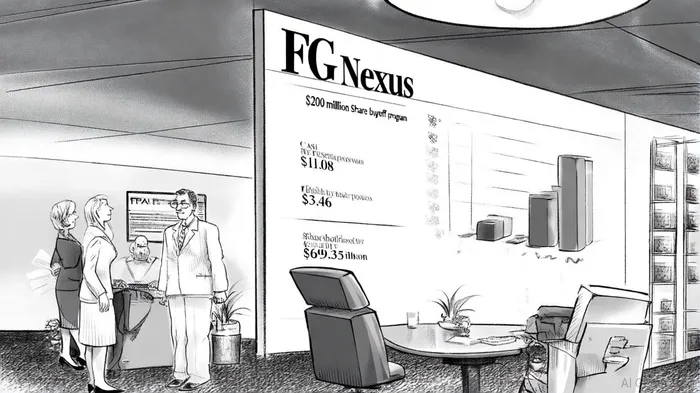
FG Nexus Inc. (FGNX) has made headlines with its $200 million share repurchase program, a move that underscores its commitment to strategic capital allocation and shareholder value creation. Announced in September 2025 and expanded in October, the program aims to repurchase shares at a discount to the company's estimated net asset value (NAV) of $5.10 per share, according to a GlobeNewswire release. This initiative, approved by the Board of Directors, reflects confidence in FG Nexus's long-term prospects and its EthereumETH-- (ETH)-centric strategy, as stated in the company announcement. However, the scale of the buyback-seven times the company's market cap-raises critical questions about funding mechanisms, financial prudence, and the potential impact on investor returns.
Funding the Buyback: Surplus Capital and Future Financing
FG Nexus's Q3 2025 financials reveal a mixed picture. The company holds $11.08 million in cash and a net cash position of $7.62 million, with a debt-to-equity ratio of 3.2%, per the Simply Wall St profile. While these metrics suggest a strong liquidity position, they fall far short of the $200 million required for the buyback. According to a Panabee article that cites Stock Titan, the company plans to fund the program using surplus capital and proceeds from a recently filed shelf registration on Form S-3 ASR. This approach aligns with the company's stated avoidance of dilutive financing tools like its At-the-Market (ATM) facility, which could reduce ETHETH-- per share value, as noted in a Business Insider summary.
The reliance on future financing, however, introduces risk. If market conditions deteriorate or the S-3 ASR underperforms, FG NexusFGNX-- may face pressure to scale back repurchases or issue additional shares-a scenario that could negate the buyback's intended value-accrual benefits.
Strategic Rationale: Ethereum Accumulation and NAV Alignment
FG Nexus's decision to prioritize share repurchases is deeply tied to its broader strategy of becoming the largest corporate holder of ETH globally. The company currently holds over 47,000 ETH, which it plans to stake and restake to generate yield, according to a GlobeNewswire release. By repurchasing shares below NAV, FG Nexus aims to enhance equity value while maintaining flexibility to acquire more ETH. CEO Kyle Cerminara emphasized, as reported by Stock Titan, that the buyback "reflects our confidence in the long-term value of Ethereum and our commitment to delivering returns to shareholders."
This dual focus on ETH accumulation and share repurchases creates a flywheel effect: reducing share count increases NAV per share, while staking ETH generates recurring revenue to fund further buybacks. However, the success of this strategy hinges on Ethereum's price performance and the company's ability to execute repurchases efficiently.
Implications for Shareholders: Value Accretion vs. Dilution Risks
For shareholders, the buyback program offers two primary benefits. First, repurchasing undervalued shares (trading below $5.10) directly increases equity value per share. Second, the program offsets dilution from prior share issuances, which had expanded the company's authorized shares to 1 trillion-a move designed to facilitate future ETH acquisitions, as detailed in a Quiver Quant post.
Yet, the aggressive scale of the buyback also exposes vulnerabilities. If FG Nexus must raise capital through equity offerings to fund the program, it risks diluting existing shareholders. Additionally, the company's reliance on Rule 10b-18 guidelines for repurchase timing-such as limiting purchases to 25% of daily trading volume when shares trade below $5.00-could slow execution during periods of high demand, as noted in the company announcement.
Conclusion: A High-Stakes Bet on Ethereum and Capital Efficiency
FG Nexus's $200 million share repurchase program is a bold bet on its Ethereum-driven future. While the company's strong balance sheet and low debt levels provide a foundation for strategic flexibility, the reliance on future financing and market conditions introduces uncertainty. For investors, the key question is whether the potential NAV accretion from buybacks and ETH staking will outweigh the risks of dilution or execution delays.
As the company navigates this ambitious strategy, close attention to its capital structure, Ethereum price trends, and repurchase progress will be critical. If executed effectively, the buyback could cement FG Nexus's position as a leader in Ethereum-powered finance. If not, it may serve as a cautionary tale about the perils of overreaching in pursuit of shareholder value.





Comentarios
Aún no hay comentarios