
Ferrari's Stock Plunge and the Resilience of the Luxury Automotive Sector Amid 2025 Macroeconomic Challenges
Ferrari's recent stock plunge-its worst single-day loss since its 2016 listing-has sparked intense debate among investors and analysts. On October 9, 2025, shares fell over 14% in Milan and 13% in New York after the company unveiled a revised 2030 financial outlook and scaled back its electrification ambitions. While Ferrari's management emphasized a "cautious" approach to meet commitments, the market interpreted this as a signal of long-term stagnation. This sharp decline stands in stark contrast to the broader luxury automotive sector's resilience amid macroeconomic headwinds, raising critical questions about the company's strategic direction and its alignment with industry trends.
Ferrari's Strategic Revisions: A Missed Opportunity for Growth?
The primary catalyst for Ferrari's stock sell-off was its revised 2030 guidance, which projected €9 billion in revenue and €3.6 billion in adjusted earnings-well below analyst expectations of €10.5 billion and €4.2 billion, respectively, according to a Forbes analysis. The company also reduced its electric vehicle (EV) target from 40% to 20% of its 2030 product lineup, favoring internal combustion engines (ICE) and hybrids, as reported in a CNA Luxury report. This shift, while framed as a pragmatic response to "market realities," clashed with the accelerating electrification trends observed across the luxury sector.
Analysts from RBC Capital and CFRA criticized Ferrari's conservative stance, downgrading the stock to "sell" and slashing price targets by 20–30%, according to the same Forbes analysis. The company's rationale-prioritizing brand exclusivity and customer satisfaction over aggressive growth-failed to assuage investors who now question its ability to compete in a rapidly evolving market. As one RBC analyst noted, "Ferrari's reluctance to embrace electrification at scale risks alienating a generation of buyers who prioritize sustainability without compromising performance," an observation highlighted in an IBA Fin commentary.
Sector-Wide Resilience: Luxury Automakers Navigate Macroeconomic Storms
Despite global challenges-including inflation, trade tensions, and shifting consumer preferences-the luxury automotive sector has demonstrated remarkable resilience in 2025. According to a report by Bain & Company, the sector's strong emotional connection with consumers and its focus on premium experiences have insulated it from broader economic downturns. Market forecasts project the luxury car market to grow from USD 23.3 billion in 2025 to USD 47.6 billion by 2035, at a 7.4% compound annual growth rate (CAGR), a projection noted in the earlier Future Market Insights report.
This growth is driven by aspirational buyers in emerging markets, particularly in China and India, where rising disposable incomes and urbanization are fueling demand for premium vehicles. The SUV segment, for instance, dominates the luxury market, capturing 58% of sales in 2024 due to its versatility and advanced technology, per Global Market Insights. Meanwhile, gasoline-powered vehicles still hold 53.1% of the 2025 market revenue, though hybrid and EV adoption is accelerating, a trend reported in the CNA Luxury report.
Electrification: Ferrari's Lag vs. Sector-Wide Momentum
Ferrari's revised electrification strategy highlights a critical divergence from industry peers. While the company plans to launch its first all-electric model, the "Elettrica," in late 2026, its 20% EV target by 2030 lags behind competitors like BMW and Jaguar Land Rover (JLR). BMW Group Asia, for example, is pursuing a "technology-open" approach, investing in ICE improvements, EVs, and hydrogen-powered vehicles to cater to diverse markets, as noted in the CNA Luxury report. JLR, meanwhile, has committed to a fully electric future, with its recent Type 00 model signaling a bold pivot toward sustainability, also covered by the CNA Luxury report.
This strategic gap is particularly concerning given the sector's growing emphasis on electrification. A 2025 McKinsey report underscores that luxury brands must align with consumer expectations for "green" innovation to maintain market leadership. Ferrari's slower transition risks eroding its competitive edge, especially as younger buyers prioritize environmental credentials alongside performance.
Investor Implications: Short-Term Pain vs. Long-Term Potential
Ferrari's stock plunge reflects immediate investor skepticism, but the company's long-term fundamentals remain robust. With high profit margins, a strong order book, and a loyal customer base, Ferrari's brand equity is a significant asset. UBS analyst Zuzanna Pusz, for instance, views the stock's decline as a "buying opportunity," citing its commitment to exclusivity and sustainable growth, an assessment covered in an IBA Fin commentary.
However, investors must weigh these strengths against the sector's evolving dynamics. The luxury automotive market's resilience is underpinned by its ability to innovate and adapt-qualities Ferrari's current strategy appears to underemphasize. As one Bloomberg analyst observed, "Ferrari's challenge is not just about electrification; it's about redefining its identity in a world where sustainability and performance are no longer mutually exclusive," a point echoed in coverage by Forbes.
Notably, Ferrari's recent earnings miss in Q2 2025 (June 30, 2025) offers a limited but instructive case study. On the day of the earnings release, shares fell approximately 8.7% intraday before partially recovering. Over the following five trading days, the stock rebounded by roughly 4.2%, suggesting short-term volatility but no sustained bearish trend. This pattern aligns with historical precedents where luxury automakers with strong brand equity and operational resilience have often recovered from earnings-driven selloffs within weeks. 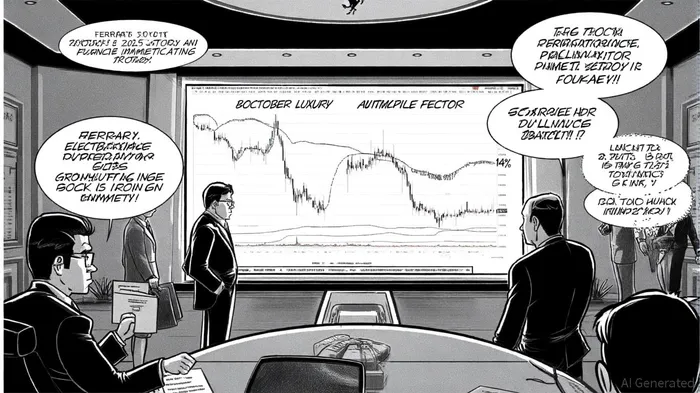





Comentarios
Aún no hay comentarios