
Ferrari's Earnings Test: Can Excess Profit Justify a Premium Valuation in a Shifting Luxury Market?
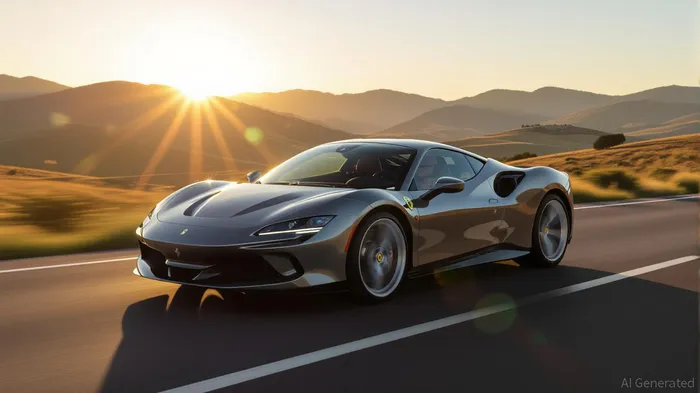
As FerrariTSLA-- N.V. (RACE) prepares to unveil its Q2 2025 earnings report on July 31, the luxury automotive world watches closely. The Italian icon, long revered for its engineering prowess and brand mystique, now faces a pivotal question: Can its exceptional profitability and relentless earnings growth justify a valuation that appears increasingly detached from industry norms? With a trailing P/E ratio of 53.64 and a PEG ratio of 2.88—nearly triple the median of its peers—the company's stock trades at a premium that demands scrutiny.
The Ferrari Formula: Profitability, Not Volume
Ferrari's financial engine has long thrived on scarcity. In Q1 2025, the company reported revenue of $1.94 billion, a 7% year-over-year increase, and EBITDA of €700 million, with industrial free cash flow exceeding €600 million. These figures underscore a business model built on exclusivity: annual production of roughly 13,000 vehicles, a covered order book through 2026, and an average selling price of €430,000. The 296 GTB and 296 GTS hybrids, priced at $350,000+, have become cash cows, with demand outpacing supply by years.
The Q2 earnings report will be critical in determining whether this momentum continues. Analysts project $2.05 billion in revenue and $2.40 in EPS, both in line with Q1's outperformance. However, the company must navigate headwinds, including U.S. import tariffs that could erode EBITDA margins by 50 basis points and macroeconomic volatility in key markets like China and the Middle East.
Valuation in Context: A Luxury Premium or Overreach?
Ferrari's valuation metrics stand in stark contrast to its peers. While the industry median P/E for luxury automakers hovers around 5.3x, Ferrari trades at 54x. Its EV/EBITDA of 30.2x is more than five times the median of 5.4x among competitors like Porsche, Mercedes-Benz, and StellantisSTLA--. This premium reflects investor faith in Ferrari's brand equity, operational efficiency, and ability to command price increases.
Yet, the math raises red flags. A PEG ratio of 2.88 implies investors are paying 2.88 times the company's 5-year EBITDA growth rate of 18.9%. By comparison, Porsche, which owns the Panamera and Macan, trades at a PEG of -0.47 (due to losses) and a P/E of 4.36. Even ToyotaTM--, a mass-market giant, has a P/E of 6.90. Ferrari's valuation appears anchored to its heritage and scarcity rather than scalable growth.
Market Dynamics: Electrification and the Threat of Tariffs
The luxury automotive market is undergoing a seismic shift. By 2025, electric luxury vehicles (ELVs) accounted for 15% of global sales, with Tesla's Model S and BMW's iX5 Hydrogen leading the charge. Ferrari, however, is playing catch-up. While the 296 GTB hybrid is a technological marvel, the company's first fully electric model is slated for Q4 2025. This delay risks alienating a segment of affluent consumers who prioritize sustainability as much as performance.
Meanwhile, U.S. tariffs on European luxury vehicles, now at 25%, threaten to further strain margins. Ferrari's U.S. market, which contributed 25% of 2024 revenue, could see demand softening as tariffs push prices beyond the $400,000 threshold. The company's response—hiking prices and shifting production to lower-cost regions—may mitigate short-term pain but cannot offset long-term structural risks.
The Investment Thesis: Risk vs. Reward
For investors, Ferrari presents a paradox. On one hand, its brand strength, cash flow generation, and order book visibility make it a fortress in uncertain times. The company's EBITDA margin of 38.3% in 2024 is enviable, and its industrial free cash flow of €600 million in Q1 suggests robust financial flexibility. On the other hand, the valuation multiples are stratospheric.
The key question is whether Ferrari's premium pricing power can sustain these multiples as the industry pivots to EVs and as global demand moderates. The upcoming Q2 report will provide clarity on two fronts:
1. Hybrid Sales Mix: Has the 296 GTB's success offset slower demand for traditional V12 models?
2. Tariff Impact: Are margins holding up, or is the company absorbing costs that could pressure future earnings?
Conclusion: A Bet on the Brand, Not the Numbers
Ferrari's valuation is a bet on its ability to remain a cultural and financial icon. For decades, the company has transcended its role as a carmaker, becoming a symbol of status and engineering excellence. Yet, in an era where EVs and shifting consumer priorities redefine luxury, the question is whether this brand equity is enough to justify a 54x P/E.
Investors who believe in Ferrari's long-term vision—electrification, expanded production, and global market penetration—may find the current valuation a compelling risk. For others, the premium feels unjustified, especially in a sector where peers like Porsche and Mercedes-Benz offer more attractive growth multiples.
As the market awaits the Q2 report, one truth remains: Ferrari's stock is not for the faint of heart. It is a high-stakes play on a brand that has mastered the art of scarcity—and now must prove it can thrive in a world where scarcity is no longer a luxury.







Comentarios
Aún no hay comentarios