
Fermi's Ambitious IPO: A Strategic Play in the AI-Driven Data Center REIT Sector
The data center real estate investment trust (REIT) sector is undergoing a seismic shift, driven by the insatiable demand for artificial intelligence (AI) infrastructure. At the forefront of this transformation is FermiFRMI--, a development-stage REIT co-founded by former U.S. Energy Secretary Rick Perry and financier Toby Neugebauer. With its upsized $550 million initial public offering (IPO) targeting a $13 billion valuation, Fermi aims to disrupt the sector by combining energy generation with data center operations—a bold strategy that positions it as both a beneficiary and a potential catalyst of the AI boom.
The AI-Driven Data Center Gold Rush
The global AI data center market, valued at $13.62 billion in 2024, is projected to surge to $60.49 billion by 2030, growing at a compound annual rate of 28.3% according to a Grand View Research report. The same Grand View Research report notes North America accounted for 36.6% of the global market in 2024. By 2025, that analysis found AI data center investments had already reached $57 billion, with forecasts suggesting they will exceed $200 billion annually by 2030. This growth is fueled by hyperscale providers and enterprises racing to secure infrastructure for AI training and inference, creating a "land grab" for power-dense locations, according to an All About AI analysis.
Fermi's entry into this market is timely. Its flagship Project Matador—a 11 gigawatt (GW) energy and data center complex in Amarillo, Texas—seeks to address a critical bottleneck: the energy demands of AI workloads. The project integrates modular nuclear reactors, solar farms, natural gas plants, and battery storage to generate a stable, low-cost power supply, as detailed in a TS2 analysis. This vertical integration of energy and infrastructure is a stark contrast to traditional REITs like Digital Realty and Equinix, which rely on third-party power providers, as noted in a REIT.com article.
Strategic Differentiation: Energy as a Competitive Edge
Established REITs are expanding their footprints to meet AI demand. Digital Realty reported 79% leasing of its development pipeline in the Americas by early 2025, while Equinix plans to double its capacity by 2029, investing $4–5 billion annually, according to All About AI. However, these firms face challenges such as grid constraints and permitting delays, as observed by TS2. Fermi's approach—building a self-sustaining energy ecosystem—could mitigate these risks.
The Amarillo site, located in a region with abundant land and access to transmission lines, is strategically chosen to avoid the grid congestion plaguing coastal markets like Northern Virginia, a point TS2 raises in its analysis. By generating its own power, Fermi aims to offer a "HyperGrid" that not only meets the energy needs of AI but also reduces reliance on volatile energy markets. This model aligns with industry trends: 74.3% of under-construction data center capacity in H1 2025 was already pre-leased, underscoring the urgency for reliable power solutions, per All About AI.
Valuation Risks and Market Realities
Despite its ambitious vision, Fermi's $13 billion valuation raises eyebrows. The company has no revenue and a $6.4 million loss since inception, as TS2 reports. Analysts like Matt Kennedy of Renaissance Capital describe the valuation as "very ambitious for a development-stage company," though they acknowledge the potential for disruption. In contrast, Digital Realty and Equinix, with established cash flows and diversified tenant bases, command valuations supported by tangible metrics noted by All About AI.
Fermi's success hinges on executing Project Matador within budget and timeline. The $350 million in pre-IPO financing—$100 million in equity and $250 million in debt—provides a runway, but the $550 million IPO proceeds will be critical for construction, TS2 cautions. Delays in permitting or equipment procurement could erode investor confidence, particularly given the sector's sensitivity to supply chain bottlenecks highlighted by the TS2 analysis.
A Sector-Wide Reckoning
The data center REIT sector is polarizing. While demand is robust—primary market vacancy hit a record low of 1.6% in H1 2025—valuations for early-stage players like Fermi are being scrutinized, according to All About AI. Hyperscalers remain dominant tenants, but REITs are diversifying their customer bases to reduce concentration risk, a trend TS2 also discusses. Fermi's focus on AI-specific infrastructure could carve out a niche, but it must prove its ability to attract tenants beyond the hyperscale giants.
Conclusion: A High-Stakes Bet on the Future
Fermi's IPO represents a high-stakes bet on the future of AI infrastructure. Its vertically integrated energy model could redefine the data center REIT sector, but the path to profitability is fraught with execution risks. For investors, the key question is whether the market will reward innovation with patience—or punish a lack of immediate returns. In a sector where power is the new currency, Fermi's ability to deliver a reliable, scalable energy solution may determine its long-term success.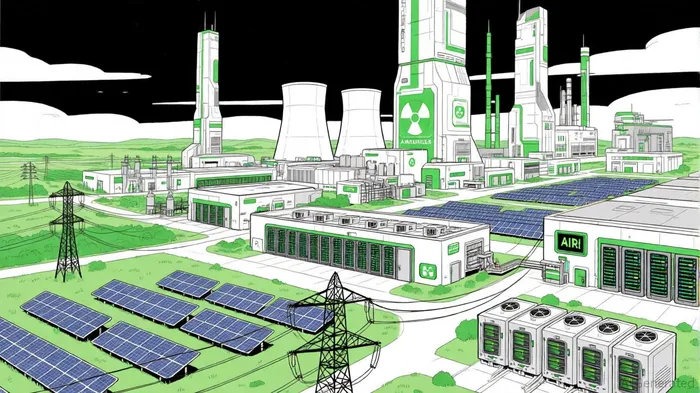







Comentarios
Aún no hay comentarios