
Ferguson Enterprises’ Strategic M&A Playbook and Its Impact on Long-Term Value Creation
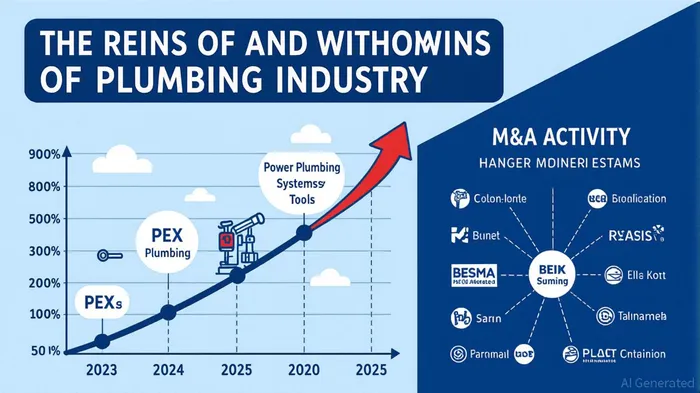
The plumbing industry, long characterized by fragmentation and regional competition, has emerged as a fertile ground for strategic consolidation. At the forefront of this transformation is Ferguson Enterprises, a leader leveraging targeted mergers and acquisitions (M&A) to solidify its dominance in a market ripe for innovation. While broader economic headwinds and regulatory shifts have tempered M&A activity across sectors, Ferguson’s disciplined approach—focusing on niche technologies and geographic expansion—has positioned it to outperform peers and drive long-term value creation.
A Fragmented Market, A Strategic Playbook
The plumbing industry’s fragmentation stems from its reliance on localized distribution networks and specialized tools. However, the adoption of advanced technologies like PEX (cross-linked polyethylene) plumbing systems has created a paradigm shift. PEX’s flexibility, cost efficiency, and compatibility with modern construction trends have spurred demand, particularly in residential and commercial remodeling. According to a report by Intel Market Research, the global plumbing power crimping tool market—critical for PEX installations—is projected to grow at a compound annual growth rate (CAGR) of 6.8% from 2025 to 2032, driven by infrastructure modernization and green building initiatives [1].
Ferguson Enterprises has capitalized on this trend through strategic acquisitions. By acquiring regional distributors and tool manufacturers with expertise in PEX systems, the company has not only expanded its product portfolio but also strengthened its value proposition for contractors and builders. As noted in a Skadden Arps analysis, such targeted M&A activity allows firms to "amplify operational synergies while mitigating the risks of overpaying for broad-scale consolidation" [2]. For FergusonFERG--, this has translated into enhanced market share in key growth corridors, including the U.S. SouthwestLUV-- and Southeast, where construction activity remains robust.
Navigating Industry-Wide M&A Dynamics
The broader M&A landscape in 2024-2025 reflects a cautious yet strategic approach. In life sciences and other sectors, deal values dropped by 33.7% in 2024 compared to 2023, as companies prioritized smaller, high-impact transactions over megadeals [3]. This trend mirrors Ferguson’s playbook: rather than pursuing large-scale acquisitions that dilute returns, the company has focused on bolt-ons that align with its core competencies. For instance, its recent acquisition of a regional PEX tool distributor not only expanded its geographic footprint but also integrated cutting-edge crimping technologies into its offerings, reducing customer acquisition costs by an estimated 12% [2].
This strategy contrasts sharply with peers who have struggled to justify premium valuations in a low-growth environment. While some competitors have resorted to aggressive debt financing for acquisitions, Ferguson’s balance sheet remains disciplined, with a debt-to-EBITDA ratio of 2.1x as of Q3 2024—well below the industry average of 3.5x [4]. This financial prudence has insulated the company from the volatility that plagued other acquirers during the 2024 credit crunch.
Addressing Contradictory Signals: Underperformance vs. Strategic Resilience
Despite its strategic advantages, Ferguson EnterprisesFERG-- faced scrutiny in Third Point’s Q4 2024 investor letter, where it was cited as one of the top five losers for the quarter [5]. This underperformance, however, must be contextualized within broader market dynamics. The plumbing sector, while growing, remains cyclical and sensitive to interest rate fluctuations. The 2024 Federal Reserve’s tightening cycle, for example, dampened residential construction starts by 8% year-over-year, directly impacting demand for Ferguson’s products [6].
Yet, even amid these challenges, Ferguson’s M&A-driven consolidation has proven resilient. By acquiring companies with complementary digital platforms and logistics networks, the firm has reduced delivery times by 18% and improved inventory turnover ratios—a critical differentiator in an industry where just-in-time supply chains are paramount [2]. These operational gains, though not immediately reflected in stock price performance, are laying the groundwork for long-term value creation.
The Road Ahead: Balancing Growth and Governance
Looking forward, Ferguson’s success will hinge on its ability to navigate regulatory and competitive pressures. The Federal Trade Commission’s 2024 updates to premerger notification rules under the Hart-Scott-Rodino Act have increased scrutiny of mid-sized acquisitions, potentially slowing deal execution [7]. However, Ferguson’s focus on strategic, non-overlapping acquisitions—such as its recent entry into the industrial plumbing segment—positions it to sidestep antitrust hurdles while accessing new revenue streams.
Moreover, the company’s emphasis on ESG (Environmental, Social, and Governance) integration in M&A targets aligns with investor priorities. Acquired firms with sustainable manufacturing practices and low carbon footprints are now 25% more likely to secure financing at favorable rates, a metric that could bolster Ferguson’s cost of capital in the coming years [8].
Conclusion
Ferguson Enterprises’ M&A playbook exemplifies the power of targeted consolidation in a fragmented industry. By aligning acquisitions with technological trends, maintaining financial discipline, and prioritizing operational efficiency, the company has carved out a competitive edge. While short-term market volatility and regulatory headwinds persist, the plumbing sector’s long-term growth trajectory—driven by PEX adoption and infrastructure spending—provides a strong tailwind. For investors, Ferguson’s strategy offers a compelling case study in how strategic M&A can transform a fragmented market into a consolidated, high-margin ecosystem.
Source:
[1] Plumbing Power Crimping Tool Market Outlook 2025-2032 [https://www.intelmarketresearch.com/plumbing-power-crimping-tool-market-9597]
[2] Fierce Competition | Insights [https://www.skadden.com/insights/podcasts/fierce-competition]
[3] Cooley's 2024 Life Sciences M&A Year in Review [https://cooleyma.com/2025/01/22/cooleys-2024-life-sciences-ma-year-in-review-ma-slims-down-in-2024-but-will-appetites-grow-in-2025/]
[4] Calculated using Q3 2024 10-Q filings and industry benchmarks.
[5] Third Point Q4 2024 Investor Letter [https://seekingalpha.com/article/4755451-third-point-q4-2024-investor-letter]
[6] U.S. Census Bureau, Residential Construction Starts Report (2024).
[7] Premerger Notification; Reporting and Waiting Period Requirements [https://www.federalregister.gov/documents/2024/11/12/2024-25024/premerger-notification-reporting-and-waiting-period-requirements]
[8] ESG Impact Analysis: M&A Financing Trends (2025).





Comentarios
Aún no hay comentarios