
Ferguson Enterprises' 2031 Senior Unsecured Notes: Credit Risk and Yield Attractiveness in a Rising Rate Environment
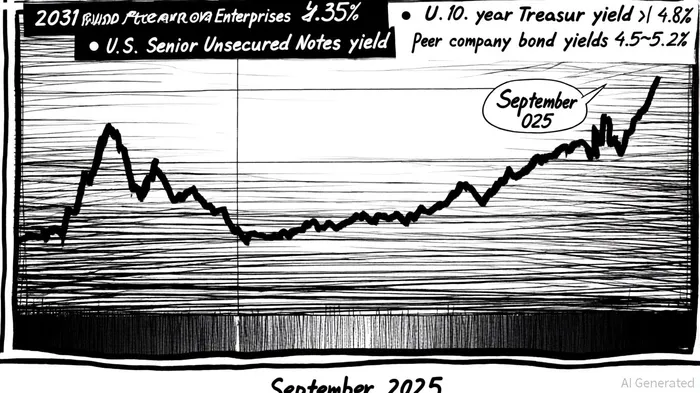
Ferguson Enterprises Inc. recently priced a $750 million issuance of 4.350% senior unsecured notes due 2031, a move that underscores its strategic approach to capital structure optimization amid a tightening monetary policy environment[1]. As interest rates climb globally, investors and analysts are scrutinizing the credit risk and yield competitiveness of such instruments. This analysis evaluates the 2031 notes through the lens of Ferguson's financial health, credit ratings, and broader market dynamics.
Credit Risk Assessment: A Stable Foundation
Ferguson's credit risk profile appears robust, supported by its strong operational performance and prudent leverage management. For fiscal year 2025, the company reported revenue of $30.8 billion, a 3.8% year-over-year increase, with net income rising 7.0% to $1.86 billion[3]. Gross margins improved to 31.0% in Q3 2025, up from 30.5% in the prior-year period[5], reflecting effective cost controls and pricing power in its core plumbing and heating distribution markets.
Moody's Investors Service upgraded Ferguson's credit rating to Baa1 (the second-highest investment-grade rating) in 2024, citing its dominant market position and “solid liquidity”[4]. While specific S&P and Fitch ratings as of 2025 are not disclosed in available sources, the company's net debt-to-adjusted EBITDA ratio of 1.2x in Q3 2025—down from 1.0x in the same period in 2024—suggests continued alignment with investment-grade criteria[5]. This metric, combined with annualized operational savings of $100 million from efficiency initiatives[5], reinforces confidence in its ability to service debt.
Yield Competitiveness: Balancing Risk and Return
The 4.35% coupon on the 2031 notes is slightly below the 5.0% yield on Ferguson's 2034 notes issued in October 2024[2], reflecting a lower rate environment at the time of the earlier issuance. However, in a rising rate context, this coupon remains competitive relative to peers and risk-free benchmarks. As of September 2025, the U.S. 10-year Treasury yield stands at approximately 4.8%[6], meaning Ferguson's notes offer a yield-to-maturity that is roughly 45 basis points lower than Treasuries—a spread that appears justified given its Baa1 credit rating and low default probability.
Moreover, the notes are fully guaranteed by FergusonFERG-- UK Holdings Limited, an indirect subsidiary[1], adding an additional layer of security for bondholders. Proceeds will be allocated to general corporate purposes, including potential debt repayment[1], which could further strengthen the company's balance sheet and reduce refinancing risks.
Strategic Implications for Investors
In a rising rate environment, the 2031 notes present a compelling case for investors seeking exposure to high-quality industrial debt. Ferguson's operational resilience—evidenced by its 6.0% FY2025 profit margin[3]—and its proactive cost management initiatives mitigate concerns about interest expense volatility. While the coupon rate may appear modest compared to high-yield alternatives, the combination of investment-grade security, stable cash flows, and a conservative leverage profile makes these notes a defensive play in a diversified fixed-income portfolio.
Critically, the absence of recent S&P and Fitch ratings updates does not detract from the investment thesis, as Moody's Baa1 rating and the company's financial metrics provide sufficient visibility into its creditworthiness. Investors should monitor any shifts in the company's debt-to-EBITDA trajectory or margin pressures from inflationary trends, though current indicators suggest these risks are well-managed.
Conclusion
Ferguson Enterprises' 2031 Senior Unsecured Notes offer a balanced proposition for income-focused investors. With a credit profile bolstered by operational excellence and a yield that aligns with its risk level, the issuance reflects the company's strategic agility in navigating a challenging interest rate landscape. For those prioritizing capital preservation alongside moderate income, these notes represent a prudent addition to a fixed-income portfolio.





Comentarios
Aún no hay comentarios