
FEMA's Restructuring: A Crossroads for Disaster Response Infrastructure Investments
The Federal Emergency Management Agency (FEMA) stands at a pivotal juncture, with its future shape and funding increasingly tied to a political tug-of-war between federal retrenchment and bipartisan reform. This seismic shift has profound implications for investors in disaster response infrastructure, from climate-resilient construction firms to private emergency management services. Below, we dissect the risks and opportunities emerging from FEMA's restructuring—and why now is a critical time to position for climate adaptation and public safety investments.
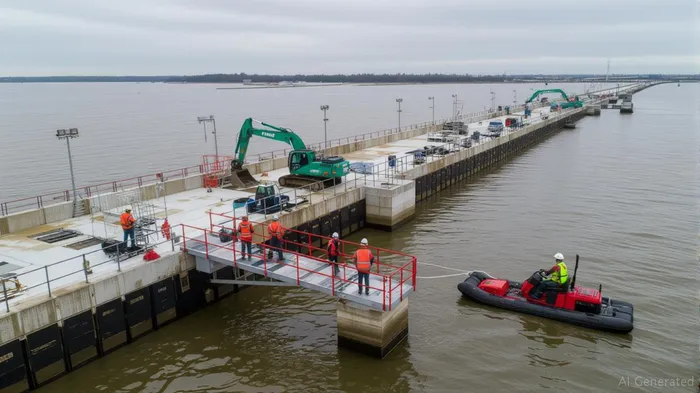
The Dual Path of FEMA's Future
The Trump administration's push to dismantle FEMA's federal role and shift disaster management to states has collided head-on with a bipartisan congressional draft bill—the Fixing Emergency Management for Americans (FEMA) Act of 2025. While the administration seeks to slash FEMA's budget, phase out its programs by December 2025, and reduce federal disaster declarations, the bill aims to strengthen FEMA by elevating it to a cabinet-level agency, streamlining recovery grants, and creating a $3.6 billion Recovery Task Force to address over 1,000 unresolved disaster cases.
This divide creates both risks and opportunities for investors.
Sector-Specific Risks: State Capacity Gaps and Federal Retreat
1. Infrastructure Resilience Firms: A Double-Edged Sword
- Risk: If FEMA is dissolved, states may face budget shortfalls in funding pre-disaster mitigation. The canceled Building Resilient Infrastructure and Communities (BRIC) program, which allocated $1.2B annually for flood barriers and climate-hardened infrastructure, now risks leaving states scrambling to fund projects. Smaller states with limited fiscal capacity could delay or abandon critical resilience upgrades, hurting firms like AECOM (ACM) or Bechtel, which specialize in such projects.
- Query:
- Opportunity: The bipartisan bill's emphasis on state incentives—such as tying FEMA grants to states' adoption of mitigation measures—creates a tailwind for firms offering turnkey solutions. Companies like HDR, which designs climate-resilient bridges and utilities, could see rising demand if states rush to qualify for federal funding.
2. Private Emergency Management Firms: A Growing Niche
- Risk: A FEMA phaseout could lead states to outsource disaster response to private firms, but this hinges on whether states can afford such contracts. Firms like Paladino & Company (consulting) or Everbridge (emergency alert systems) might face volatility as states prioritize austerity over spending.
- Opportunity: The bipartisan bill's push to streamline disaster declarations and fast-track recovery grants could boost demand for private firms' expertise in logistics and risk assessment. Look for Verisk Analytics (VRSK), which provides disaster modeling, to benefit from heightened state reliance on data-driven preparedness.
3. Insurance and Reinsurance Sectors: Mitigation as a Hedge
- Risk: Reduced federal aid could leave insurers exposed to higher claims from underprepared communities. Firms like Allianz (AZSEY) or Chubb (CB) may see higher loss ratios if states fail to invest in mitigation.
- Opportunity: The bill's requirement for states to adopt consensus-based building codes and mitigation incentives creates a long-term tailwind for insurers. Stronger infrastructure reduces claims volatility, improving underwriting margins.
Bipartisan Pushback and State Autonomy: A Catalyst for Investment Themes
While the administration's “rebalance” plan risks underfunding disaster prep, the bipartisan bill offers a more investable roadmap. Key themes to watch:
1. Pre-Disaster Mitigation as a Growth Driver
The bill's sliding scale for federal cost-sharing—85% for states that invest in mitigation vs. 65% otherwise—creates a financial incentive for states to boost resilience spending. This benefits firms in:
- Smart Infrastructure: Companies like Schneider Electric (SBGL) (smart grid tech) or Trimble (TRMB) (GIS mapping for flood zones).
- Environmental Services: Firms like AECOM or Stantec (STNCF), which design flood-control systems and green infrastructure.
2. Streamlined Disaster Response: Tech and Logistics Winners
The bill's push to eliminate bureaucratic delays opens doors for tech firms enabling faster recovery:
- Drone and AI Analytics: Veritone (VERI) or Airbus DS (disaster damage assessment via AI).
- Logistics Platforms: Convoy or Flexe, which optimize emergency supply chains.
3. Bipartisan Consensus on Transparency: A Compliance Play
The mandated centralized website tracking disaster funding and the GAO review of FEMA's rules create demand for compliance software. Firms like Workday (WDAY) or BlackLine, which digitize financial and regulatory reporting, could see state-level adoption.
Investment Strategy: Navigate the Uncertainty
The outcome of FEMA's future—whether a strengthened agency or a phased-out relic—will shape these sectors for years. Here's how to position:
1. Buy the Bipartisan Bill's Winners
- Long: Infrastructure resilience firms (ACM, HDR), private emergency management tech (VRSK, EVER), and compliance software (WDAY).
- Query:
2. Hedge Against Federal Retreat
- Short: Insurers or construction firms reliant on federal contracts if FEMA's budget is slashed.
- Long: State bond ETFs (e.g., STOXX US States Infrastructure) if states ramp up borrowing to fund mitigation.
3. Monitor Regulatory Triggers
- Catalyst: The FEMA Review Council's November 2025 report will clarify the agency's post-2026 role. Investors should watch for bipartisan amendments to the bill, such as expanded state grants or private-sector partnerships.
Conclusion: A Climate-Adapted Future Requires Public-Private Synergy
FEMA's restructuring is not just a bureaucratic reshuffle—it's a defining moment for disaster preparedness in an era of climate volatility. While federal retrenchment poses risks, the bipartisan push to empower states with incentives and streamlined funding creates a framework for growth in resilience infrastructure. Investors should prioritize firms that thrive in hybrid models: those blending public-sector contracts with private innovation. The road ahead is uncertain, but the stakes—for communities and portfolios—are too high to ignore.





Comentarios
Aún no hay comentarios