
Feist's Integration with Stripe's Tempo and Its Implications for Ether-Compatible Stablecoin Growth
The Rise of Tempo: A Payments-First L1 for Stablecoins
Stripe's Tempo, a payments-focused Layer 1 blockchain incubated with Paradigm, has emerged as a disruptive force in the stablecoin ecosystem. Launched in September 2025, Tempo is optimized for stablecoin transactions, offering sub-second finality, 24/7 settlement, and predictable fees, as described in Tempo's launch announcement. Its architecture supports over 100,000 transactions per second (TPS)-a stark contrast to Ethereum's current 20 TPS-and allows users to pay gas fees in stablecoins like USDCUSDC-- or USDTUSDT--, bypassing volatile crypto assets, as noted in a Cryptonomist article. This design aligns with Stripe's broader strategy to vertically integrate its payment infrastructure, reducing reliance on external networks while capturing value from the $250+ billion stablecoin market, according to the Stablecoin Insider report.
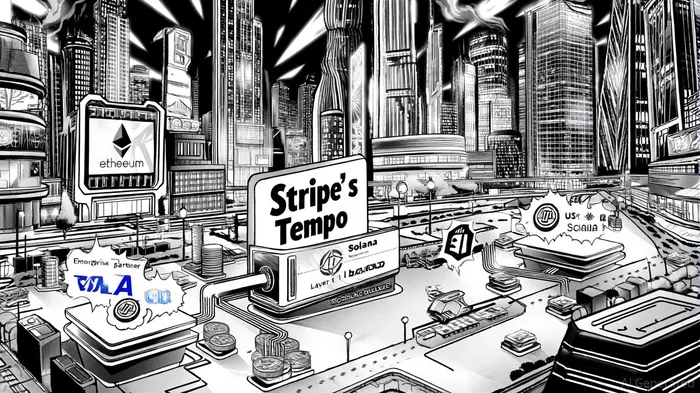
The project's credibility has been bolstered by the recruitment of Dankrad Feist, a former EthereumETH-- core developer and protocol researcher. Feist's role at Tempo includes advancing data availability and sharding research, with a stated goal of ensuring the blockchain's compatibility with Ethereum's open-source ideals, according to a Cointelegraph report. His move has sparked debate: while some Ethereum purists view it as a loss of leadership, others see it as a strategic pivot to accelerate blockchain adoption in mainstream finance, as noted in a Cryptopolitan piece.
Implications for Ethereum-Compatible Stablecoin Growth
Tempo's rise raises critical questions about its relationship with Ethereum, the dominant chain for stablecoin issuance. As of mid-2025, Ethereum hosts ~70% of the stablecoin supply, with USDT and USDC accounting for 88% of the $250+ billion market cap, according to Coinlaw statistics. Tempo's EVM compatibility and focus on stablecoin-native transactions position it to either complement or compete with Ethereum's ecosystem.
Complementarity vs. Competition
Proponents argue that Tempo could enhance Ethereum's network effects by driving more stablecoin activity onto the EVM stack. For instance, Tempo's automated market maker (AMM) for stablecoin conversions and its partnerships with OpenAI, Visa, and Deutsche Bank could attract developers and enterprises already familiar with Ethereum tools, per a Yahoo Finance report. Feist himself has emphasized that Tempo's open-source ethos aligns with Ethereum's, suggesting a potential symbiosis rather than rivalry, according to a Coinlaw report.
However, skeptics warn that Tempo's standalone L1 model-optimized for payments rather than generalized computation-could divert stablecoin flows away from Ethereum and its Layer 2 (L2) solutions. Analysts like Tushar Jain of Multicoin Capital have dubbed Tempo "the beginning of the end for L2s," noting that its stablecoin-centric approach may undercut Ethereum's role as a settlement layer for high-volume, low-margin transactions, as argued in an AMBCrypto article.
Investment Opportunities in Blockchain Payment Infrastructure
The launch of Tempo, coupled with a $500 million Series A funding round led by Thrive Capital and Greenoaks, signals a maturing market for stablecoin infrastructure. At a $5 billion valuation, Tempo is now a key player in a sector projected to grow to $2 trillion by 2028, driven by regulatory clarity (e.g., the U.S. GENIUS Act and EU's MiCA) and institutional adoption, according to a BeInCrypto analysis.
Key Sectors for Investors
1. Specialized L1s: Beyond Tempo, projects like Circle's Arc and Noble are building enterprise-grade blockchains for stablecoins. These chains prioritize compliance, interoperability, and high throughput, addressing pain points in cross-border payments and B2B settlements, as covered in a Techopedia analysis.
2. Middleware Providers: Firms like Fireblocks and Crossmint are abstracting blockchain complexity, enabling businesses to operate across multiple chains without vendor lock-in. Fireblocks, for instance, processes 15% of global stablecoin volume and supports 40+ blockchains, according to the Fireblocks report.
3. Stablecoin Issuers: USDC (Circle) and USDT (Tether) remain dominant, but emerging players like GHO (Aave) and PYUSD (Palo Alto Labs) are gaining traction in DeFi and embedded finance use cases, as noted in the Stablecoin Insider report.
Risks to Consider
- Regulatory Uncertainty: While frameworks like MiCA provide clarity in Europe, U.S. policies remain fragmented, posing risks for cross-border operations.
- Adoption Hurdles: Tempo's success hinges on real-world uptake by merchants and users. Early partnerships with Shopify and Deutsche Bank are promising, but execution risks persist, as discussed in a CoinRank analysis.
- Technological Competition: SolanaSOL-- and other high-throughput chains may counter Tempo's stablecoin focus with their own enterprise partnerships and fee models, according to a Coinotag analysis.
Conclusion: A New Era for Stablecoin Infrastructure
The integration of Feist into Stripe's Tempo marks a pivotal moment in the evolution of blockchain payment infrastructure. By combining Ethereum's technical rigor with Stripe's enterprise reach, Tempo is poised to accelerate stablecoin adoption in real-world use cases-from payroll to AI-driven payments. For investors, the key lies in balancing exposure to specialized L1s like Tempo with broader ecosystem players that benefit from Ethereum's enduring network effects. As the stablecoin market matures, the winners will be those who bridge the gap between decentralized innovation and traditional finance.






Comentarios
Aún no hay comentarios