
Zero-Fee Spot Trading and Its Impact on Retail Investor Behavior
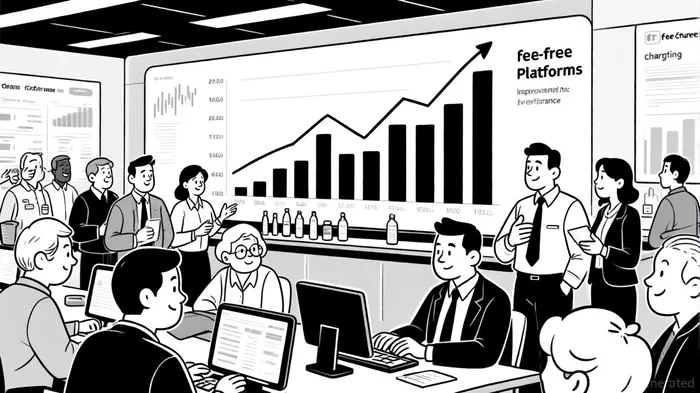
The rise of zero-fee trading platforms has fundamentally reshaped retail investor behavior, democratizing access to financial markets while introducing new dynamics in trading psychology and corporate governance. Platforms like KCEX, which offer zero-fee spot trading and ultra-low futures fees, have become catalysts for this transformation, enabling retail investors to engage with markets at unprecedented scale and speed.
The Behavioral Shift: Frequency, Diversification, and Performance
According to a report by the Berkeley Haas Research Center, the removal of trading fees has led to a 30% increase in trading frequency and a 172% surge in new users on platforms like eToroETOR-- in fee-free countries, compared to only 18% growth in fee-charging regions [1]. This surge is not merely speculative; it has translated into improved net performance for average traders. The same study found that retail investors saved approximately 11% annually due to the elimination of fees, even as trade returns remained stable [1].
KCEX, a cryptocurrency exchange, exemplifies this trend. By offering zero trading fees for both makers and takers in spot markets and ultra-low futures taker fees (0.02%), KCEX has attracted a diverse user base, including first-time traders and high-frequency participants. The platform's no-KYC onboarding and zero withdrawal fees further lower barriers to entry, enabling novice traders to experiment with positions without financial constraints [5].
Market Democratization and Corporate Governance Implications
The proliferation of zero-fee platforms has democratized access to markets, particularly in emerging asset classes like cryptocurrencies. KCEX's support for over 1,000 spot pairs and 500 futures pairs, including major assets like BitcoinBTC-- and EthereumETH--, underscores its role in expanding retail participation [6]. However, this shift has also altered corporate governance dynamics. A Harvard Law School study revealed that increased retail ownership—driven by zero-fee platforms—has reduced institutional shareholder influence, leading to declines in shareholder voting participation and ESG performance metrics [2]. Retail investors, while more numerous, often lack the resources or incentives to engage in active governance, creating a governance vacuum [2].
Execution Quality and Hidden Costs
Despite concerns about the sustainability of zero-fee models, execution quality for retail investors has remained robust. A 2024 study in the Journal of Banking & Finance found that effective spreads on retail trades were still significantly smaller than those on institutional trades, even after commission removal [3]. This suggests that platforms like KCEX, which prioritize low-latency execution and liquidity, can maintain competitive pricing without compromising investor outcomes [5].
However, the absence of explicit fees does not eliminate all costs. The same study highlighted the rise of "hidden costs," such as execution spreads and payment-for-order-flow (PFOF) arrangements, which may indirectly affect retail investors [3]. While KCEX avoids PFOF by not participating in such practices, other platforms have faced scrutiny for prioritizing liquidity provider rebates over investor best interests [1].
The Future of Zero-Fee Trading
The global e-brokerage market, valued at $14.1 billion in 2024, is projected to grow at a 9.4% CAGR through 2034, driven by mobile-first platforms and AI-powered tools [3]. KCEX's integration with TradingView in 2025 further illustrates the industry's shift toward real-time data accessibility, empowering retail traders with advanced analytics [4]. Yet, challenges persist. Behavioral studies note that zero-fee platforms can exacerbate herd behavior and overconfidence, particularly among younger investors influenced by social media [6].
Conclusion
Zero-fee spot trading has undeniably lowered barriers to entry, fostering a new era of retail participation. Platforms like KCEX have demonstrated that cost-free models can coexist with strong execution quality and user growth. However, the long-term implications for market stability and governance remain uncertain. As the industry evolves, regulators and platforms must balance democratization with safeguards against speculative excess and governance neglect.





Comentarios
Aún no hay comentarios