
FedEx’s Reinstatement of International Demand Surcharges: A Strategic Move for Operational Resilience and Margin Recovery
FedEx’s recent reinstatement of international demand surcharges has sparked significant debate among investors and logistics analysts. As global supply chains grapple with inflationary pressures, geopolitical tensions, and shifting trade dynamics, the company’s pricing strategies are being scrutinized for their role in bolstering operational resilience and margin recovery. This analysis examines the strategic rationale behind these surcharges, their financial implications, and the broader industry context, drawing on recent data and expert commentary.
Strategic Rationale: Balancing Costs and Capacity
FedEx’s decision to reintroduce demand surcharges for international shipments is rooted in its need to address surging operational costs and capacity constraints. The company has faced rising expenses from fuel, labor, and inflation, prompting a 5.9% General Rate Increase (GRI) in January 2025 and additional handling fees that surged by over 26% [5]. These adjustments are not arbitrary; they reflect a calculated effort to align pricing with the realities of a volatile market.
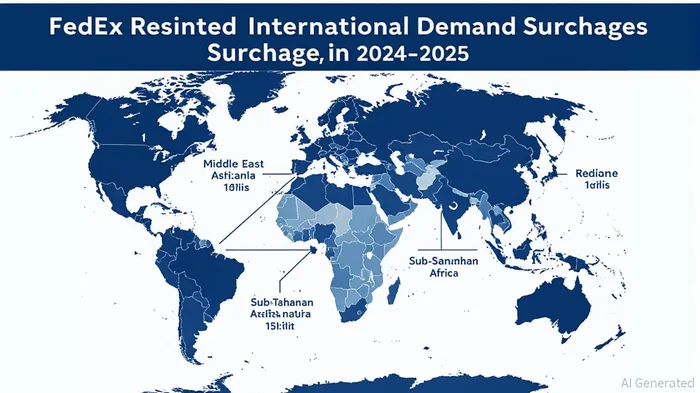
For instance, in India, demand surcharges for international parcel and freight shipments were reinstated on September 16, 2024, while similar measures took effect in Kenya and the Middle East/North Africa regions by September 2024 [2][4]. These region-specific surcharges are tied to localized assessments of shipment volume and capacity, ensuring that pricing reflects the actual costs of service delivery. As noted by a report from 3PL Center, such surcharges are critical for maintaining service reliability during peak seasons, particularly when demand outstrips available infrastructure [1].
The strategic timing of these surcharges also underscores FedEx’s proactive approach to managing seasonal fluctuations. For example, the company’s 2024–2025 international surcharge period (September 30, 2024, to January 19, 2025) coincides with the holiday shopping season, a period historically marked by heightened demand and logistical bottlenecks [1]. By preemptively adjusting rates, FedExFDX-- aims to smooth out capacity imbalances and avoid service disruptions that could erode customer trust.
Financial Performance: Mixed Signals Amid Cost-Cutting Efforts
The financial impact of these surcharges is nuanced. In fiscal 2025, FedEx reported an operating income of $5.22 billion and adjusted diluted earnings per share (EPS) of $3.60, driven by its DRIVE initiative—a cost-reduction program focused on optimizing the network and cutting structural expenses [1]. However, the company also faced challenges, including a shift in customer demand from priority to deferred services and higher operating expenses, which constrained yield growth [2].
Notably, Q4 2025 results demonstrated resilience, with the company surpassing earnings and revenue forecasts. EPS reached $6.07, and revenue hit $22.2 billion, reflecting improved cost management and operational efficiency [1]. The DRIVE program contributed $2.2 billion in savings for FY2025, with an additional $600 million in Q3 alone, underscoring its role in offsetting surcharge-related costs [2]. Analysts at Logistics Monitor highlight that these savings, combined with surcharge-driven revenue, have helped stabilize margins despite macroeconomic headwinds [2].
Yet, the financial picture is not uniformly positive. Reduced freight volumes on the Asia-U.S. route and the impending spin-off of FedEx Freight in June 2026 introduce uncertainties [5]. While the surcharges provide short-term relief, long-term margin recovery will depend on the company’s ability to adapt to shifting trade policies and geopolitical risks, such as potential U.S. tariffs on imports from China and Mexico [2].
Analyst Insights: Surcharges as a Tool for Resilience
Third-party analysts have largely validated FedEx’s surcharge strategy as a necessary step for maintaining operational resilience. According to a report by Supply Chain Dive, the reinstatement of dimensional weight pricing and fuel surcharges—such as a 200-basis-point increase in fuel fees—reflects the company’s alignment with industry practices to better match revenue with resource consumption [3]. These changes, while increasing costs for shippers, are seen as essential for preserving service quality during high-demand periods.
Moreover, FedEx’s focus on cost-cutting and network optimization has been praised. The DRIVE initiative, which has already secured $2.2 billion in savings for FY2025, is projected to yield further efficiencies in 2026 [5]. Analysts at FreightCaviar note that these measures, combined with surcharge-driven revenue, position FedEx to navigate the “tariff turbulence” affecting the logistics sector [6].
However, challenges remain. The shift to dimensional weight pricing—where fractional dimensions are rounded up—has raised concerns among high-volume shippers, who face potential cost increases of 6–9% for certain packages [1]. While FedEx encourages packaging optimization to mitigate these effects, the broader trend of frequent rate adjustments underscores the need for shippers to adopt data-driven cost management strategies [5].
Conclusion: A Calculated Path Forward
FedEx’s reinstatement of international demand surcharges is a multifaceted strategy aimed at balancing operational resilience with margin recovery. By aligning pricing with capacity constraints and rising costs, the company has demonstrated its ability to adapt to a volatile market. Financial results, particularly in Q4 2025, highlight the effectiveness of cost-cutting initiatives like DRIVE in stabilizing margins, even as external pressures persist.
For investors, the key takeaway is that FedEx’s surcharge policies are not merely reactive but part of a broader, proactive strategy to future-proof its logistics network. While challenges such as trade policy shifts and regional demand fluctuations remain, the company’s focus on innovation, cost optimization, and strategic restructuring positions it to navigate these uncertainties. As the logistics landscape evolves, FedEx’s ability to maintain this balance will be critical to its long-term success.
Source:
[1] FedEx Demand Surcharges for 2024 Peak Season,
https://3plcenter.com/fedex-demand-surcharges-for-2024-peak-season/
[2] Logistics Monitor End of the Year Recap and What Lies ...,
https://www.linkedin.com/pulse/logistics-monitor-end-year-recap-what-lies-ahead-bryan-gross-d9skc
[3] FedEx Announces Price Changes For Its Ground and Freight Offerings,
https://www.logisticsmgmt.com/article/fedex_announces_price_changes_for_its_ground_and_freight_offerings
[4] FedEx and UPS Reinstate Surcharges on Asia-to-U.S.,
https://ebblogistics.com/surcharges-reinstated/
[5] FedEx Corp (FDX) Reports Third Quarter Fiscal 2025 Results,
https://www.gurufocus.com/news/2746842/fedex-corp-fdx-reports-third-quarter-fiscal-2025-results
[6] What FedEx's Earnings Reveal About Trucking's Tariff Turbulence,
https://www.freightcaviar.com/what-fedexs-earnings-reveal-about-truckings-tariff-turbulence/







Comentarios
Aún no hay comentarios