
FedEx Freight's Strategic Expansion: Sales Team Growth as a Catalyst for Competitive Edge in the LTL Market
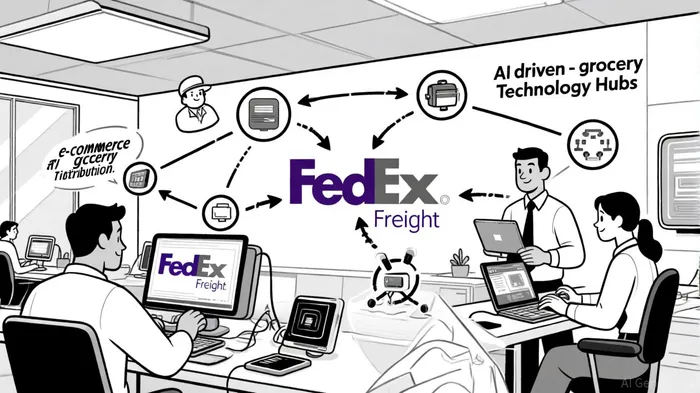
The logistics sector is undergoing a pivotal transformation in 2025, with the less-than-truckload (LTL) market navigating weak demand and excess capacity. Against this backdrop, FedEx Freight has positioned itself as a strategic contender ahead of its 2026 spinoff, leveraging aggressive sales team expansion and operational retooling to secure market share. This analysis examines how FedExFDX-- Freight's growth initiatives—particularly its hiring of 400 sales and sales support professionals by 2026—signal both competitive positioning and operational readiness in a sector marked by consolidation and technological disruption.
Strategic Sales Expansion: A Counter to Market Stagnation
FedEx Freight's decision to hire 400 additional sales professionals by 2026 reflects a calculated response to the LTL market's flat growth trajectory. According to a report by FleetOwner, the division has already hired 200 dedicated LTL sales professionals, with the remaining hires expected to bolster its focus on small-business customers, e-commerce, and the grocery sector[4]. This expansion is critical in a market where competitors like Saia and Old Dominion Freight Line are adopting divergent strategies.
For instance, Saia has prioritized network expansion through terminal openings and relocations but reported a 4.2% reduction in headcount during Q2 2025, signaling a focus on cost efficiency over aggressive sales force growth[2]. Meanwhile, Old Dominion Freight Line maintains a near 1% annual sales team turnover, emphasizing retention and experience over rapid hiring[2]. In contrast, FedEx Freight's 400-hire target underscores its intent to outpace rivals by directly targeting underserved customer segments, particularly in high-growth areas like e-commerce.
Operational Readiness: Technology and Spinoff Synergies
Operational readiness is another cornerstone of FedEx Freight's strategy. The company is investing heavily in technology to enhance customer experience, including AI-driven tools for route optimization and real-time shipping visibility[2]. These initiatives align with broader industry benchmarks, such as APQC's Open Standards Benchmarking® (OSB), which emphasizes metrics like on-time delivery rates and transportation cost per unit as critical indicators of logistics efficiency[1].
The impending spinoff further amplifies these efforts. By operating independently, FedEx Freight will gain agility to tailor pricing strategies and service offerings without the constraints of its parent company's diversified portfolio. As stated in FreightCenter, the spinoff is expected to unlock up to $20 billion in market value, enabling the division to reinvest in high-margin sectors like healthcare and automotive logistics[2]. This strategic separation mirrors industry trends where standalone LTL carriers, such as Old Dominion, have historically outperformed in pricing discipline and operational margins[5].
Competitive Positioning: Navigating a Fragmented Market
The LTL market's fragmentation is evident in the contrasting strategies of key players. While Saia's 2024 network expansion drove an 8.3% tonnage increase, its operating ratio deteriorated to 87.8% in Q2 2025, highlighting the trade-off between volume growth and margin preservation[2]. Old Dominion, conversely, has maintained a 99% on-time performance rate but faced a 9.3% decline in LTL tons per day in Q2 2025, opting to reduce capacity in anticipation of market recovery[3].
FedEx Freight's approach balances these extremes. By expanding its sales team while investing in AI and automation, the company aims to capture volume without sacrificing profitability. For example, its 2025 Plan includes a $4 billion cost-saving target through initiatives like Network 2.0 and the DRIVE program[3]. These measures position FedEx Freight to compete with carriers like Saia, which has seen rising labor costs erode operating margins, and Old Dominion, which relies on pricing discipline to offset volume declines[4].
Data-Driven Insights: A Visual Snapshot
Conclusion: A Strategic Bet on Agility and Innovation
FedEx Freight's strategic expansion ahead of its spinoff is a masterclass in aligning sales force growth with operational readiness. By directly addressing the LTL market's challenges—through targeted hiring, technological investment, and spinoff-driven agility—the company is positioning itself to outperform peers in a sector defined by volatility. For investors, this strategy signals a commitment to long-term value creation, particularly as the industry navigates the NMFTA's density-based freight classification overhaul and the lingering effects of global macroeconomic shifts[3].
As the logistics sector evolves, FedEx Freight's ability to balance growth with efficiency will be a key determinant of its success. With its 400-hire target and $20 billion spinoff valuation, the division is not merely adapting to market conditions—it is actively reshaping them.





Comentarios
Aún no hay comentarios