
Is FedEx (FDX) Stock a Buy Before Earnings? A Deep Dive into Valuation, Earnings Momentum, and Industry Positioning
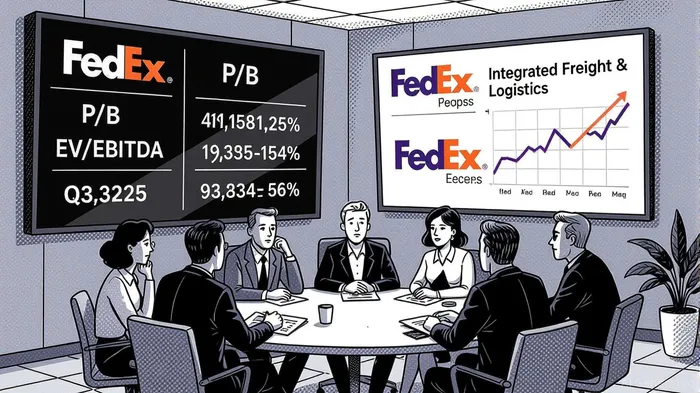
The question of whether FedExFDX-- (FDX) stock is a buy before its upcoming earnings report hinges on three critical factors: valuation, earnings momentum, and industry positioning. A dispassionate analysis of these elements, supported by recent financial data and industry trends, reveals a nuanced picture of opportunity and risk.
Valuation: A Discounted Giant?
FedEx’s valuation metrics suggest it is trading at a discount relative to its peers. As of Q3 2025, the company’s trailing price-to-earnings (P/E) ratio stands at 13.55, while its forward P/E is 12.29 [1]. These figures place FDXFDX-- in the lower quartile of the Integrated Freight & Logistics industry, which has an average P/E of 27.03 [2]. The company’s price-to-book (P/B) ratio of 1.91 is even more strikingly low compared to the industry average of 27.03, indicating that the market is valuing FDX’s equity at a fraction of its peers [2]. Meanwhile, the enterprise value-to-EBITDA (EV/EBITDA) ratio of 7.92 is significantly below the industry average of 12.59, further underscoring its relative affordability [2].
These metrics suggest that FDX is undervalued, particularly when considering its 27.2% gross profit margin and robust operating income [4]. However, the PEG ratio of 1.00 (indicating fair valuation relative to earnings growth expectations) implies that the market is not discounting future growth prospects excessively [1]. For value investors, this presents a compelling case: a company with strong fundamentals trading at a discount to its intrinsic value.
Earnings Momentum: Progress Amid Headwinds
FedEx’s Q3 2025 earnings report was a mixed bag. The company reported adjusted diluted EPS of $4.51, exceeding revenue expectations of $21.92 billion with actual revenue of $22.2 billion [3]. However, the EPS figure fell short of forecasts ($4.61), and management revised its full-year adjusted EPS outlook downward to $18–$18.60 from $19–$20 [3]. This revision reflects persistent challenges, including weaker B2B demand, inflationary pressures, and the expiration of its USPS contract [3].
Despite these headwinds, FedEx’s DRIVE cost-cutting initiative delivered $600 million in savings during Q3, contributing to a 12% year-over-year increase in adjusted operating income [3]. The company remains on track to achieve $4 billion in structural cost reductions by the end of FY25 [1]. Strategic investments in Network 2.0 and AI-powered logistics tools are also yielding efficiency gains, with management projecting a 10% reduction in pickup and delivery costs in fully optimized markets [3].
The key question is whether these cost-saving measures can offset declining demand. While the 5.9% general rate increase and demand surcharges may help stabilize revenue, the broader macroeconomic environment—marked by geopolitical tensions and uncertain trade policies—remains a drag [3].
Industry Positioning: Navigating a Challenging Landscape
The Integrated Freight & Logistics sector is in a low-growth, high-pressure environment. North American freight volumes contracted by 3% year-over-year in Q2 2025, with truckload spot rates rising 6.5% but showing signs of plateauing [1]. Carrier attrition is accelerating, with 5,000–6,000 monthly revocations outpacing new carrier entries [1]. Meanwhile, trade policy uncertainties—such as the extension of U.S.-China tariff pauses—have disrupted traditional demand patterns, leading to front-loaded imports and compressed peak seasonality [3].
FedEx’s response to these challenges has been multifaceted. The company is divesting non-core assets (e.g., its Freight business) to unlock shareholder value and is leveraging technology to optimize its network. Its acquisition of RouteSmart Technologies and deployment of AI-driven routing tools are enhancing operational efficiency [1]. However, the USPS contract expiration and severe weather events in Q3 have exposed vulnerabilities in its domestic package segment [3].
Conclusion: A Buy Before Earnings?
FedEx’s valuation metrics are undeniably attractive, with P/E, P/B, and EV/EBITDA ratios significantly below industry averages. Its earnings momentum, while tempered by macroeconomic headwinds, is supported by aggressive cost-cutting and operational improvements. However, the company’s ability to sustain these gains depends on executing its strategic initiatives and navigating trade policy risks.
For investors with a medium-term horizon, FDX appears to offer a compelling risk-reward profile. The stock’s current discount to intrinsic value, combined with its strong balance sheet and transformative investments, suggests that the market may be underestimating its long-term potential. That said, the downward revision to full-year guidance and ongoing demand pressures warrant caution.
In the short term, the upcoming earnings report will be critical. If FedEx can demonstrate meaningful progress in offsetting B2B demand weakness and accelerate cost savings, the stock could see a re-rating. For now, the case for FDX as a buy hinges on its ability to prove that its strategic pivot can outpace industry headwinds.
**Source:[1] FedEx CorporationFDX-- (FDX) Stock Price, News, Quote & History [https://finance.yahoo.com/quote/FDX/][2] FTAI vs. JBHT: A Head-to-Head Stock Comparison [https://seekreturns.com/en/stock-comparisons/ftai-vs-jbht][3] FedEx (FDX) Q3 2025 Earnings Call Transcript [https://www.fool.com/earnings/call-transcripts/2025/03/21/fedex-fdx-q3-2025-earnings-call-transcript/][4] Earnings call: FedEx outlines strategic responses to ... [https://www.investing.com/news/stock-market-news/earnings-call-fedex-outlines-strategic-responses-to-demand-challenges-93CH-3625728]





Comentarios
Aún no hay comentarios