
Federal Reserve Rate Cuts and Their Impact on Risk Assets: Strategic Reallocation in Equity and High-Yield Debt Markets
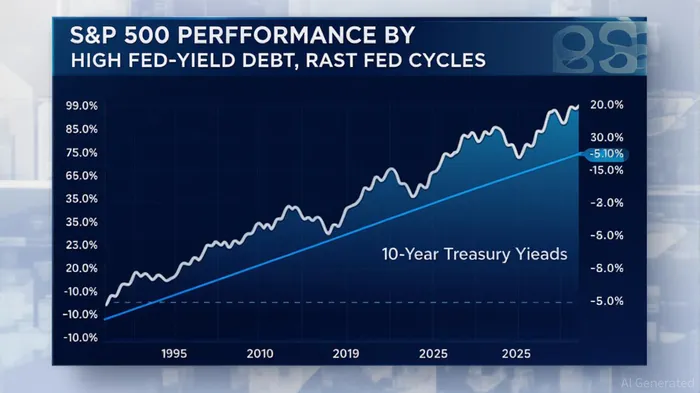
The Federal Reserve's September 17, 2025, decision to cut the federal funds rate by 25 basis points—bringing the target range to 4.00%-4.25%—has reignited debates about the strategic reallocation of capital across risk assets. This move, the first of 2025, reflects a delicate balancing act between addressing a softening labor market and managing inflationary pressures. For investors, the implications are clear: understanding the interplay between monetary policy and asset performance is critical to optimizing portfolios in a shifting landscape.
Historical Context: Rate Cuts and Market Outcomes
Historical data reveals that the economic context in which rate cuts occur significantly shapes their impact on equities and high-yield debt. Normalization-driven cuts, such as those in 1995 and 2019, have historically delivered robust equity returns. For instance, the S&P 500 surged by over 20% and 114% one and three years after the 1995 and 2019 cuts, respectively[1]. Conversely, cuts made during or in anticipation of recessions, such as in 2001 and 2007, have been associated with negative market outcomes[1].
The September 2025 cut falls into a normalization context, albeit with caution. While inflation remains above the Fed's 2% target at 2.9%, policymakers anticipate that tariff-driven price pressures will be temporary[2]. This contrasts with the 2007 scenario, where rate cuts were a response to an already deteriorating economy. As such, the current environment suggests a more favorable outlook for risk assets, provided economic growth holds steady.
Immediate Market Reactions: Equities and High-Yield Debt
The September 2025 rate cut triggered an immediate positive response in equity markets. The S&P 500 rose 0.8%, while the Nasdaq Composite climbed 0.9% post-announcement[3]. Rate-sensitive sectors, such as real estate and technology, outperformed. The Vanguard Real Estate ETF (VNQ) surged 2.3%, reflecting renewed demand for assets with lower borrowing costs[3]. Similarly, unprofitable tech firms like PalantirPLTR-- saw strong gains, underscoring investor optimism about growth-oriented equities[3].
High-yield debt markets also reacted favorably. Investors extended duration and purchased longer-term bonds, anticipating further rate cuts. The 10-year Treasury yield fell to 4.05-4.07% by early September 2025[4], signaling a shift toward higher-yielding assets. BlackRockBLK-- advised investors to reduce cash allocations and prioritize high-yield bonds, which offer compelling absolute yields and lower volatility compared to long-dated Treasuries[4]. However, risks persist: if economic growth weakens further, default rates in high-yield sectors could rise, mirroring the 2007 experience[1].
Strategic Reallocation: Balancing Opportunity and Risk
For investors, the September 2025 rate cut underscores the need for a nuanced approach to asset allocation. In equities, sectors with high sensitivity to borrowing costs—such as real estate, utilities, and technology—remain attractive. These sectors historically outperform during rate-cut cycles, particularly when growth expectations are stable[3]. However, caution is warranted in overleveraged industries, where falling rates could mask underlying fragility.
In high-yield debt, the key is to balance yield-seeking behavior with credit risk management. While the current environment supports higher-yielding bonds, investors should prioritize issuers with strong liquidity and resilient cash flows. Diversification across sectors and geographies can further mitigate risks, especially given the Fed's projected path of 1.6% GDP growth for 2025[2].
Conclusion: Navigating the New Normal
The September 2025 rate cut marks a pivotal moment in the Fed's 2025 policy trajectory. While the immediate market response has been positive, the long-term success of strategic reallocations will depend on the interplay between monetary easing and economic resilience. Investors must remain agile, leveraging historical insights while staying attuned to evolving macroeconomic signals. As Chair Jerome Powell emphasized, the Fed's dual mandate of employment and price stability will continue to shape policy, making diversification and active management essential in this dynamic environment[2].





Comentarios
Aún no hay comentarios