
Federal Reserve Policy Shifts: RBC's Labor Market Insights and Market Positioning Strategies
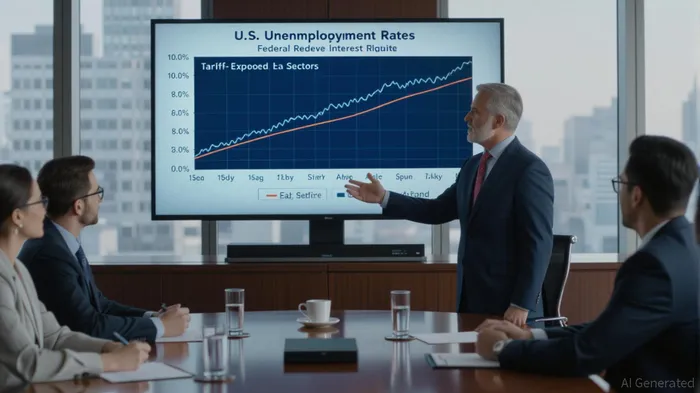
The U.S. labor market is at a pivotal inflection pointIPCX--, and RBC Capital Markets’ latest analysis offers a compelling roadmap for investors navigating the Federal Reserve’s evolving policy trajectory. With trade policy uncertainty and demographic shifts reshaping employment dynamics, the upcoming August jobs report—forecasted to show 64,000 new jobs and a 4.3% unemployment rate—could serve as a catalyst for Fed rate cuts by year-end [3]. This analysis unpacks how RBC’s insights into labor market softening, coupled with central bank responsiveness, are redefining investment strategies across asset classes.
Labor Market Cooling: A Structural and Cyclical Convergence
RBC’s research underscores a dual force at play: structural headwinds and cyclical moderation. The labor force participation rate has fallen to 62.2%, driven by an aging population, mass retirements, and reduced immigration [2]. Meanwhile, tariff-exposed sectors like manufacturing and retail are experiencing pronounced job losses, while service industries remain resilient, adding 146,000 jobs since late 2024 [4]. This divergence highlights a labor market where demand for labor is outpacing supply, creating a “mismatch” that RBC terms “America needs workers, not jobs” [2].
The August jobs report, if it aligns with RBC’s forecast, would signal a cyclical slowdown. A 4.3% unemployment rate—a rise from 4.1% in July—combined with a participation rate near historic lows, suggests the Fed may soon face a trade-off between inflation control and employment stability. As RBC’s Blake Gwinn notes, “There are no signs of permanent job losses yet, but the labor market is clearly shifting toward a more balanced, less inflationary equilibrium” [3].
Fed Policy: Data-Dependent Cuts and Market Expectations
The Federal Reserve’s recent stance has been one of cautious restraint, with rates held steady for four consecutive meetings as of June 2025. However, RBC anticipates a shift by December, with policymakers responding to cooling labor data and inflation pressures that may peak at 3.0% PCE by year-end [1]. The key question is timing: while eight FOMC members see two 25-basis-point cuts by December, seven still favor no action [1].
RBC’s analysis suggests the Fed’s data-dependent approach is becoming more responsive to labor market signals. At the Jackson Hole symposium, Chair Jerome Powell hinted at potential cuts, emphasizing a “shifting balance of risks” and near-full employment [2]. Bond markets have priced in cumulative cuts of 75 basis points for 2025, with a 50-basis-point move in September now seen as plausible [3]. This aligns with RBC’s projection that the Fed will cut rates in December and January 2025 but pause by March, potentially shifting to a hiking bias by year-end [3].
Investment Implications: Positioning for a Fed Easing Cycle
RBC’s investment strategy emphasizes caution and selectivity amid a Fed pivot. For equities, the firm recommends a “normal, market-weight allocation” to U.S. stocks, avoiding overexposure to stretched valuations. Dividend growth stocks and technology sectors are highlighted as beneficiaries of accommodative policy, given their resilience to rate volatility [1].
In fixed income, RBC favors Treasuries and investment-grade corporate bonds, which have outperformed amid rising yields. However, municipal bonds remain a caution due to tariff-related volatility and concerns over their tax-advantaged status [1]. Corporate bond valuations are also under scrutiny, with yield spreads over Treasuries compressed to 0.8%—a historically narrow margin that suggests limited upside [1].
Sector positioning is equally critical. RBC advises overweighting service-producing industries, which have added 146,000 jobs since late 2024, while underweighting tariff-exposed manufacturing and retail [4]. This aligns with the firm’s view that the U.S. economy will remain resilient in 2025, supported by strong balance sheets and corporate profitability [3].
Conclusion: A Fed Pivot and Strategic Reallocation
RBC’s analysis paints a clear picture: a labor market in transition, a Fed poised to cut rates, and a market landscape demanding tactical positioning. The August jobs report will be a critical test of these dynamics. If the data confirms RBC’s forecast, investors can expect a more aggressive Fed easing cycle, with implications for equities, bonds, and sector rotations. As always, the key to navigating this environment lies in aligning asset allocations with structural trends—prioritizing quality, liquidity, and sectors insulated from trade policy shocks.
Source:
[1] 2025 Midyear Outlook: United States [https://www.rbcwealthmanagement.com/en-us/insights/2025-midyear-outlook-united-states]
[2] America needs workers, not jobs [https://www.rbccm.com/en/story/2025/07/america-needs-workers-not-jobs]
[3] RBC's Carrier on Outlook for Jobs Report, Fed Rates [https://www.marketscreener.com/news/rbc-s-carrier-on-outlook-for-jobs-report-fed-rates-ce7d59d8d88bf126]
[4] US Week Ahead: Payrolls at the nexus of less demand and ... [https://www.rbc.com/en/thought-leadership/economics/featured-insights/us-week-ahead-payrolls-at-the-nexus-of-less-demand-and-supply-of-workers/]







Comentarios
Aún no hay comentarios