
Federal Reserve Policy Shifts and Market Implications: Decoding Communication Patterns for Rate-Cut Anticipation
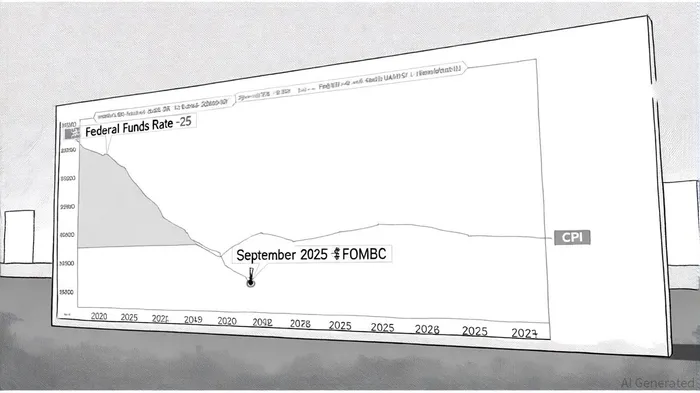
The Federal Reserve's September 2025 policy pivot—marking the first rate cut of President Donald Trump's second term—has reignited debates about the interplay between central bank communication and market dynamics. By reducing the benchmark rate by 25 basis points to a range of 4.00%–4.25%, the Fed signaled a recalibration of its stance amid a softening labor market and persistent inflationary pressures[2]. This decision, while modest, underscores the critical role of communication in shaping investor expectations and asset valuations.
The September 2025 Rate Cut: A Policy Pivotal Point
The FOMC's action followed a month of mixed economic signals. While inflation remained above the 2% target, the committee noted “weakening labor demand” and a “shift in risks toward employment,” as highlighted by Chair Jerome Powell[2]. The 25-basis-point cut, supported by a broad majority (with Stephen Miran dissenting in favor of a 50-basis-point reduction), reflected a data-dependent approach. Powell explicitly rejected political pressures, stating there was “no widespread support at all” for a larger cut[3]. This emphasis on independence reinforced the Fed's commitment to its dual mandate of price stability and maximum employment.
The market response was immediate. Equity indices, including the S&P 500 and Nasdaq Composite, saw intraday volatility as traders priced in the likelihood of further easing. According to a report by Yahoo Finance, the Dow Jones Industrial Average dipped sharply ahead of the decision, while tech-heavy benchmarks held closer to records, illustrating sector-specific sensitivity to rate expectations[3].
Communication as a Market Signal: Historical Context and Current Dynamics
Central bank communication has long served as a forward guide for financial markets. The Fed's use of language—whether in FOMC statements, press conferences, or “dot plots”—shapes expectations about future policy paths. In the case of September 2025, the Fed's acknowledgment of “softening labor demand” and its revised GDP forecast of 1.6% for the year[2] provided critical clues to its dovish tilt.
Historically, such signals have preceded rate-cut cycles. For example, during the 2008 financial crisis and the 2020 pandemic, forward guidance and explicit references to “unusual uncertainty” spurred market optimism about accommodative policies[3]. Similarly, the September 2025 meeting saw Powell's repeated emphasis on “data dependence,” a phrase that has historically correlated with delayed but inevitable easing cycles.
Market Implications and Investor Strategy
The September 2025 cut has already triggered strategic shifts among investors. Equities, particularly growth stocks, have benefited from lower discount rates, while bond yields retreated as rate-cut expectations deepened. However, the Fed's unchanged inflation and unemployment projections[2] suggest that further cuts may be contingent on economic data, creating a tug-of-war between risk-on and risk-off sentiment.
For investors, the key lies in parsing the Fed's nuanced messaging. Powell's insistence on a “measured approach” implies that subsequent cuts will likely be incremental, contrasting with the aggressive 100-basis-point reductions seen in 2020. This environment favors a balanced portfolio with exposure to sectors historically resilient during easing cycles (e.g., technology, consumer discretionary) while hedging against potential volatility in rate-sensitive assets like long-duration bonds.
The Road Ahead: Navigating Uncertainty with Data-Driven Insights
The Fed's September 2025 decision reaffirms that policy shifts are driven by evolving economic fundamentals rather than political timelines. With inflation still above target and labor market weakness emerging, the stage is set for a prolonged period of cautious easing. However, the central bank's emphasis on data dependency means that future meetings could pivot sharply if inflationary pressures resurge or employment metrics improve.
Investors should monitor two key communication channels:
1. FOMC Statement Language: Look for shifts in descriptors of inflation, employment, and “risks” to gauge the Fed's tolerance for further easing.
2. Chair Powell's Press Conferences: His emphasis on “independence” and “data-driven decisions” will likely shape the pace of rate cuts.
As the Fed navigates this delicate balancing act, markets will continue to price in a range of outcomes. For now, the September 2025 cut serves as a reminder that central bank communication remains the most potent tool in shaping financial market trajectories.







Comentarios
Aún no hay comentarios