
Federal Reserve Policy Shifts and Their Impact on Equity and Fixed Income Markets
The Federal Reserve's evolving inflation framework and recent policy actions have sparked intense debate among economists, investors, and policymakers. As 2025 draws to a close, the central bank's balancing act between inflation control and economic stability has taken center stage. With inflation stubbornly above the 2% target and labor market momentum softening, the Fed's decisions-particularly under Chair Jerome Powell's final months in office-carry profound implications for equity and fixed income markets.
Powell's Inflation Framework and the "Hawkish Cut" Dilemma
The Federal Reserve's revised Statement on Longer-Run Goals and Monetary Policy Strategy, released in August 2025, reaffirmed its dual mandate but signaled a departure from the "flexible average inflation targeting" (FAIT) approach introduced in 2020. Instead, the Fed emphasized a more decisive stance to prevent inflation expectations from becoming unanchored, even as it acknowledged temporary deviations from the 2% target due to external shocks. This shift reflects a recognition that the post-pandemic economic landscape demands greater agility in responding to both high and low inflation scenarios.
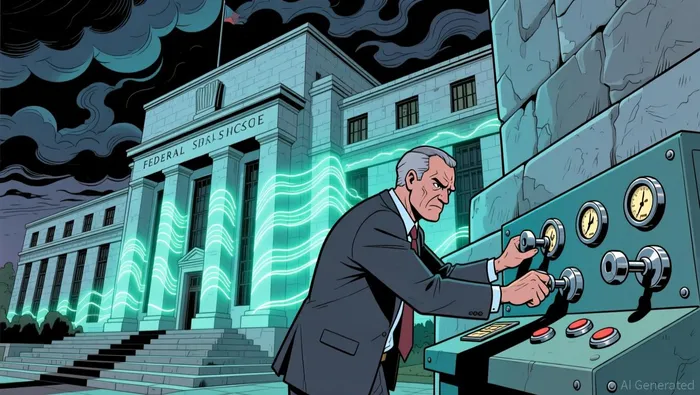
In November 2025, the Fed delivered a third consecutive rate cut, reducing the federal funds rate to 3.50–3.75%. However, the decision was framed as "hawkish" due to the Fed's cautious language about the "extent and timing" of future adjustments. This duality-cutting rates while signaling restraint-has created uncertainty, particularly as internal divisions within the FOMC have become more pronounced. Some officials advocated for larger cuts to stimulate growth, while others resisted any further reductions, fearing inflationary risks.
The political dimension of these decisions cannot be ignored. With Powell's term set to expire in May 2026, speculation about his successor-narrowed to Kevin Warsh or Kevin Hassett under President Trump-has heightened concerns about the Fed's independence and long-term inflation tolerance. These uncertainties have already begun to manifest in financial markets, with rising risk premia in U.S. Treasuries as investors demand higher compensation for holding longer-dated bonds.
Siegel's Dovish Pivot and Investment Implications
Jeremy Siegel, a senior economist at Wharton, has been a vocal advocate for a more accommodative monetary policy in 2025. He argues that the Fed's current stance, with rates at 4.25–4.5%, is overly restrictive and risks stifling economic activity. Siegel predicts a series of rate cuts, including a 0.25 basis point reduction in September 2025 and two additional cuts by year-end, bringing the federal funds rate down to 3.5–3.75%. This dovish pivot, he contends, would inject liquidity into the banking system and support a soft landing for the economy.
Siegel's analysis also highlights the importance of balance sheet adjustments. The Fed's resumption of Reserve Management Purchases (RMPs) in December 2025-a move to address repo rate strains and declining reserve balances-aligns with his call for proactive liquidity management. Such measures, he argues, are critical to maintaining economic stability and preventing a recession.
For investors, Siegel's outlook suggests a strategic rebalancing of portfolios. While he acknowledges the potential for a 10% correction in equities, he emphasizes the long-term outperformance of stocks over alternatives like gold or cash. Historically, equities have delivered superior returns, with a dollar invested in 1802 growing to $2.4 million by 2025, compared to just $6.38 for gold. However, Siegel cautions that 2025's volatility-driven by geopolitical tensions and AI sector challenges-requires a nuanced approach. He recommends capital-efficient strategies that maintain equity exposure while selectively adding gold.
On the fixed income side, Siegel anticipates a normalization of interest rates. With the Fed expected to cut rates by 50 basis points in 2025, 10-year Treasury yields could rise to 4.5–5%, reflecting improved economic prospects and inflation expectations. This environment, he argues, favors longer-duration bonds as investors seek income in a low-yield world. Investors should prioritize duration extension to lock in higher returns before the cycle peaks.
Strategic Allocation in a Dovish Environment
The interplay between the Fed's policy shifts and Siegel's insights points to a nuanced investment landscape. For equities, the dovish pivot creates favorable conditions for rate-sensitive sectors like small-cap and value stocks, which have historically outperformed in low-rate environments. However, Siegel warns that the Magnificent Seven tech stocks-driven by AI and innovation-may face headwinds in 2025 due to competition and adoption challenges. Investors should diversify beyond high-flying tech names to capitalize on broader market opportunities.
In fixed income, the Fed's balance sheet adjustments and rate cuts could lead to a flattening yield curve, with long-term Treasuries offering attractive yields relative to short-term instruments. Siegel's projection of 10-year yields reaching 4.5–5% suggests that Treasury investors should prioritize duration extension to lock in higher returns before the cycle peaks.
Conclusion
The Federal Reserve's evolving inflation framework and the prospect of a dovish pivot in 2025 present both opportunities and risks for investors. While Powell's cautious approach to rate cuts and balance sheet management aims to stabilize inflation expectations, the political uncertainties surrounding his successor add a layer of complexity. Siegel's analysis underscores the need for a balanced portfolio strategy-leveraging equities for long-term growth while hedging against volatility through strategic fixed income allocations. As the Fed navigates this delicate balancing act, investors must remain agile, aligning their strategies with the shifting tides of monetary policy and market dynamics.







Comentarios
Aún no hay comentarios