
Federal Reserve Policy and the Paradox of Rising Treasury Yields Amid Easing Monetary Policy
The Federal Reserve's aggressive rate-cutting campaign in 2025 has failed to curb the upward trajectory of U.S. Treasury yields, creating a disconnection between monetary policy and bond market dynamics. Despite three 25-basis-point reductions in the federal funds rate and projections of further easing, 10-year Treasury yields climbed to 4.09% by December 2025, defying expectations of a dovish Fed-driven decline. This paradox reflects a complex interplay of inflation expectations, fiscal policy shifts, and evolving investor behavior, all of which are reshaping the bond market's calculus.
Inflation Expectations: A Tug-of-War Between Policy and Tariffs
The Fed's rate cuts are designed to stimulate growth and temper inflation, which remains stubbornly above its 2% target. The FOMC's Summary of Economic Projections forecasts core PCE inflation declining from 3.1% in 2025 to 2.0% by 2028, a trajectory that suggests gradual progress toward price stability. However, the Trump administration's aggressive tariff policies have introduced a counterforce. Tariffs averaging 15% on most imports have pushed core goods prices 1.9% above pre-2025 trends, contributing 0.5 percentage points to headline PCE inflation and 0.4 percentage points to core PCE inflation in the June–August 2025 period.
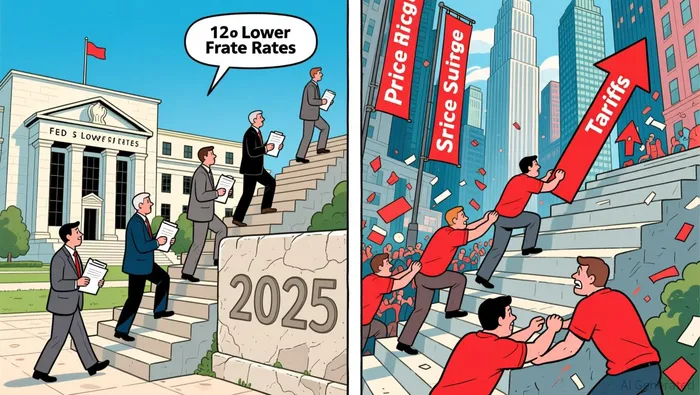
These tariffs have created a "toxic combination" of inflationary pressures and fiscal expansion, according to J.P. Morgan Global Research, which warns that Treasury yields could rise toward 6% within 12–18 months. While the Fed acknowledges tariffs' limited pass-through to broader inflation, market participants are pricing in persistent supply-side shocks, particularly in durable goods and energy sectors.
Fiscal Policy and Political Uncertainty: A Double-Edged Sword
The Trump administration's fiscal agenda has further complicated the Fed's task. Tariff revenue surged to $88 billion through August 2025, with new tariffs averaging 10–11.5% in July and August-up from 2.4% at the start of the year. This fiscal expansion, coupled with potential infrastructure spending and tax cuts, has raised concerns about inflationary overshooting and long-term debt sustainability.
Political uncertainties are also amplifying market volatility. Stephen Miran, a Trump ally and newly appointed Federal Reserve Governor, advocated for a 50-basis-point rate cut at the September meeting, signaling a potential ideological shift within the FOMC. Such developments have reinforced a "Fed put" mentality among investors, who anticipate central bank support during market stress. This dynamic has buoyed equities and kept credit spreads narrow, even as Treasury yields climb.
Investor Behavior and Market Dynamics: The Role of Expectations
Investor behavior has played a pivotal role in the yield disconnect. As of December 2025, traders priced in an 87% probability of a 25-basis-point rate cut at the Fed's final meeting, reflecting a dovish pivot. Yet, bond yields continued to rise, driven by expectations of inflation resilience and fiscal policy-driven inflation. The 3-year U.S. Treasury inflation breakeven rate, a key gauge of market inflation expectations, showed a modest decline, indicating a nuanced view of future price pressures.
This divergence highlights a broader shift in market dynamics. Investors are increasingly prioritizing real returns over nominal yields, favoring inflation-linked Treasuries and commodities over traditional fixed-income assets. Meanwhile, the S&P 500 reached record highs in late 2025, with equities benefiting from the Fed's accommodative stance and a risk-on environment fueled by the "Fed put" narrative.
Conclusion: Navigating a New Normal
The disconnection between Fed rate cuts and rising Treasury yields underscores a new era of market uncertainty. While the Fed remains committed to its dual mandate, the interplay of tariffs, fiscal policy, and political shifts is creating a landscape where traditional monetary policy tools have diminished efficacy. For investors, this environment demands active portfolio management and a nuanced understanding of inflationary risks. As Chair Jerome Powell emphasized, policy is not on a "preset course" but must adapt to evolving data and risks-a reality that will define the bond market's trajectory in 2026 and beyond.







Comentarios
Aún no hay comentarios