
Federal Reserve Policy Inconsistency: Navigating Fixed Income and Equity Market Allocations in 2025
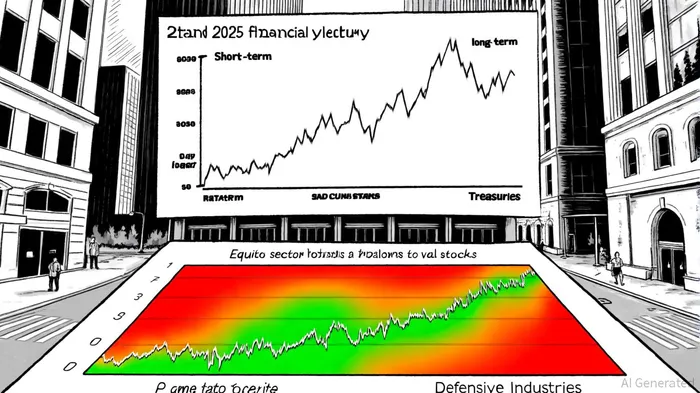
In 2025, the Federal Reserve faces a complex landscape shaped by geopolitical tensions and economic uncertainties. These factors have introduced significant unpredictability into monetary policy, directly impacting fixed income and equity market allocations. This article examines how central bank inconsistency, driven by these uncertainties, is reshaping investment strategies and market dynamics.
The Fed's Balancing Act: Inflation, Growth, and Geopolitical Risks
The Federal Reserve's 2025 policy statements underscore a delicate balancing act between controlling inflation and sustaining economic growth. According to a report by the Federal Reserve Board, rising geopolitical uncertainties—such as the U.S. government's imposition of broad global tariffs in April 2025—have complicated the Fed's calculus, spurring market speculation about economic slowdowns and potential interventions [1]. While strong personal consumption and resilient labor markets have delayed aggressive rate cuts, the Fed's Five-Year Monetary Policy Review highlights ongoing debates about recalibrating the 2% inflation target to accommodate high government debt and moderate inflation [4]. This policy ambiguity has created a “new normal” of higher interest rates, with investors pricing in a shallow rate-cutting cycle for 2025 [5].
Fixed Income: Duration Adjustments and Credit Spread Dynamics
The anticipated 2025 rate cuts have prompted significant shifts in fixed income strategies. According to a report by BlackRockBLK--, investors are moving away from high cash allocations—now accounting for 21% of the fixed income sleeve in June 2025—and favoring intermediate-term bonds over long-dated Treasuries [1]. This shift is partly due to the Fed's base-case expectation of a “shallow cut” scenario, where long-term bonds historically underperform [1]. Additionally, weakening demand for long-term bonds from foreign investors and concerns over U.S. debt sustainability are pushing up term premiums, limiting returns on long-duration assets [1].
Credit spreads have remained tight, with investment-grade spreads at 0.7% and high-yield spreads at 2.8% as of August 2025 [1]. While these spreads offer attractive yields, they require active due diligence to manage risk, particularly for issuers with stressed capital structures. Investors are increasingly favoring credit strategies over duration extension, as economic growth remains positive but slower [1].
Equity Markets: Sector Rotations and Volatility
Central bank unpredictability has also driven sector rotations in equity markets. A report by UBSUBS-- highlights that investors are shifting capital toward value stocks and international equities as large-cap technology leadership wanes [4]. The mixed signals from central banks—such as the Fed's hawkish stance versus the European Central Bank's rate cuts—have prompted a reallocation toward defensive sectors like healthcare and utilities, which offer income stability and lower cyclicality [1].
The introduction of aggressive trade restrictions in early 2025 further amplified volatility. According to the St. Louis Fed, the VIX index surged to the 99.9th percentile of historical volatility in April 2025, driven by fears of trade wars and economic recession [1]. This environment has favored sectors with pricing power, such as luxury goods and finance, while consumer discretionary and healthcare face headwinds [4].
Strategic Implications for Investors
For fixed income, a balanced approach is critical. Investors are advised to prioritize intermediate-term bonds (maturities under seven years) and active credit selection to mitigate reinvestment risks [1]. In equities, diversification across sectors and geographies—particularly in value stocks and international markets—offers resilience against policy-driven volatility [4].
The Federal Reserve's recalibration of its policy framework, as outlined in its 2025 review, suggests a long-term shift toward flexibility, with monetary policy increasingly shaped by structural economic challenges [4]. Investors must remain agile, leveraging data-driven insights to navigate the evolving landscape.
Conclusion
Federal Reserve policy inconsistency in 2025, driven by geopolitical and economic uncertainties, has created a dynamic environment for fixed income and equity markets. While rate-cut expectations and credit opportunities present opportunities, they also demand cautious, diversified strategies. As central banks continue to navigate this complex terrain, investors must prioritize adaptability and active portfolio management to capitalize on emerging trends.





Comentarios
Aún no hay comentarios