
Federal Reserve Independence Under Threat: Implications for Financial Markets
The Federal Reserve's independence has long been a cornerstone of U.S. monetary policy, allowing it to act as a stabilizing force in global markets. However, recent developments-most notably the Department of Justice's (DOJ) criminal investigation into Federal Reserve Chair Jerome Powell-have cast a shadow over this independence, raising urgent questions about the future of U.S. monetary policy and its ripple effects on global capital flows.
Political Interference and the Erosion of Institutional Trust
The DOJ's investigation into Powell, centered on his testimony about the Fed's $2.5 billion headquarters renovation project, has been framed by the central bank as a politically motivated effort to undermine its autonomy. According to a report by , Powell revealed that the DOJ had served the Fed with grand jury subpoenas and threatened criminal indictment, calling the move "unprecedented" and tied to political frustration over the Fed's decision to cut interest rates based on economic data rather than presidential preferences. This scrutiny has intensified concerns that the Fed's ability to make independent, evidence-based policy decisions is under threat.
Such interference risks eroding institutional trust, a critical factor in maintaining market stability. Historically, the Fed's independence has allowed it to prioritize long-term economic health over short-term political gains. For example, during periods of high inflation, the Fed has raised rates despite political pressure to avoid economic pain. If this independence is compromised, as suggested by the DOJ probe, investors may lose confidence in the Fed's ability to anchor expectations, leading to heightened volatility in bond yields, currency markets, and equities.
Market Reactions: Safe Havens and De-Dollarization
The investigation has already triggered shifts in investor behavior. Safe-haven assets like gold have seen renewed demand as a hedge against institutional uncertainty. notes that gold's role as a store of value has been reinforced by broader geopolitical tensions, including U.S. military actions in Venezuela, compounding concerns about the Fed's credibility. Meanwhile, the U.S. dollar, once a near-universal reserve currency, faces headwinds. Data from JPMorgan highlights that the dollar's share in central bank foreign exchange reserves has fallen to a two-decade low, reflecting a global reallocation of capital away from dollar-denominated assets.
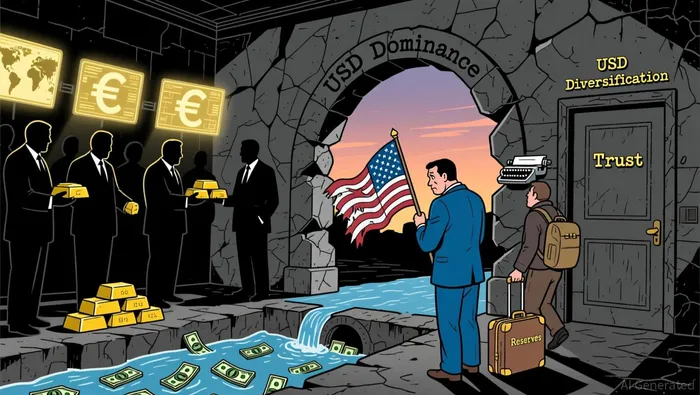
This de-dollarization trend is further amplified by divergent monetary policy trajectories. While the Fed has signaled a potential dovish shift, central banks in Europe and Asia have maintained tighter policies, creating a "currency war" dynamic. As a result, the dollar has weakened by over 8% in 2025-the steepest annual decline in nearly a decade- prompting investors to diversify portfolios into alternative currencies and commodities.
Portfolio Implications: Diversification and Hedging Strategies
For investors, the erosion of Fed independence necessitates a reevaluation of portfolio strategies. First, diversification across asset classes and geographies is critical. Safe-haven assets like gold, Treasury bonds, and defensive equities are likely to remain attractive as hedges against policy uncertainty. Second, hedging against currency risk-particularly in dollar-based portfolios-has become more pressing. With the dollar's dominance under pressure, investors may need to allocate to non-U.S. assets or use derivatives to mitigate exposure.
Third, the potential appointment of a politically aligned Fed chair in 2026 adds another layer of uncertainty. As noted by , investors are closely monitoring the selection process, as a weaker or more politicized Fed could lead to erratic policy shifts, further destabilizing markets. In such an environment, maintaining liquidity and avoiding overexposure to rate-sensitive sectors (e.g., high-yield bonds, real estate) becomes paramount.
Conclusion: A New Era of Policy Uncertainty
The DOJ's investigation into Powell is not merely a legal matter-it is a symbolic and practical challenge to the Fed's role as an independent institution. If political interference becomes normalized, the Fed's credibility as a guardian of price stability and financial stability will be undermined, with cascading effects on global markets. Investors must adapt by prioritizing diversification, hedging against currency and policy risks, and staying attuned to the evolving geopolitical landscape. In a world where institutional trust is eroding, agility and foresight will be the keys to navigating the next chapter of monetary policy uncertainty.







Comentarios
Aún no hay comentarios