
Federal Reserve Independence and Market Stability: The Political Interference Dilemma
The Federal Reserve's independence has long been a cornerstone of U.S. economic policy, designed to insulate monetary decisions from short-term political cycles. However, recent events and historical precedents reveal a troubling pattern: political interference in the Fed's operations can destabilize markets, distort investor sentiment, and erode confidence in long-term economic stability. As the 2025 policy debates unfold, the interplay between political pressure and monetary autonomy has become a critical concern for investors navigating asset allocation strategies.
The Historical Precedent: Nixon and the 1970s Inflation Crisis
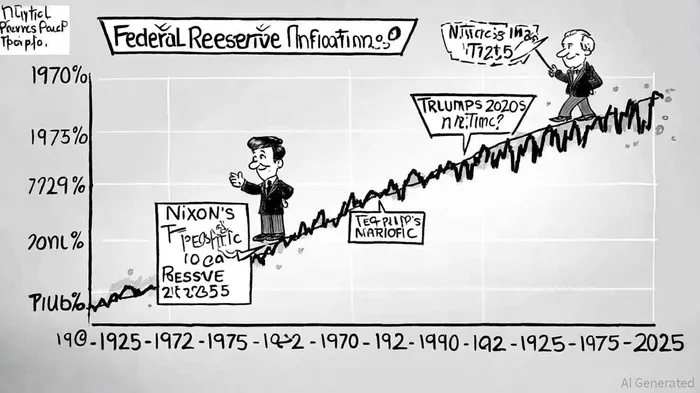
Political pressure on the Fed is not a new phenomenon. President Richard Nixon's 1972 campaign for re-election saw direct appeals to then-Fed Chair Arthur Burns to ease monetary policy, leading to expansionary measures that fueled a decade of stagflation. Research by Thomas Drechsel (2023) estimates that Nixon-era political pressure alone could have raised the U.S. price level by 5% over four years, with inflation expectations persistently elevated[1]. This period underscores how political interference can decouple monetary policy from its inflation-control mandate, creating a feedback loop of rising prices and eroded public trust.
The consequences for investor behavior were profound. As inflation expectations solidified, investors shifted toward inflation-protected assets, such as Treasury Inflation-Protected Securities (TIPS) and commodities, while long-term fixed-income instruments lost appeal[2]. The 1970s also saw a rise in risk-averse strategies, with portfolios increasingly prioritizing short-term liquidity over growth-oriented equities. This shift, documented in the Livingston Survey, highlights how political-driven inflation uncertainty can reshape asset allocation norms[3].
Modern Challenges: Trump's 2020s Rhetoric and Market Volatility
The erosion of Fed independence has resurfaced in recent years, particularly under President Donald Trump's public demands for rate cuts. According to a 2025 Washington Post analysis, Trump's frequent criticisms of the Fed—such as his 2024 tweet accusing the central bank of “wrecking the economy”—created a climate of uncertainty, with investors questioning the Fed's ability to remain apolitical[4]. This dynamic mirrors Nixon's playbook but occurs in an era of heightened media scrutiny and real-time market reactions.
Empirical studies confirm the link between political pressure and investor sentiment. A 2024 paper in Promarket found that political pressure akin to Nixon's could raise the U.S. price level by over 8% if sustained[5]. Such scenarios trigger immediate market responses: equity indices often exhibit heightened volatility, while bond yields fluctuate as inflation expectations shift. For example, during Trump's 2024 campaign, the 10-year Treasury yield spiked by 0.5% following a Fed meeting, reflecting investor skepticism about the central bank's independence[6].
Asset Allocation in the Shadow of Political Uncertainty
Investors are increasingly factoring political risk into their strategies. A 2023 Harvard Law and Brookings Institution survey revealed that 90% of institutional investors perceive rising political risks in the U.S., with 60% adjusting their engagements with portfolio companies to address governance and lobbying concerns[7]. This trend is evident in sectoral shifts: real estate and consumer discretionary stocks, sensitive to interest rates, have underperformed in high-uncertainty environments, while financials with robust net interest margins have gained traction[8].
However, the relationship between political risk and asset allocation is nuanced. Vanguard's 2024 analysis argues that while political cycles may generate short-term volatility, long-term returns remain tied to diversified, strategic allocations[9]. For instance, during the 2020–2024 period, investors who maintained exposure to equities despite political turbulence outperformed those who shifted to cash or defensive assets[10]. This suggests that while political interference creates noise, it does not necessarily dictate long-term outcomes.
The Path Forward: Preserving Fed Independence for Market Stability
The Fed's credibility hinges on its perceived independence. As the 2025 policy debates intensify, policymakers must resist external pressures to prioritize short-term political gains over long-term stability. For investors, the lesson is clear: diversification and a focus on fundamentals remain critical in an era of heightened uncertainty.
Yet, the risks of politicization are real. A 2025 Federal Reserve Board report warns that rising economic uncertainty—whether from policy shifts, geopolitical events, or domestic political strife—can delay investment, tighten credit, and prolong downturns[11]. In this context, maintaining the Fed's autonomy is not just an institutional safeguard but a market imperative.







Comentarios
Aún no hay comentarios