
Federal Reserve Independence and the Looming Shadow of Political Interference
The Federal Reserve's independence has long been a cornerstone of U.S. monetary policy stability, enabling it to prioritize long-term economic health over short-term political gains. However, recent trends and historical precedents reveal a troubling pattern: political interference in central banking, even in democracies, can distort interest rate decisions, inflate inflation expectations, and erode investor confidence. For investors, understanding these risks is critical to navigating asset valuations in an era of heightened uncertainty.
The Historical Foundation of Fed Independence
The 1951 Treasury-Fed Accord marked a pivotal shift in U.S. monetary policy, formally separating the Federal Reserve's role in controlling interest rates from the Treasury's fiscal responsibilities. This agreement allowed the Fed to focus on price stability, a mandate that has historically insulated it from direct political pressure. Yet, as recent events demonstrate, the boundaries of this independence are increasingly under scrutiny.
Political Pressures and Monetary Policy Cycles
Political interference in central banking is not a new phenomenon, but its manifestations have evolved. From 2010 to 2025, empirical studies reveal a recurring pattern known as "political monetary cycles" (PMCs), where central banks expand monetary aggregates by an average of 1.45% in the lead-up to national elections. This trend is particularly pronounced in presidential systems, where re-election incentives can drive short-term stimulus at the expense of long-term stability.
The Trump administration's repeated criticisms of Federal Reserve Chair Jerome Powell and its push for rate cuts exemplify this dynamic. Research indicates that Trump's public pressure-often conveyed through social media-significantly influenced market expectations of future Fed policy, even when actual decisions remained unchanged. Such interference not only undermines the Fed's credibility but also creates volatility in inflation expectations, a critical determinant of asset valuations.
Global Parallels and the Erosion of Credibility
The U.S. is not alone in grappling with political pressures on central banks. In Turkey, the 2021 appointment of Şahap Kavcıoğlu as central bank governor raised concerns about the institution's autonomy. Similarly, Argentina and Hungary have seen political leaders manipulate monetary policy to prop up short-term economic indicators, often at the cost of hyperinflation. These cases underscore a global trend: when central banks lose independence, inflation volatility and economic instability follow.
Academic analyses confirm that political interference correlates with higher inflation and reduced market confidence. A 2024 NBER study found that intense political pressure on the Fed-similar to Richard Nixon's era-can lead to a 5% increase in the price level over four years and up to 8% after six months. Such outcomes are not merely theoretical; they directly impact bond yields, equity valuations, and risk premiums.
Asset Valuations in the Crosshairs
The bond market has been particularly sensitive to perceived Fed independence. Despite aggressive rate cuts in 2020–2025, 10-year Treasury yields remained stubbornly high, reflecting investor skepticism about the Fed's ability to control inflation amid political pressures. This divergence between short-term policy and long-term expectations highlights a growing disconnect: while the Fed may lower rates to stimulate growth, investors demand higher compensation for inflation risks, especially when central bank credibility is in question.
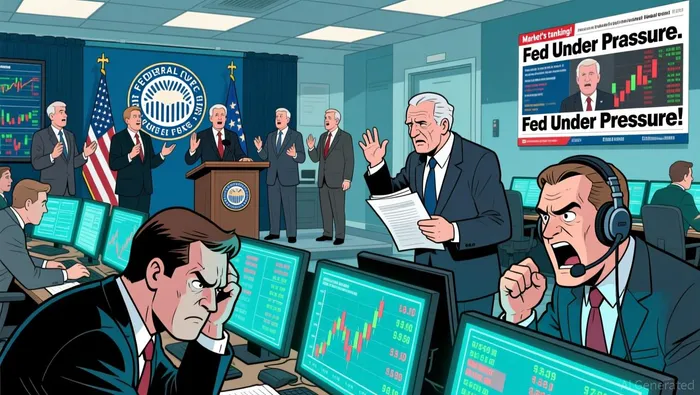 Equity markets, meanwhile, have shown a mixed response. Lower interest rates have historically buoyed stock valuations, particularly for long-duration assets like growth stocks. However, the specter of inflation and currency devaluation-exacerbated by politically driven monetary policies-has introduced uncertainty. Morgan Stanley advised investors to prioritize "quality large-cap stocks and real assets" while reducing exposure to small-cap and unprofitable tech companies. This strategy reflects a broader shift toward hedging against macroeconomic risks tied to Fed governance.
Strategic Recommendations for Investors
Given these risks, investors must adopt a nuanced approach to portfolio positioning:
1. Diversify Across Asset Classes: Allocate to inflation-protected securities (TIPS) and real assets (e.g., commodities, real estate) to hedge against inflationary shocks.
2. Prioritize Quality Equities: Favor companies with strong balance sheets and predictable cash flows, which are less vulnerable to interest rate volatility.
3. Monitor Policy Developments: Stay attuned to political appointments and regulatory changes that could signal shifts in Fed independence.
4. Leverage Derivatives: Use interest rate swaps and inflation swaps to mitigate exposure to unexpected policy changes.
Conclusion
The Federal Reserve's independence is not a given-it is a fragile institution that requires vigilance to preserve. Political interference, whether through direct pressure or indirect policy mandates, risks destabilizing monetary stability and distorting asset valuations. For investors, the lesson is clear: in an era of heightened uncertainty, adaptability and a focus on long-term resilience will be paramount.







Comentarios
Aún no hay comentarios